Manufacture
AnthonyTsai reports on Audemars Piguet's new Iberian headquarters in Madrid, located in an emblematic building designed by Antonio Palacios. This post highlights the brand's choice of a historically significant and architecturally rich location, reflecting a blend of luxury brand presence with cultural heritage.
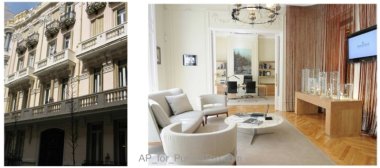
Audemars Piguet has recently transferred its Madrid headquarters to number 3 Marqués de Villamejor Street. This building, one of the most emblematic in the Spanish capital, is the work of architect Antonio Palacios Ramilo, who also designed the Palace of Communication in Plaza de Cibeles, now Madrid City Hall.
AUDEMARS PIGUET's new Iberian headquarters located in an emblematic
building in Madrid designed by Antonio Palacios: the 3 Marqués de
Villamejor.

This stately building was constructed in 1908 at the request of Tomás Rodríguez, a businessman from León, who created the dairy Mantequerías Rodríguez (his descendants still live in the area). Today, the building is a protected artistic and historic monument.
It is a fine reminder of the extensive use Antonio Palacios made of plants and ornamentation. The facade and the interiors are a combination of floral and geometric decors that evoke the influence of the Vienna Secession. A work of the known Spanish architect that most closely relates to modernism.
Palacios was very meticulous in his architectural style; he was very fond of details like door handles and aesthetics which still testify today to his genius. In this building, he paid such attention to finishes that even the pipes are decorated.
A small street in the Salamanca district, the Calle Marqués de Villamejor has three buildings designed by Antonio Palacios. One was in fact the residence of the philosopher Ortega y Gasset.
The renowned architect Tarruel, himself a neighbour of this building and in charge of renovating it in depth, explains: "This renovation required almost surgical interventions, with an accuracy worthy of a watchmaker." Words that seem almost prophetic when you realise that Audemars Piguet has decided to set up its Iberian headquarters on the first floor of this building.
The decoration of the new Audemars Piguet offices has been entrusted to the firm CGR Arquitectos, which has found a way to instil the brand's values into its own style. Oak woodwork, green plants and textiles that evoke the colours of Audemars Piguet's origins, the Vallée de Joux in Switzerland.
The new offices offer the opportunity to all friends of the brand to discover the newest collections in a private and friendly environment. Client after sale service also located in the same building.
Audemars Piguet
Audemars Piguet is the last fine watchmaking manufacturer still in the hands of its founding families (Audemars and Piguet). Since 1875, the company has written some of the finest chapters in the history of Haute Horlogerie, including a number of world firsts. In the Vallée de Joux, at the heart of the Swiss Jura, numerous masterpieces are created in limited series embodying a remarkable degree of horological perfection, including daring sporty models, classic and traditional timepieces, splendid ladies' jewellery-watches, as well as one-of-a-kind creations.
Antonio Palacios: the architect
Born in a village in Galicia in 1876, Antonio Palacios spent the vast majority of his life in Madrid, where he created some of his best known works. The architect nevertheless always retained a cultural and professional link with his native region.
Palacios designed his greatest buildings between 1910 and 1926.
He took his initial inspiration from the Vienna Secession before gradually moving towards regionalism. Throughout his career, his designs remained despite everything imprinted with his Spanish roots, characterised by the Plateresque and Manuelin styles. He was also strongly influenced by expressionism.
His work revolves around three periods marked by his own state of mind. The first, from 1900 to 1917, marked his close collaboration with his old friend Otamendui. From 1917 onwards, Palacios pursued a solitary career in architecture and town planning. His monumental tendencies increased during this period. Lastly, from 1936 until his death, he lived isolated and only designed extravagant visions. His work is highly thought of up to 1926, the year during which he designed the cultural centre Circulo de Bellas Artes de Madrid. This building was the peak of his career and his success gradually faded from thereon. Antonio Palacios seemed disappointed by the monumental movement and the design of public buildings. He died in 1945 in a small house he had designed himself in the Madrid district ofEl Plantío.
Three buildings in Madrid are the most representative of the style of Antonio Palacios - the Palace of Communication (now City Hall), the Jornaleros de Maudes Hospital (Ministry of Transport of the Autonomous Community of Madrid) and the Cariétides Building (headquarters of the Cervantes Institute).
The interior of the first metro stations in the Spanish capital is also another of his signature works. He designed the access routes and aesthetics of the first lines and the famous diamond-shaped logo.
Press Release
I would enjoy visiting one day.
This thread is active on the Audemars Piguet forum with 1 replies. Share your knowledge with fellow collectors.
Join the Discussion →