Although the majority of my watches have light dials, my chronos are all black. Much to my amazement, I eventually found 10 black-dialed chronographs in my watch cabinet! Why do I have so many that look so much alike? How do they differ? I pulled them all out and a few hours later ...
and their backsides.

I began to wonder WHAT? and WHY? and HOW? had these watches clicked? How had they convinced me to buy (and keep) 10 of them. I wondered if this was a reflection of my mental state? Did it indicate some fixation? Some theme?
Taking them all out of the cabinet for winding, setting and photos gave me a chance to examine each of them:
THE INDIVIDUALS
The
IWC GST Perpetual Calendar Moon which I've had almost 15 years

The
IWC GST Split-Second with complication developed by Richard Habring

The
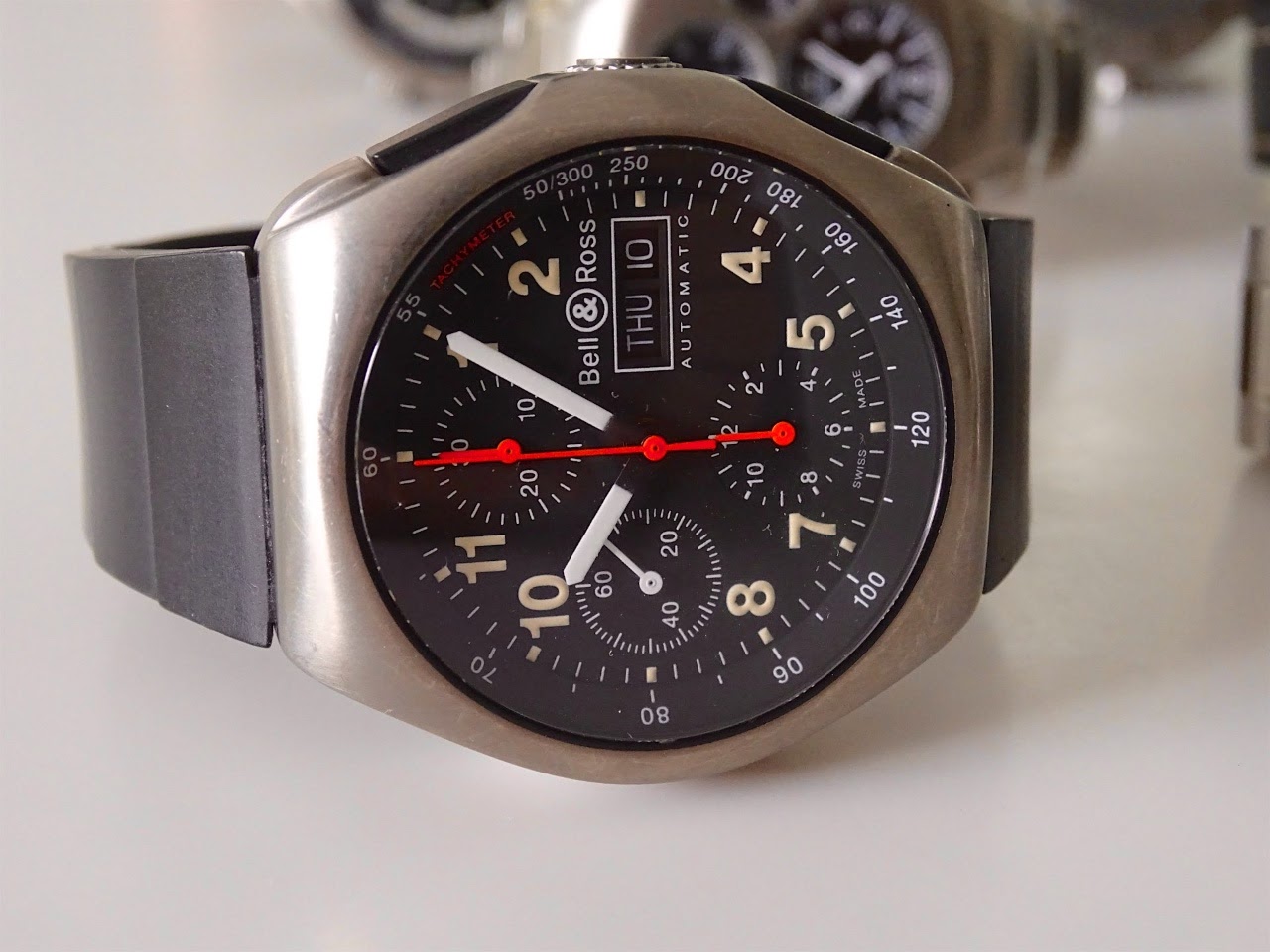
Bell & Ross (Sinn) Space 4 using ubiquitous 7750 in a clever flush case with recessed crown, and recessed pushers in black rubber to match the strap.
The
Seiko Sportura Kinetic Chronograph with its 5 small dials and individual crystals, has a quartz "brain" powered by an energy cell / self-generating rotor, and is topped by a mechanical chrono module.
Half are powered by the venerable 7750 movement, albeit many with modifications or modules. I see 70% are titanium, which is simply a reflection of my preference for function over beauty. That might also explain why these dials are all black, as watch designers seem to connect the darker tone of titanium with darker dials. Naturally, the hands are bright (white and/or yellow) to better contrast with the dials.
BACK OF EACH WATCH
Let's look at the back sides (I skipped the three with boring solid casebacks)
Bell & Ross leaves a brand on your wrist after a long wearing ...
I need to clean the Seiko Kinetic whose beautifully-decorated movement is not revealed in this photo.
Seiko Flight Master, showing off its column wheel at 12 o'clock in the photo.

Seiko Presage with Urushi dial looks conventional from the back
The Zenith proudly declares our site's motto on the rotor, and shows off its column wheel at 9.
The enigmatic MIH; whose chrono is still running

The Girard-Perregaux is a bit of a yawn from this angle, with a small window and large caseback rim.
Along with this complete variety of windows, movement displays, screw-down versus screw-in casebacks, we can see incredible diversity in the location, shape and style of the crowns and pushers:
CROWNS & PUSHERS
The GST Perpetual - it has a no-nonsense, screw-down crown and solid pushers

The Split takes the same approach using precisely the same crown and pushers, but also

includes a 3rd pusher at 10 o'clock for the split function control.

The Bell & Ross uses a unique and charming setup, with a baffling recessed crown, and pushers styled to match the case and special rubber strap.

Here's the crown in full-extended position, and unscrewed.

The Seiko Kinetic adopts an unusual approach to pusher placement, with start/stop on the right of the case, and reset at the left. The crown is where the normal chrono would place the reset button. It takes some concentration to operate this timer. At least the pushers are labeled on the case.

The Flight Master uses the conventional position for its round pushers, but adds "Daytona-like" screw locks on each pusher so a user can assure they cannot be disturbed accidentally.

The Presage has conventional pushers coming out of little shoulders on the case

The Zenith has what I'd call "tower" pushers where the top is larger than the shaft below.
(I can see that my watches need a good cleaning!) 
Alone in my collection of 10, the MIH makes do with just one solid IWC-like pusher for start/stop/reset. It's in the 2 o'clock position

The GP is the only watch which uses solid rounded rectangle pushers in the 2 and 4 positions, but makes up for that conventionality but adding ...

a second crown at 9 o'clock to control the World Timer inner rotating dial ring.

Gerald Genta's design failed here, as he specified a very small, recessed crown that is virtually unusable. Some variants have brass pushers and crowns, and later watches have much larger and taller steel crowns.
The pushers are conventional, but ribbed, as if he wanted us to turn them as well as push them. I presume that was for harmony with the shape of the crown.

BRACELETS, STRAPS & BUCKLES
Finally, to finish the analysis we can take a look at the strap/bracelet arrangements. As you can see in the photo above, the Genta uses an unconventional approach to connecting the strap to the case. That assures them that we have to go back to the factory for straps... assuming they are still in business.
IWC's GST series was justly renowned for comfort, strength and convenience in adjustment. Only a pair of toothpicks (or the provided brass tools) was required to adjust or dismantle the bracelet. The locking button never releases accidentally but is easy to operate when you want to take it off.

The Bell & Ross designer(s) did a great job on the factory-design rubber strap and double-butterfly deployant clasp. Too bad you have to cut the rubber to fit, but at least they provided two sets of holes to give a slight amount of adjustment when we grow older and fatter. I bought this strap after I got the watch on a bracelet. The price made me cry, and didn't include the very classy clasp which I located separately.

Here is the original titanium bracelet (ho-hum) for the Bell & Ross, and likewise the original, more stylish bracelet for the Flight Master. Neither have a very impressive clasp.

This is the generic, thick leather strap which I mounted on the Flight Master, as a stop-gap measure for one day. It's now been on there for 13 years!
The Sportura's titanium bracelet and latching buckle are well made and pretty well worn now, after 16-17 years of wearing. It rattles a bit, but it has never come open.