
New Release
SJX's 2009 analysis of Breguet's novelties, focusing on the Classique 5967 and 7337, provides a critical look at the brand's direction during a period of significant change. This article synthesizes community reactions to Breguet's evolving movement strategies, case sizing, and design aesthetics, offering a valuable historical perspective on the brand's trajectory.



This is part one of a series of posts looking at the 2009 Breguet novelties, beginning with the Classique 5967 and the Classique 7337.
Before that, several trends evidenced in Breguet collection of recent years have been affirmed by this year’s novelties.
One is the increasing use of Frederic Piguet movements in Breguet watches. Breguet was originally a sister company of Nouvelle Lemania back when it was owned by Investcorp and prior to that, Chaumet, and at that point in time nearly every Breguet was equipped with a Lemania calibre. Both companies were so closely intertwined it is a matter of debate whether the Lemania tourbillion calibre was originally Breguet or Lemania for example. Why Breguet is relying more on F. Piguet is a mystery to me, since it has a whole catalogue of Lemania calibres. While Piguet movements are extremely fine and often cleverly designed, some are fragile due to their slimness (like the cal. 71 used in the 7337 below).
Breguet watches are also getting larger (pardon the statement of the damned obvious). What I find odd is that the company is inconsistent in the quality of its enlarged designs. For example the 7337 below remains as elegant as it predecessor, but the 42 mm new minute repeater is ungainly.
Finally, and this is one that concerns me most, is the direction of Breguet. In my mind Breguet has an iron clad brand identity that is a great asset, one that gives it the best chance of catching up with Patek as the premier haute horlogerie house (apologies to the good folks at VC which is much further away in my opinion). But several of the new models, especially the god awful Marine alarm and the overly fashionable La Tradition in ruthenium finish, are potentially dilutive of the brand. Only time will tell.
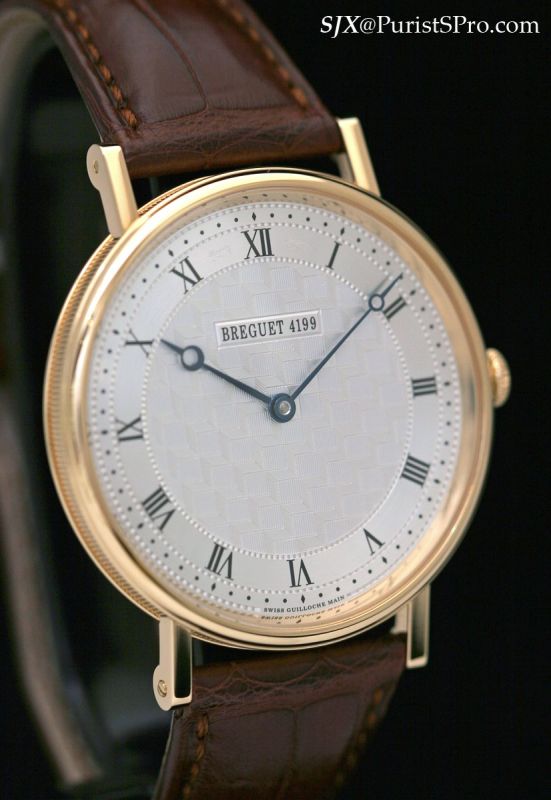
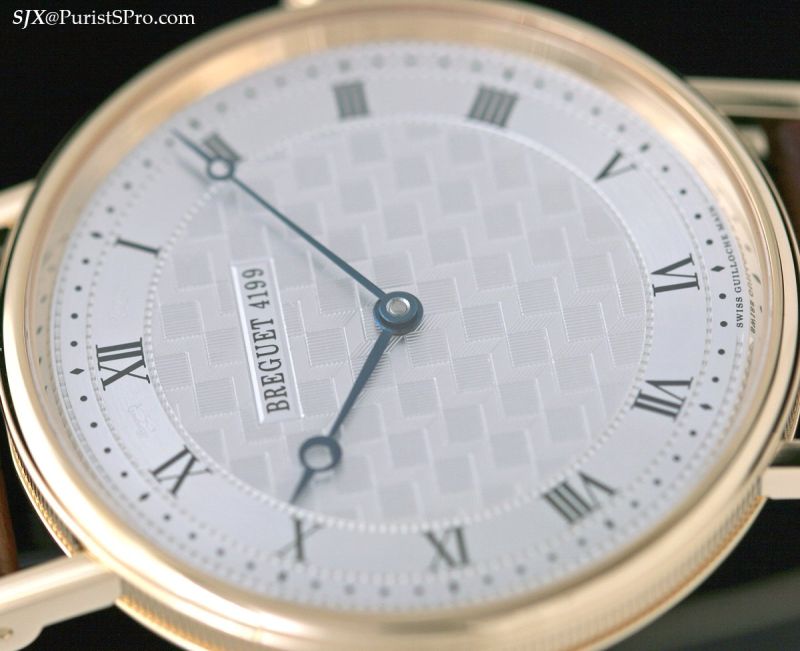
The Classique 5967 is a time-only, manual wind dress watch. It is thin and flat, 41mm wide and only several millimetres high, in the same genre as the FP Journe Chronometre Souverain and Vacheron Constantin Patrimony cal. 4400.


But unlike most of its competitors, the 5967 utilises a Piguet pocket watch calibre that was developed in the seventies. The movement’s origins are evident in the sweeping, classical styling of the movement bridges – no one designs movement like that today. Innovation is definitely not one of the movement’s qualities, but it possesses a great deal of charm.


What is particularly interesting is the guilloche dial in a geometric Art Deco style which Breguet terms “Art Deco Damier”. Strangely enough, the first thing that came to mind when I laid eyes on this watch was M. C. Escher.


Surprisingly the Art Deco guilloche goes well with the elaborate Baroque aesthetic of Breguet.


The Classique 7337 replaces the 3337 (below) which was itself inspired by an original A. L. Breguet pocket watch. This dial design is uniquely Breguet, off-centre hours and minutes with a moon phase at 12 flanked by day and date in windows.

Source: Antiquorum
The dial is wonderfully detailed, with four different guilloche patterns. On a side note, the engraving on the sub-seconds is extremely clean and it makes me wonder if it is hand-turned on a rose engine, as opposed to being stamped or embossed.


A subtle but welcome change is the 7337 is rid of the rather feminine cabochon on the crown used in the 3337.


At 39 mm wide the 7337 is much more contemporary in size than its predecessor that was only 35 mm wide, but not so large that is looks clumsy. Though the movement is evidently small when seen from the display back, the proportions of the dial are perfect.


The movement is inside the 7337 is a Frederic Piguet cal. 71, an expensive, ultra-slim automatic distinguished by its open barrel. This calibre is now exclusive to Breguet, though it was used by several brands including Blancpain, Daniel Roth and Dunhill in the past.


In the next post I will look at the Marine Royale, the unwanted love child of a JLC Extreme World Extreme Compressor Extreme Alarm and a Zenith Extreme Defy Extreme El Primero Extreme Starfish.


- SJX
This message has been edited by SJX on 2009-07-12 06:37:30 This message has been edited by SJX on 2009-07-12 06:38:02The Fiftysix reference 4400 from Horological Meandering is a notable entry in the brand's contemporary offerings, distinguished by its design which draws inspiration from mid-20th century aesthetics. This particular reference is characterized by its balanced proportions and a focus on everyday wearability, positioning it as an accessible yet refined option within the broader collection. It represents a modern interpretation of classic watchmaking principles, aiming to appeal to a wide range of enthusiasts.
This reference features a stainless steel case, housing a Swiss Quartz movement. The case diameter is 40mm, providing a versatile size suitable for various wrist sizes. The watch is fitted with a sapphire crystal, ensuring durability and scratch resistance. Its construction allows for a water resistance of 30 meters, making it suitable for daily wear and incidental exposure to water.
As a quartz-powered timepiece, the Fiftysix reference 4400 offers reliability and convenience, appealing to collectors who prioritize precision and ease of maintenance. It stands as a testament to Horological Meandering's commitment to offering diverse options, from mechanical to quartz, within its product lines. The polished stainless steel strap further enhances its classic appeal, making it a cohesive and understated piece.
... that leaves nothing obscure (except maybe the seconds subdial of 7337, ha,ha...) Congrats SJX Tassos
Breguet is doing so well with it's collection. GEO
...but I don't care for the reedy, thin lugs. The movement, like the guilloche, is similarly elegant. I love the sweeping bridges of the 5967. I find the design choices on both these watches, alternately ornate -- particularly the engine turning on the dials and the rotor on the Ref. 7337, yet sedate in a way too. The beautifully executed Geneva stripes, and small, thin movements scream "dress watch." Thanks for the writeup, SJX. Cheers, Daos
I really like the use of the Piguet in th 5967, much better to use a somewhat common mvmt that is the right size then a 30mm exclusive mvmt in a 41mm case. On the other hand the use of the Piguet 71 surprises me. Breguet has exclusive ownership of the Lemania 8800/8810 caliber, which is a much more "exclusive" caliber of about the same size. Though it's not a total surprise, Swatch made it known that the 71 was going to be exclusive to Breguet several years back... One thing that surprised me ab
Thanks for pointing it out though. - SJX
which included these 3 pieces as well as the double tourbillon, Heritage tourbillon, the new Traditions and repeater. I must say, save the Traditions, it seems that Breguet is moving towards the "big watch" fad/trend as well which unfortunately, does not bode well for me. I was very much looking forward to the Heritage Tourbillon but found it less appealing in the metal than on the net. Just me though. Reminded me of the roman numeral UN Michaelangelo Grande. The guilloche was very nice but some
This thread is active on the Breguet forum with 15 replies. Share your knowledge with fellow collectors.
Join the Discussion →


