
Complications
MTF introduces Chopard's L.U.C XP Urushi "Year of the Monkey" dial for 2016, a stunning example of traditional Japanese lacquer art. This post delves into the intricate maki-e technique by Yamada Heiando studio, offering a glimpse into the meticulous craftsmanship behind these limited-edition timepieces. Readers gain insight into the cultural symbolism and artistic process that define this unique Chopard series.


This is a summary of the history and refinement process of Japanese lacquer (urushi) as well as the dial painting (maki-e) technique by Yamada Heiando studio for CHOPARD L.U.C XP Urushi watches . There are preview photos of a new L.U.C XP Urushi dial from Chopard depicting the Year of the Monkey for 2016. Chopard is dedicating a new exclusive series of its L.U.C XP to the Eastern zodiac. The Lunar New Tear beginning on February 8th 2016 is ascribed to the monkey and provides the theme for an exceptional Urushi lacquered dial. Hand-crafted in Japan in small series by a master lacquer artist, it depicts a popular scene believed to bring good luck and drawn from Chinese iconography: a monkey gathering peaches.

The monkey of the Eastern zodiac calendar conveys positive symbolism. People born in the Year of the Monkey are considered smart, curious and drawn to knowledge. They are cultivated, inventive as well as creative. It is an ‘earth’ sign associated with good sense. Stubborn yet charming, the monkey loves to perform for an audience and is endowed with great self-esteem. The monkey gathering eight peaches is a traditional Chinese theme that symbolises longevity and good fortune, since the peach stands for good health and eight is a lucky number.
In this interpretation, Chopard portrays a red-coated monkey perched on a branch laden with fruit. It is gathering peaches beneath a golden sky ablaze with the last rays of the sun. Behind it, golden valleys compose a warm scene in soft tones that make a perfect match with the rose gold of the case.

The Heian period (平安時代 Heian jidai) is the last segment of classical Japanese history. (794 to 1185 A.D.) The period is named after the capital city of Heian-kyō (Kyoto) and is considered the golden period when Taoism, Buddhism and other Chinese influences were at their height. The Heian period is also considered the peak of the Japanese imperial court and noted for its art, poetry and literature. Heian (平安) means "peace" in Japanese.

Glossary
Urushi: Lacquer from the sap of the lacquer tree.
Maki-e: "Sprinkled picture" artwork of painted lacquer, sprinkled with other substances like gold or silver or charcoal ash powder.
The History of Urushi
Urushi is the sap of the urushi or lacquer tree that is native to Japan, China, and Korea. Some forms of lacquer sap also originate from Burma and Thailand. Lacquer sap contains a resin that polymerises and becomes a very hard, durable, plastic-like substance when it is exposed to moisture and air.
As Japanese civilization developed, lacquerware techniques incorporated increasingly refined styles. The Nara period (710 - 794 AD) saw the onset of maki-e decoration technique in which gold "dust" is sprinkled on the lacquer surface. Maki-e means "sprinkled picture".
Making Coloured Lacquer
The sap that is tapped from cutting a lacquer tree is the source of lacquer. Lacquer turns to brownish-red after refining. Then, minerals are added to give vermillion or black colour to the lacquer. After refining, an additional process is needed to add colours to the lacquer. Traditionally, Japanese lacquerware is vermillion or black in lustre. Black substances are added to create black lacquer. For example, burnt pine wood produces black soot. Today, fine iron powder is added to create black lacquer. Similarly, vermillion dye (mercury sulphate or iron oxide) is added to produce vermillion lacquer.
Lacquerware in traditional crafts is mainly black lacquer and vermillion lacquer. However, there are other colours available including yellow, indigo, green, for a total of seven colours. These colours are created by adding pigment to the lacquer. This addition of colour needs to be done when you actually apply the lacquer.
Technique of Maki-e
Maki-e technique is what it literally means, which is, sprinkling gold and silver powders to make pictures.
A pre-drawn pattern must be transferred to the dial base. The transfer is accomplished by reversing the paper and sketching the main lines with lacquer. This is then transferred to the dial by gentle, even pressure on the surface of the paper.

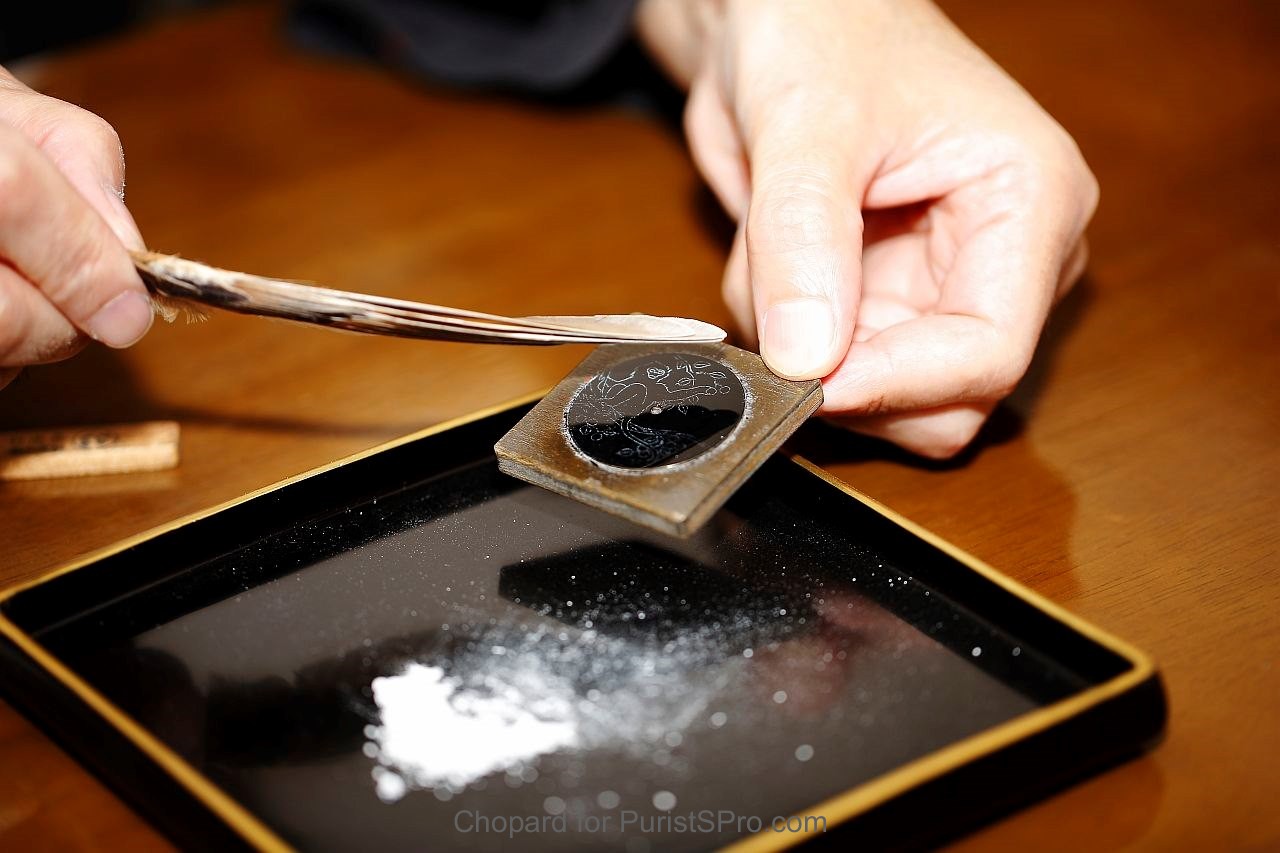

The dial is painted with lacquer. The objective is to cover the base with lacquer or drying the metallic powders on lacquered base. Because of the good adhesiveness of lacquer, powders will stick to lacquer and grow hard. Metallic powders used include gold and silver, but also doré bullion (unrefined silver), tin, and brass. Another layer of lacquer makes it stable. After that, polishing and burnishing is done repeatedly. The lacquers on the top and bottom layers fasten powders like a sandwich; the process is called “powder hardening”.
Taka maki-e: Raised lacquer work with patterns built up with mixture of metal powder, lacquer, charcoal, clay dust etc., to make it more three-dimensional. The lacquer that covers the raised shapes is applied onto the motif to produce a relief effect. For the highest relief, four, five, or even more layers could be applied. The final layers of these areas could be made from “bengara” (iron oxide powder), or other pigments mixed with lacquer. Subtle tricks of perspective were created by varying the thickness of certain areas of the design.


Implements to apply gold and silver powders by sprinkling, blowing and brushing.

Using cat- and rat-hair brushes, any area down to a hair-thin line could be painted. Sometimes pigmented lacquer was applied in areas as contrast or highlight to the overall design. This pains-taking and repetitive procedure of application, curing, and polishing extended over weeks or even months.


After each layer, the dial is dried and polished by hand before more painting. The best brushes are made of the finest hairs at the tip of a rat's tail. Cat hairs are also used.


Case:
• In 18-carat rose gold
• Total diameter 39.50 mm
• Thickness 6.80 mm
• Water resistance 30 metres
• 18-carat rose gold crown with L.U.C logo 4.00 mm
• Glareproofed sapphire crystal
• Transparent case-back

Movement:
• Mechanical self-winding L.U.C 96.17-L
• Total diameter 27.40 mm
• Thickness 3.30 mm
• Number of jewels 29
• Frequency 28,800 vph (4 Hz)
• Power reserve 65 hours
• Two barrels, Twin® technology
• Bridges adorned with Côtes de Genève
Dial and hands:
• Dial crafted using the Urushi technique with monkey motif
• Gilded Dauphine-type hours and minutes hands
Functions and displays:
• Central display of the hours and minutes
Strap and buckle:
• Hand-sewn alligator leather strap with Alsavel lining
• 18ct rose gold pin buckle
The L.U.C XP Urushi “Year of the Monkey” comes in a special presentation box also decorated using Urushi techniques. Black on the outside and gold Maki-e inside, it is shaped like an octagon, an oriental symbol of gaiety.
Ref. 161902-5061 – in 18-carat rose gold with special “Year of the Monkey” dial
Casing up the new Chopard L.U.C XP Urushi watches


Dr M. Teillol-Foo; 2015.
I know the header is not how this watch was conceived but this is what I see in it. It is as lovely as intricate with loads of atmosphere, a "primal atmosphere" with the dark background of it. Best interpretation of the topic so far. Best Moritz
The Snake, Horse and Goat previously just depicted the animals but without a back story. Monkey is "doing" something and interacting with his/her background. Regards, MTF
This thread is active on the Chopard forum with 2 replies. Share your knowledge with fellow collectors.
Join the Discussion →


