Inside Manufacture DeWitt: Creativity and Craft
Manufacture

Inside Manufacture DeWitt: Creativity and Craft

By Ornatus-Mundi · May 24, 2011 · 24 replies
Ornatus-Mundi
WPS member · Horological Meandering forum
24 replies15946 views0 photos
f 𝕏 in 💬 🔗

Ornatus-Mundi (Magnus) offers an immersive journey into the Manufacture DeWitt, a lesser-known independent watchmaker in Geneva. His detailed report, rich with personal observations and photographs, explores the company's unique approach to innovation, design, and in-house production. This article provides a rare glimpse into the creative process and artisanal craftsmanship that define DeWitt's distinctive timepieces.
Dear All:

Switzerland is quite a fascinating biotope for all different ‘species’ of watch producers. The range covers small one-man operations to multinational companies, and the output comprises of pick-up-on-the-fly Swatches to bespoke unique pieces that change hands only against a sum equal to the annual turnover of a SME.

Sandwiched in between are small manufacturers. Again, this group is quite diverse in terms of portfolio, and offers everything from conventional to extravagant watches. What make this fragment of the trade so fascinating are two aspects: (i) they are often still owned by the founders or the founders’ families; and (ii) they are the motors of innovation. The important consequence of this is that the timepieces reflect the mindsets of their creators in a most uncompromised fashion, both because the owners are only responsible for themselves (in contrast to managers and executives that are judged by economic performance), and also because the companies actually have the capacities to transform those ideas into marvellous products.

One of those lesser-known watch companies, the Manufacture DeWitt in Genève’s Meyrin suburb. DeWitt is a company founded by Mr Jérôme de Witt. Mr de Witt is the great-grandson of King Leopold II of Belgium and a direct, fifth-generation descendant of the Emperor Napoleon's brother, King Jérôme of Westphalia, a distinguished watch connoisseur.


Jérôme de Witt

The brand's first model, the Pressy Grande Complication, was launched in 2003. The collection then was named Iena:


The impressive beginnings of 2003: DeWitt Pressy Grande Complication

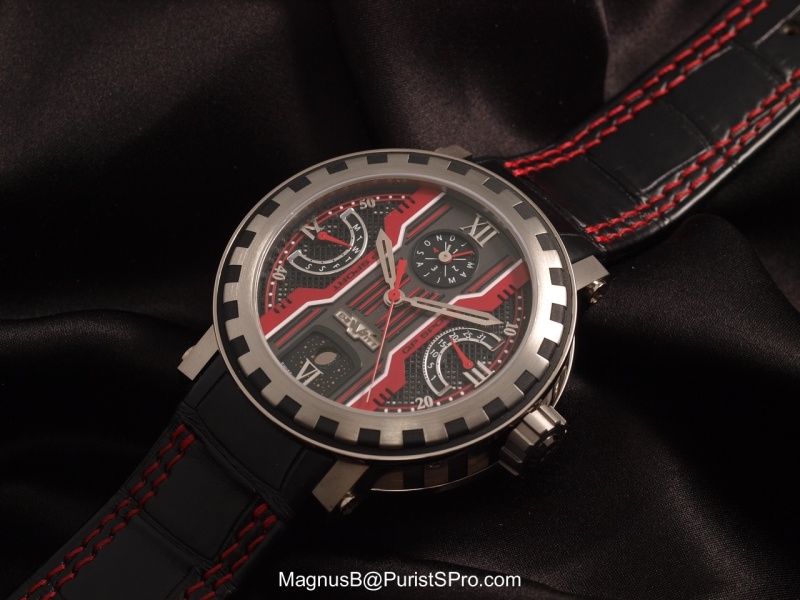
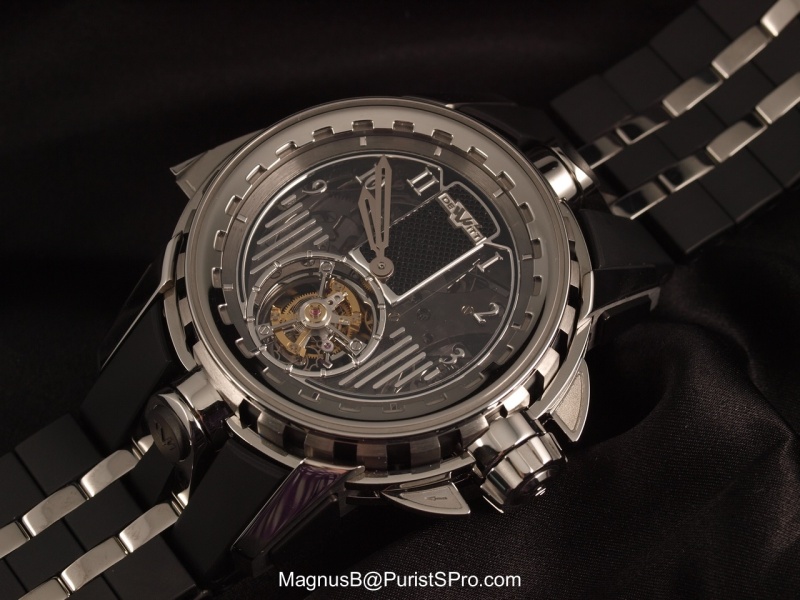
As of 2005, DeWitt watches share a remarkably consistent aesthetic identity thanks to the theme of imperial columns framing the case.


DeWitt Twenty-8-Eight Automatic


DeWitt Academia Seconde Retrograde Serenity


DeWitt Academia Perpetuel Sport


  DeWitt Academia Quantieme Perpetuel Nebula


DeWitt Twenty-8-Eight Tourbillon


DeWitt Academia Force Constant À Chaine


DeWitt Concept Watch N°1 WX-1


DeWitt Concept Watch N°2 Repetition Minutes Tourbillon GMT Antipode


DeWitt Golden Afternoon

The idea is derived from co-axial male/female gears. Mr de Witt has a reputation as a dedicated collector and restorer of thoroughbred vintage cars. With differential mechanisms there are concentric gears that consist of an outer female and an inner male part. The decisive benefit is that can the two parts can move relative to each other along their axis. DeWitt transformed this idea into watch cases. The design of the crowns is inspired by jet engine nozzles.


The name of the manufacture first gained recognition when a few truly outstanding and original creations were presented, such as the Academia Tourbillon Constant Force, the Tourbillon Differentiel or the ASW Regulator. On the technological side, DeWitt considers tradition as the essential foundation upon which creativity can prosper, not as a limiting boundary.

The first ateliers of DeWitt initially were located directly in Mr de Witt’s private house in Vandoeuvres, but then the company expanded so that a dedicated home was needed. Interimistically, in 2006, the company moved to a larger workshop in Vernier/Geneva (1.500 sqm) before buying, in 2007, the current building in Meyrin/Geneva, which is spacious enough to accommodate further expansion (5.000 sqm).

Currently, roughly 70 employees work with the manufacture, of which 2/3 are watchmakers and associated trades. The management of the company is shared between the founder himself (as owner and founder of the company, Mr de Witt is the President of the board of directors. He is active on the creative side and act as the main brand ambassador) and Ms Nathalie Veysset as CEO. All operations are in the hands of Ms Veysset. DeWitt basically is a family business.


I'll cover more on DeWitt's philosophy in the context of two interviews with Mr de Witt and Ms Veysset, which I'll post some time later!

As I mentioned above, the (intermediate) companies actually have the capacities to transform those ideas into marvellous products. Exactly, and DeWitt is a prime example of a clever approach chosen to achieve this.

The key fact is that the management had a keen eye on the growth potential of the company from the onset, and chose the middle ground between an enterprise that assembles outsourced parts and a fully-fledged 100% in-house manufacture. The ingenious aspect lies in the wise allocation of resources to ensure that creativity rules and is not hindered because financial means are locked in capital expenditures for production machinery.

Instead, DeWitt has the full equipment necessary to create and prototype mechanisms. The actual production of parts is subcontracted to specialists, who supply the kits. Finish and assembly again take place in house. In the long run, of course, full independence is planned. Furthermore, this is consistent with the inherited structure of the Swiss watch industry, which historically always relied on sourcing out of various tasks to the best suppliers. Vertical integration is a modern concept to a large extend encouraged by marketing decisions.

But this is not all! DeWitt also is in a unique position to create the dials themselves. From the personal collection of Mr de Witt, the company as access to historical 18th and 19th century rose engines to practice the art of guilloché engraving.

I hope these introductory words suffice to water your mouths. If so, please follow me on my tour through the DeWitt manufacture.

In separate, easily digestable follow-up post to this, I will present to you
  1. Manufacture DeWitt
  2. Construction and ‘Méchanique’ (=prototyping)
  3. Dial making
  4. Finishing and assemblage
  5. Training and assessment of aspiring watchmakers ;-)

Cheers,
Magnus

This message has been edited by Magnus Bosse on 2011-05-26 09:07:28 This message has been edited by ED209 on 2011-06-01 11:30:57

Key Points from the Discussion

Advertisement
The Discussion
OR
Ornatus-Mundi
May 24, 2011

Fast forward to late April: The invitation to visit DeWitt came unexpectedly and on very short notice, so I had no time to build up an expectation, and I could travel free from any preconceived opinion. And that was quite thrilling for me! In my view, factory visits are somehow like the first rendez-vous with an irresistible woman. You are nervous, you are anxious: how will she approach you? Is she as adorable as you imagined? Everything is possible, pleasant surprise, indifference or downright

OR
Ornatus-Mundi
May 24, 2011

The open and light atmosphere continues with the ateliers and workshops. DeWitt is fully equipped to develop, prototype and industrialise any mechanism possible. Ideas (mostly from Mr de Witt) are entrusted to teams of engineers and watchmakers, who have state of the art CAD design technologies at their disposal. [images DW engineer team] Once the construction is finalised, the crew of the ‘Méchanique’ department takes charge. This team is one of the core assets of the manufactu

OR
Ornatus-Mundi
May 24, 2011

Note: This part of the article is just a short introduction to the art of dial making practiced at DeWitt. I promise to post an in-depth article on this fascinating craftsmanship some time later! We watch connoisseurs tend to reduce watchmaking to movement manufacturing, finishing and assembling. What we forget is that it is most often the outer appearance of a watch that catches our fancy. It is not without reasons that a dial is also referred to as a watch’s ‘face’. Yet, we t

OR
Ornatus-Mundi
May 24, 2011

1.) Finnisage Regardless of whether parts are produced within the premises of a company or sourced outside, it is the finishing where enthusiasts put particular emphasis on. Finishing provides not only an aesthetic pleasure; it is essentially ‘unnecessary’ (in a technical sense) and thus an attribute of luxury and refinement. Good finishing is hand applied, and with increasing complexities of mechanisms and shapes it adds significant to the price point of a watch. Seasoned collectors

OR
Ornatus-Mundi
May 24, 2011

As you surely know, trained watchmakers are a rare commodity these days. Thus, watch manufacturers use different and sometimes quite innovative way to address the shortage and hunt for talents. Some establish their own watch schools; others attract promising candidates from their competitors. DeWitt indeed developed a very unique way… So, at the end of my visit, ready to leave for the airport I was summoned to a remote room where an assessment was prepared: The task was to assemble the movement

JF
jfsuperior
May 26, 2011

Magnus, Your photo report is both mouth watering and an eye popper. Kudos to the company and thanks to you for bringing your extensive report to this forum for all to share. The report is informative and educational. As a watchmaker I can attest that no amount of words alone can illustrate the scope of technical work required to manufacture high quality movements and timepieces. With so many photos you did a fantastic job in covering all aspects of what goes on in the construction of these luxur

Advertisement

Continue the conversation

This thread is active on the Horological Meandering forum with 24 replies. Share your knowledge with fellow collectors.

Join the Discussion →