Review
AndrewD's comprehensive review of the Girard-Perregaux 1966 Chronograph (Ref. 49539-52-151-BK6A) offers a detailed look at a dress chronograph that balances classic aesthetics with modern wearability. His long-term impressions, captured through excellent photography, provide valuable insights into how this timepiece performs in daily use. This article explores the nuances of its design, comfort, and movement, making it relevant for collectors considering a sophisticated chronograph.


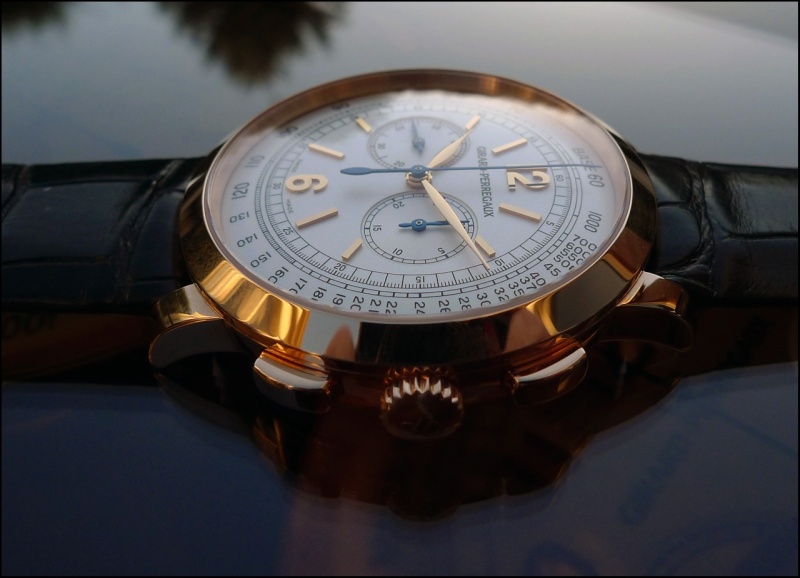
I have been wearing the Girard-Perregaux 1966 Chronograph (Ref. 49539-52-151-BK6A) continuously over the last 4 weeks. This is the pink (rose) gold version of the watch and it also comes in white gold with a silver dial or blue dial (the anniversary watch, although not a limited edition). I was given the option of trying several different watches, but the 1966 Chronograph was the one I jumped at, and I hope you can see why.


As I said in my 'initial impressions' [click here] the wrist photos really tell the story. The 1966 Chrono is a delight to wear. The 40 x 10.7mm case, with short its curved lugs, sits comfortably on my 17.5cm wrist.

The watch is presented on an elegantly thin black crocodile strap that has curved ends to frame the watch. The lugs are 20mm apart and the strap tapers down to a classic 16mm pin buckle.

There is no stitching on the strap and the sides are painted black. The 'standard' straps delivered with the watch are 111mm and 74mm long, which I would describe as 'medium' in length.


The polished case itself is in three parts with a sloping bezel. The chronograph pushers are rectangular and rounded on the ends and they are very comfortable to actuate. The crown is signed "GP" and the alignment of the pushers and crown is almost perfect; you wouldn't know this was a modular chronograph by looking at this aspect of the watch.


The front antireflective sapphire is gently convex and there is an exhibition pressed display back. While we’re talking about the case, the rear of the four lugs are stamped with various hallmarks including 750 (for 18k gold) and the St. Bernard dogshead for the Swiss assay office. The 18K gold buckle is also hallmarked.


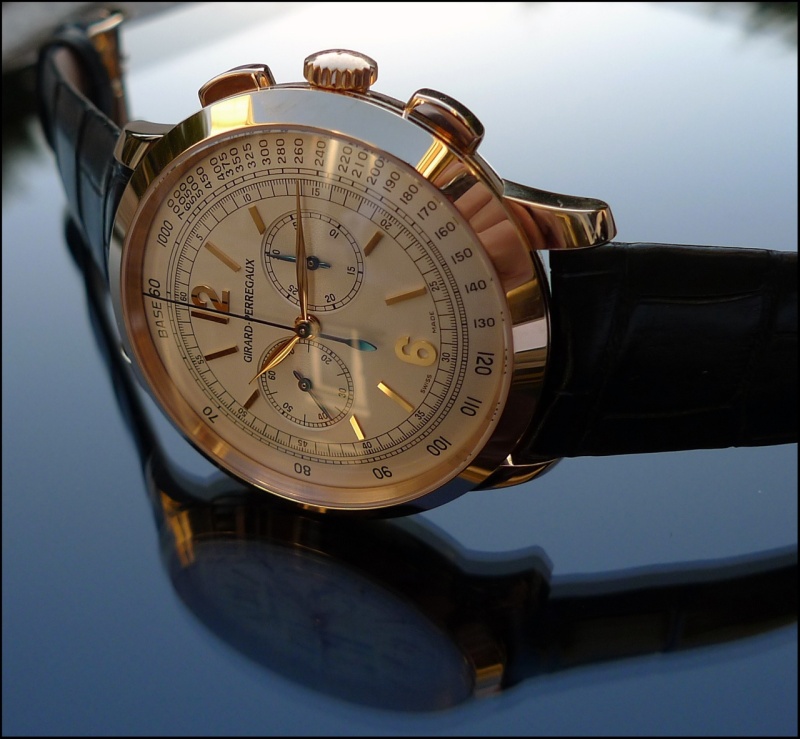
Adding to the elegant case is a beautiful dial and here is where the magic really is. The dial itself is a uniform satin/crème/off white/pale eggshell colour - do you get the idea?! It is the perfect canvas for the polished RG applied Arabic numerals (at 12 and 6), the hour markers and the RG leaf-shaped hour and minute hands. The dial is also slightly curved.


The bicompax design features a small continuous sub-seconds dial at 9 o'clock and a discrete chronograph minute totaliser at 3 o'clock. What really lights up the dial is the slender central heat-blued polished steel chronograph seconds and the hands of the subdials. All the hands are of the correct length and taper to points at their appropriate scales. Under a 10x loupe the printing is crisp and dark black; nice work from the dial makers befitting a watch of this standard.


When I first saw pictures of the 1966 Chronograph I thought that the prominent tachometer scale unbalanced the dial. However after wearing the watch for a while I now like this design element. Its rather like the date at 4:30 on the 1999 Chronograph, some find it distracting and others feel it adds some interest and 'tension' to the dial. I feel the same about the tachymeter scale which acts somewhat like a frame for the watch. The minutes and seconds scale are also presented in a 'railway-style' design and emphasise this 'frame'.

So what beats inside? The Cal. GP030C0 has 304 parts and is based on the automatic base GP3300 calibre with a column wheel chronograph module (see the press photo). This beats at 28,800vph (4Hz), has 38 jewels and a power reserve of at least 36 hours. The calibre is 10.5 Ligne in diameter (and 6.28mm thick) which is why the subdials are centered near the middle of the watch. Through the rear sapphire can be seen the 18k gold rotor and the prosaically finished plates with Geneva stripes.


Functionally the pushers are easy to use and notchy in feel.
Girard-Perregaux has a long history of bicompax chronographs extending back to the 1940's which feature similar dial designs with peripheral seconds and tachometer scales.

I said this in my review of the more sporty (Ref. 4946) 1999 Chronograph [click here], but the pleasure from GP watches is in the wearing; they really excel on the wrist. Any compromises and quibbles are quickly forgotten when the watch is strapped on and you are gazing at its beauty. Nicely done and a wonderful member of the classic, elegant 1966 family.


Having worn both the 1966 and 1999 Chronographs virtually side-by-side there are several advantages to the dial layout of the 1966 Chrono. 'Centering' the subdials and having a wider tachometer and seconds scale makes it easier to read off the elapsed time. The 40mm diameter compared with 38mm also makes reading the chronograph functions easier. Disconcertingly, when I changed between the 1966 and 1999 Chrono’s it took me a moment to readjust to the positions of the subdials, but design wise I do not have a preference and you quickly get comfortable with either.


How useful a 30 minute bi-compax chronograph will be compared with 12 hour tri-compax will depend on application. There were occasions when I had to consciously think how many times the 30 minute counter had gone around (2 hour parking space for example). So your usage will dictate the design that is most appropriate for you.
I was a little sad to return the watch to GP as it is a really lovely piece that any owner should be proud of. A suitable companion to the automatic chronograph would be a manual wind integrated chronograph and I hope we also see that option from Girard-Perregaux in the future.

My thanks to GP and AVSTEV, the Australian GP Agent, for allowing me to road test the 1966 Chronograph. The watch arrived 'factory sealed' in plastic and I felt a little nervous wielding the scissors and strapping on a brand new watch. But I did it for all of you.


The Girard-Perregaux reference 4946 is a notable example from the brand's production during the 1960s, representing a period of design evolution for the manufacturer. This reference is characterized by its understated aesthetic, reflecting the prevailing design sensibilities of the era for dress watches. It offers a clear indication of Girard-Perregaux's approach to automatic timekeeping in a more compact form factor, distinguishing it from larger or more complicated offerings of the time.
The watch features a stainless steel case measuring 34mm in diameter, a size typical for men's watches of its decade. It is fitted with an acrylic crystal, common for watches of this period, providing durability and ease of maintenance. The timepiece is powered by the automatic GP Caliber 39, which provides a power reserve of approximately 40 hours. The dial is presented in a silver finish, complemented by a fixed bezel and a leather strap.
This reference appeals to collectors interested in vintage Girard-Perregaux pieces that embody the brand's mid-century design language and mechanical craftsmanship. Its straightforward date complication and classic proportions make it a versatile piece for those seeking a historically accurate representation of the brand's output. The 4946 offers a glimpse into the foundational elements that would influence later Girard-Perregaux designs.
Unfortunately this is the only view you will get of the column wheel chronograph module; a company press release. This business end of the watch is rather pretty, but it is hidden under the dial. The sacrifice is that you get convenient automatic winding, but a manual wind version of this watch would be a beauty.
And a few more watch photos because I know you love it. :-)
Your photos are superb. I really love the look of this watch, the dial is succulent. Pity about the mouvement though, not that it is bad, oh heaven no, just that it is too small and the subdials are.."perhaps" a little too close to the centre just a wee bit "perhaps". The fact that it is a modular chronograph mouvement doesn't disturb me a bit however because as you say and your pictures show, the alignment is quite perfect. Perhaps, it would have been better not to install a see throu sapphire
The advantage of the rose gold is that its got the blued hands which are KILLER! The automatic movement in this watch is pretty and very elegant. GP autos have rotors that move very smoothly and efficiently. Automatic watches have a convenience factor that is nice, but a manual movement in this watch would be very welcome. Cheers, Daos
...but thank you very much to do it in such a nice way. I am seriously reconsidering some plans already made, thanks to your report. The wristshots are great and 1966 is simply a beauty. I agree with the other comments, that a manual wind would be the ultimate pleasure and appeal to the watch enthusiasts, but the current offer with the automatic movement is tempting as well. thanks again for giving us such a hard time! Best, Stefan
... is perfect for those looking for an elegant ,sophisticated dress watch with some useful complications. Well, perhaps not the EOT, but it's still cool! To be honest, after I went over the movement with a 10x loupe to satisfy myself about the level of finish and took a few photos for the review, I didn't really go back to the movement. It could well have had a solid case back. The automatic chronograph did what it should - wound efficiently, kept consistently good time and the chronograph func
This thread is active on the Girard Perregaux forum with 25 replies. Share your knowledge with fellow collectors.
Join the Discussion →