Vintage
Blomman Mr Blue's post meticulously clarifies the often-misunderstood history of Girard-Perregaux's 1968 Olimpico Chronographs, specifically focusing on the reference 8862 B. This article is a vital resource for collectors, as it corrects common misconceptions about production years and reference numbers, drawing on confirmed information from the manufacture. It underscores the importance of diligent research in vintage watch collecting, making complex historical details accessible.


Friends,
Back in 2014 I posted the Part #1 and #2 of the 1968 Olimpico Chronographs as a part of my Girard-Perregaux Summer Edition…
Now the time has come for me to put the third part of the 1968 Olimpico Chronographs online!
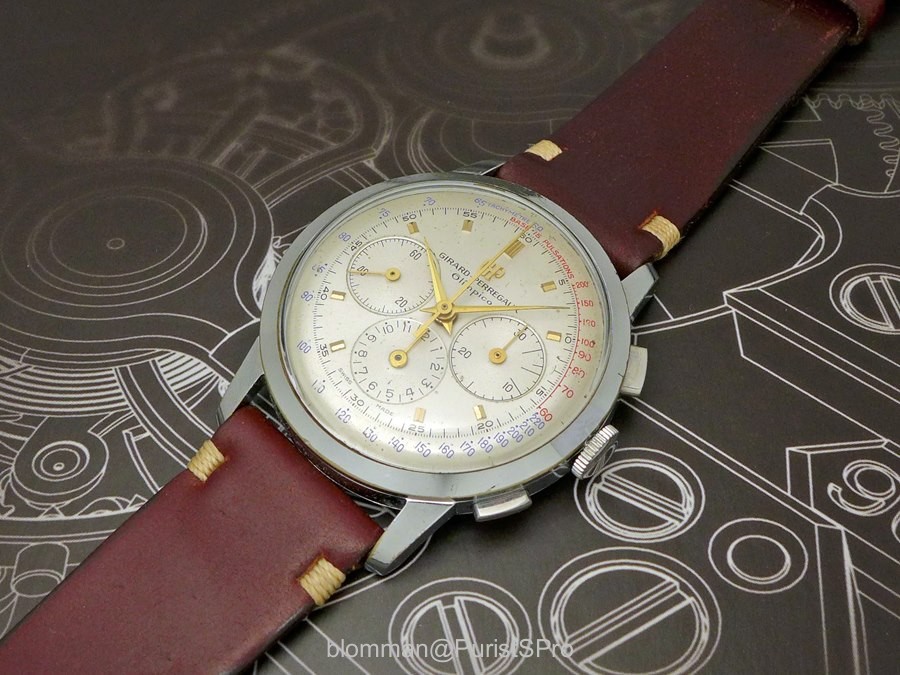
The Girard-Perregaux Olimpico Chronograph reference 8862 B:
Frist of all I like to clarify some facts about the Olimpico Chronograph line is often mistaken:
1: The first year of the Olimpico Chronograph line is 1968 the Mexico Olympic Games.
This has been confirmed by the curator of Girard-Perregaux.
2: More than one reference was released per Olympic Game.
This has been confirmed by the curator of Girard-Perregaux.
There are still question marks regarding if GP only released the Olimpico references during an Olympic Game year or if they in fact released Olimpico references between the Olympic years.
I still hope to be able to find proof of which case is true.
One big reason for this common misunderstanding is this document: a scan from the booklet of the last Olimpico Chronograph ever released from GP, the year 1996, reference 8017:

The scan shows four different Olimpico chronographs with a year printed.
I have added the references beside each watch and will walk you through how I have come to the conclusion that the printed years are not correct.
The 1956/8862; I will explain later in this post.
1960/8846; Confirmed from the manufacture that the 8846 in fact is from 1968.
Also the reference number 8846 is way too high to match 1960. Back in 1960 most numbers were between 69XX – 77XX. OK, all references were not released in chronological order, but the main part of references in the 1968 catalogue are between 80XX – 88XX.
1964/9075; Here I have confirmation from GP that the 9075 was in production in 1976. Was 1976 the first year of production? I don’t know. Still searching evidence but I am having a hard time believing that this reference would be in production over 12 years. Also if that were the case, why is it so hard to find one?
1968/9227; Here, again confirmation from GP that this reference was in production in 1976.
So for three of these watches shown I have actual confirmation from the manufacture that they at least also belong to other years than printed in the booklet.
Add to that the fact that GP didn’t start the Olimpico Chronograph line until 1968…
My conclusion: this scan is a product of a sales team putting together something they didn’t really know as true!
OK, over to the 8862 B which is the main focus for this post!

The 8862 is quite similar to the more well-known 8846.
Three register chronograph with Pulsation and Tachymeter scale.

In fact, they share the same movement: the GP calibre 07-3, based on the Excelsior Park P40.
A manual column wheel chronograph movement.

The big difference between the two is the case.
Size is similar 37.5. – 38 mm for the 8846 and 38 – 38.5 for the 8862.
But the 8862 looks even bigger due to the flat bezel.
A very obvious difference is the shape of the pushers, rectangular on the 8862 while the 8846 have round pushers.

A less obvious difference is the fact that the 8862 have chromac plated brass case while the 8846 have stainless steel case.
Another change is the snap on case back.

These details bring to mind the 6557, which has the same chromac but stainless steel case and snap on case back.
In fact, the cases look identical except for the metal under the plating.

For the 8862 I have no confirmation from the manufacture of the production year…
BUT, I did find proof that the 8862 was in the 1968 catalogue!

And in the price list there are evidence of the 8862 existing in at least three more versions:
Steel, Gold plated and solid Gold.
I wonder how much 54 000 Lire would be in today’s currency?

And while talking about different versions, I wonder if the 8862 also existed with black dial.
Like the 8846.

As you can imagine, accessories help a lot while collecting vintage watches!

Thank you for reading this Girard-Perregaux 1968 Olimpico Chronographs Part #3.
Hope you enjoyed. At the end of this post you will find links to the previous Olimpico reviews.
Will finish this post with a classic “Blomman” shot!


Wishing you all a happy Midsummer!
Blomman
Vintage GP journey, Summer Edition, Part #3.1 - GP 8846 N
Vintage GP journey, Summer Edition, Part #3.2 - GP 8846 N
Girard-Perregaux 1976 Olimpico Chronographs Part #1: 9238 FA
Girard-Perregaux 1976 Olimpico Chronographs Part #2: 9245 FA
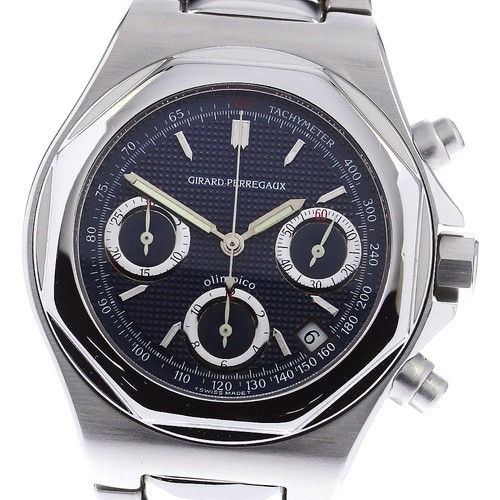
This message has been edited by blomman on 2016-06-23 15:16:22The Girard-Perregaux Laureato Olimpico reference 8017 represents a chronograph variant within the Laureato collection, produced around 1996. This reference is distinguished by its integrated bracelet design and the inclusion of chronograph functionality, setting it apart from time-only Laureato models of the era. It was offered in various material and dial configurations, indicating a strategic expansion of the Laureato line to include more complex offerings for collectors. The Olimpico designation often refers to specific limited editions or special production runs.
This particular reference 8017 features a 40 mm case, available in configurations such as steel and rose gold, or full steel. The movement is an automatic chronograph caliber, providing reliable timekeeping and stopwatch functions. The crystal is typically sapphire, ensuring durability and scratch resistance. Dial colors observed include tobacco grey and Yves-Klein blue, each contributing to the distinct aesthetic of the individual variants within this reference.
For collectors, the Laureato Olimpico reference 8017 is notable for its limited production numbers, particularly for certain variants. The steel and rose gold version with a tobacco grey dial, for instance, is noted to have been produced in very small quantities, approximately 10 pieces. The full steel version with an Yves-Klein blue dial saw a slightly larger, though still limited, production run. These factors contribute to its appeal among those seeking less common examples of neo-vintage chronographs from a respected manufacturer.
Yes, this is a topic I am really interested in and spent a lot of time to putting the dots together! You might say that the Olimpico theme is what made me to go from being a "No chrono guy" to be a "Chrono guy"! Best Blomman
I am not a big fan of chrono like you but I have to say that, sometimes, I regret my VC 47101 :-( Best wishes Alkiro
But, yes I understand the problem... Best Blomman
This thread is active on the Girard Perregaux forum with 27 replies. Share your knowledge with fellow collectors.
Join the Discussion →