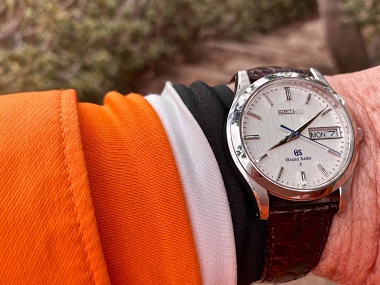
Service
Halgedahl shares an update on living with his Seiko 003, focusing on critical questions regarding its long-term care and performance. His post delves into the practicalities of servicing a vintage Seiko, seeking community advice on maintaining its pristine, unmolested condition. This discussion is particularly relevant for collectors who prioritize preserving the originality and mechanical integrity of their timepieces.


[This thread concludes with questions that have come as a result of living with the 003 for nigh on six weeks, as well as additional views of the watch. Initial impressions can be found in Part III.]
The observations made in Part III aside, I do have some questions for any of you kind enough to have read this far. To whom might I entrust such a precious thing for service? This is primary. For, as I stated before, there is no record that the watch has ever been opened. The slots in the screw heads holding down the display back look pretty sharp and unmolested. I don’t have any equipment, but both the ToolWatch app and visual comparisons with time.gov indicate the watch is running fast, ~+8-10 spd. (possibly down to ~+6 when I wore it continuously even through a night). It could be magnetized, but in any case I have a feeling a service might be prudent. I feel quite a sense of responsibility as an owner who might carry this watch forward for many years. Would it be possible to send it back to Japan to have it serviced (as was the moderator’s) in the studio where it was originally made? That has a strong emotional appeal to me! But I’ve no idea about costs, customs, and the like. I’m all ears, though, and hope you will have the time to answer.
Not surprisingly, the paperwork that came with the watch indicates a daily rate that is much better than I presently record. Yet I can’t make heads nor tails of much of the certificate, and wonder if anyone has ever superimposed a translation of the Japanese on such an image. If not—an idea for a quiet weekend? I’m wondering, as well, what a fair expectation would be in terms of a more precise rate after service and regulation.
But the most pressing question I have regards winding. I own several manual wind watches, including the Montblanc Heritage Chronometrie Ultra Slim, with its remarkable 17J Peseux 7001—21,600 Vph, and a Speedmaster, with its tried and true Omega-adjusted Lemania 1873—also a 21,600.

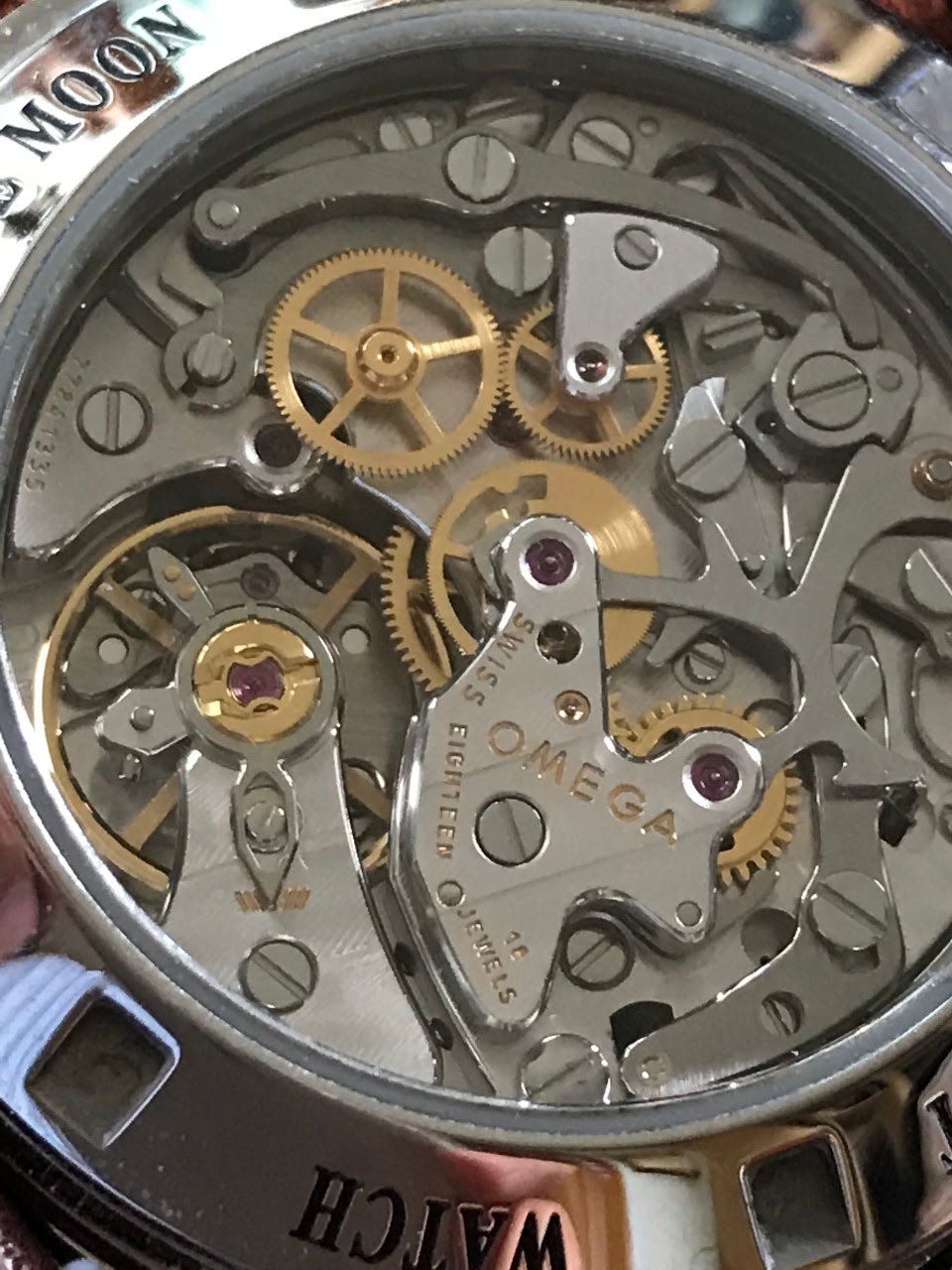
Both watches offer a definitive “stop” when fully wound. (Remember, I’m a violinist, and not apt to carelessly force a delicate system.) Yet, the 003 winds smoothly up to a point, after which it does not stop, but the winding suddenly feels alarmingly rough—almost like something is slipping. Needless to say, I have avoided winding past that point. Allowing the movement to wind down completely from there, on two trials the watch ran for 53hr, 41 min, and 52 hr 20 min, respectively—over the 50 hr. maximum Cazalea catalogs in his post. (I’m aware, of course, that this figure will depend on any number of variables, and it should be noted that past the 50 hr mark the watch had begun to slow.) It took about exactly thirty healthy turns of the crown, each time, to reach that point of resistance again. What does this say about the condition of the winding train? Is something possibly broken that allows the winding train to turn past the mainspring’s maximum? Needless to say I don’t want to damage the watch in any way.
Lastly, perhaps on the face of it a useless observation, but one that might inform another owner who has lost sleep over the condition of the original display box. The lightly flocked coating of my box has, with time, degraded, leaving an unpleasant, sticky residue. I would have been more taken aback by this had it not been for the fact that three years ago I hauled out of my attic a high-end, portable, compact stereo system that I used in the past at a summer music festival. And what a sticky mess the speakers were! They must have been coated with a remarkably similar substance, for my version of Seiko’s display box exhibits pretty much exactly the same unpleasant characteristic. Words to the wise: keep your display boxes out of extreme heat! Or… no manufacturer—not even Seiko—can make the right choices 100% of the time? Perhaps others have some knowledge of this phenomenon.
Finally, finally… I owe the moderator a great debt of thanks for the enormous amount of knowledge he has contributed to this community. I’m so glad to be a part of it. And to Bill, who helped me to finally “get it right.” A Gallery of sorts follows.
Additional views of the SBGW003…
My first duty, here, is to call the reader’s attention to the peerless watch photography of SteveG. Many of you already will be familiar with his work. But this post, from November 2001, captures the details of the 003 as no one else’s efforts have. A heads-up, though, the photo at the top of this post is NOT of the 003; scroll down patiently, and she’ll come into view.
http://ninanet.net/watches/others03/Mediums/mgseiko.html
My photos, by contrast, leave much to be desired, as I have no true macro capability. But these views we’ll call “from life,” and I’ll hope that, taken in that sense, the viewer will make the necessary allowances.


Finally, what you can do when you have the right equipment and expertise. Hat’s off to “sixfignig” a member of the Rolex Forums, who posted these images from Australia


Have a great morning/afternoon/evening wherever this finds you, PuristS. I look forward to conversations with many of you in the weeks and months to come.
Regards,
FH
The Heritage Chronométrie Ultra Slim, reference 112515, is a notable offering within Montblanc's Heritage Chronométrie collection, distinguished by its focus on slender proportions and classic design. This particular reference emphasizes a minimalist aesthetic, appealing to collectors who value understated elegance and traditional watchmaking principles. Its design prioritizes legibility and a refined profile, making it a versatile piece suitable for various occasions. The watch reflects Montblanc's commitment to accessible high-quality watchmaking, drawing inspiration from historical Minerva designs.
This reference features a 38mm case crafted from stainless steel, contributing to its slim profile and comfortable wear. It houses a mechanical movement, known for its reliability and thin construction, which allows for the watch's svelte dimensions. The dial is protected by a sapphire crystal, ensuring durability and clear viewing. The movement provides a practical power reserve, aligning with the expectations for a daily wear timepiece. The overall construction emphasizes a balance between robustness and refined finishing.
For collectors, the Heritage Chronométrie Ultra Slim 112515 represents an entry point into Montblanc's more traditional watchmaking lineage, distinct from its sportier or more complicated offerings. Its appeal lies in its adherence to classic dress watch conventions, making it a strong candidate for those seeking a discreet yet well-executed timepiece. The discussion around its hand design highlights the attention to detail among enthusiasts, underscoring its place in collector discourse.
Mine is so bad I dusted it with talcum powder, wiped it with alcohol, set it in the Sunlight - all to little effect. Worse, my watch had been kept in humid, un-air conditioned Singapore and had mildew growing on the dial. As the dial is almost everything with this watch (see my recent article on dials), I couldn't live with that. So I sent it back to Japan and they rebuilt the watch and replaced the dial. I will check on the cost at that time, but I think the dial was a highly unusual and unnece
This thread is active on the Seiko forum with 2 replies. Share your knowledge with fellow collectors.
Join the Discussion →