WPS member · Horological Meandering forum
9 replies5239 views28 photos
Marcus Hanke shares his personal journey with the Hanhart Primus "Austrian Air Force" chronograph, a limited edition piece he acquired with a touch of patriotic fervor. His detailed review highlights the watch's unique features and the unexpected delight of its arrival, offering collectors a close look at this distinctive Hanhart model.
It must have been in a moment of patriotic enthusiasm when I placed an order, just after Hanhart presented pictures of its chronograph dedicated to the Austrian military, and limited to 100 pieces. Yet thereafter, I forgot the issue and was puzzled at first when - several months later - the delivery of the timepiece was announced and I was politely asked to send the money.
After my initial confusion was overcome, I looked forward to the watch, and was not disappointed when I held it in my hands.
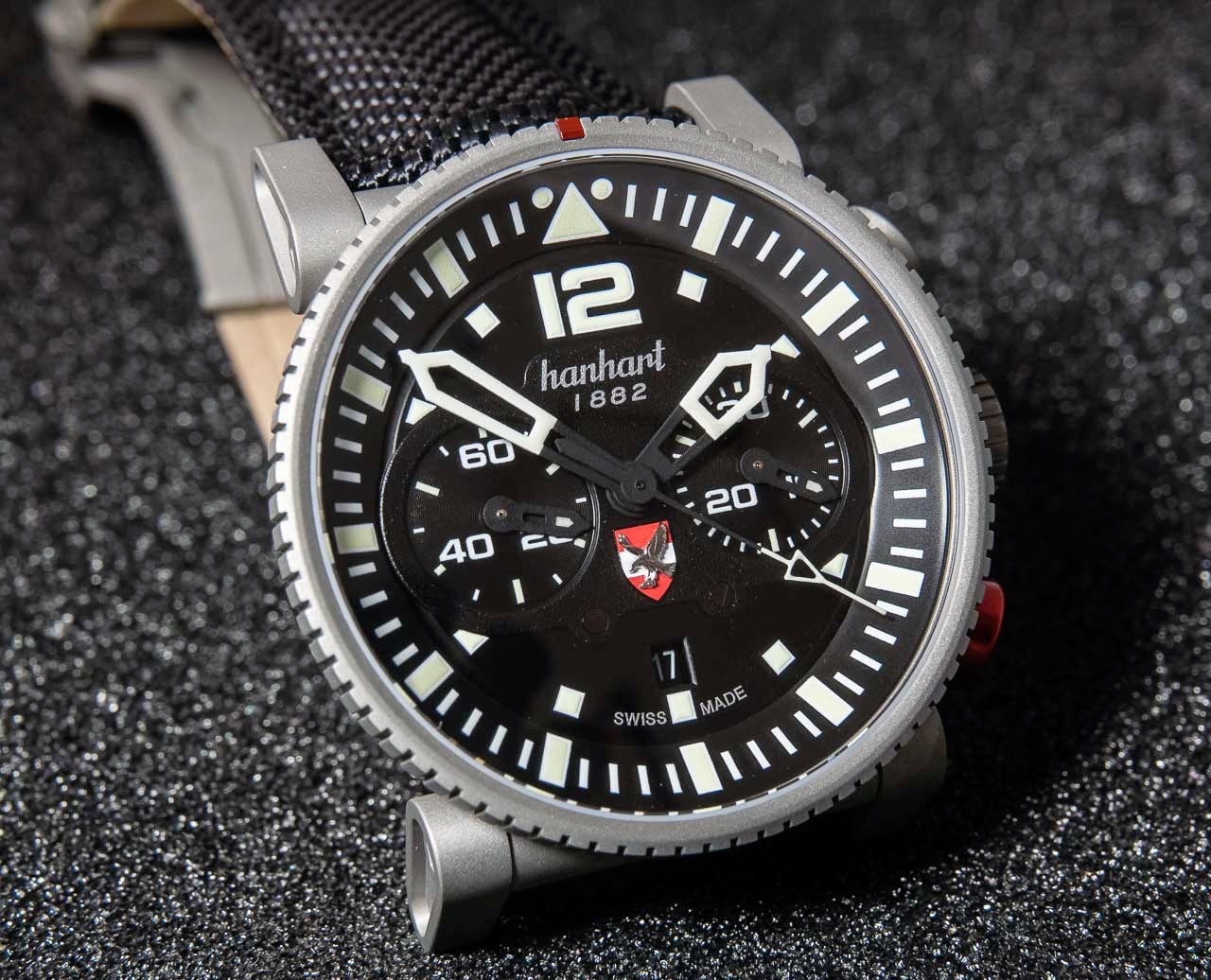
The "Primus" is not a newcomer in Hanhart's line-up of chronographs, being there with a manifold of variants since about six years. The only clue marking the limited edition I have received is the red-white-red coat of arms of Austria, with a beautifully crafted silver eagle applied to it, being the sign of the Austrian Air Force. Well, for historical and political reasons, this "Air Force" is barely worth to be mentioned, but for me as Austrian and fan of fast planes alike, this watch is a nice addition to the collection.
It is offered in threee different finishes of the stainless steel case: polished, sand-blasted or DLC-coated. Having already a few black cased watches, I opted for the matte sand-blasted finish, which was very fashionable some ten years ago, but has virtually disappeared from the market since.
Speaking of the case, it has massive dimensions, with 44mm diameter and a height of 15mm. However, the cleverly designed movable lugs permit it to comfortably fit also on smaller wrists. The instrumental design of the dial is very legible, with many elements treated with luminous mass.


The movement choice is noteworthy: The bi-compax subdial layout of a running second at 9 and thirty minutes counter at 3 originally made me believe Hanhart had used the Valjoux 7753 variant. However, this version does not have the date quicksetting function via the crown, but offers a separate pusher at 11 to serve this purpose. Since the pictures did not show any sign of this pusher, I was worried Hanhart could have committed the same folly as Breitling, deleting the possibility of quickly setting the date altogether. A query at the manufacturer dispersed my worries: Hanhart uses a specially modified Sellita cal. SW500, basically a 7750 clone. It was re-worked to relocate the thirty minutes counter from 12 to 3, but retained the original crown functionality to quick-set the date.


Additionally, this movement offers the smoothest chrono pusher operation I ever experienced in a 7750 class chronograph. It is really a joy to operate them. btw, the red coating on the reset pusher is a design element typical for Hanhart chronographs already since the 1940s.
The watch came on a magnificent textile strap with an also sand-blasted folding clasp.
If there is something to criticize it is that the fluted bezel and red marking at 12 are suggesting a rotating pilot's bezel where there is none, since this part is a fixed component of the case. This is really sad, since it would have been possible to make a classic pilot-watch revolving bezel (together with the sapphire crystal) without having to increase the attractive price of 2,700 Euros too much. Of course, such a construction would not have permitted its current depth rating of 100 meters. But 50 meters, as I recently had on an Oris Big Crown watch with revolving bezel/crystal unit, would have been perfectly enough for a chronograph without screw-down pushers.
Generally, this Primus chronograph is a rather unique interpretation of the endless "pilot's chronograph" theme, with an interesting movement choice and excellent quality of finish.
Marcus