Review
KIH's hands-on review of the Hublot Oceanographic 4000, reference 731.NX.1190.RX, offers a detailed look at this robust dive watch and its connection to the Oceanographic Museum of Monaco. The article delves into the technical aspects of saturation diving, providing crucial context for understanding the watch's extreme capabilities. This review is essential for anyone interested in Hublot's commitment to marine conservation and high-performance horology.




“I think this new OCEANOGRAPHIC 4000 from Hublot is an incredible watch. First of all, it is a beautiful watch. It looks very robust, very strong and just really fits in well with the image of the museum here in Monaco, the Oceanographic Museum which was founded by my great great grandfather, Prince Albert I, who had a great vision for oceanography, and for this museum especially…..”, - HSH Prince Albert II of Monaco.
I stopped by the Ginza Boutique the other day and there I was introduced to a sample (working) piece of this much anticipated novelty. I asked for an hour alone with this guy to take pics and handle it to review this model.
Introduction:
(from the booklet which comes with the watch) “A partnership based on a shared love for the sea. Like a window revealing the marvels and treasures to which the Oceanographic Museum has been dedicating its work for around a century, Hublot wishes to pay tribute to its extraordinary holdings while helping to protect and preserve the oceans. The watch company has chosen to actively support the study and preservation of the marine environment by providing financial backing for missions and scientific surveys conducted by the Oceanographic Institute.”
The world record of such saturation diving is by a team of professional divers of the Comex S.A. (You know well, a French company: Comapagnie Maritime D’Expertises), industrial deep-sea diving company performing pipe line connection exercises at a depth of 534 meters of sea water in 1988, while 701 meters is the record in an on shore hyperbaric chamber, again by a diver of Comex in 1992.
After US Navy gave up most of the Saturation Diving projects in late 1960s, the commercial use (oil related) took over its development and evolution. But, there were some incidents/ tragedies where more developed saturation diving technique was needed – TWA flight 800 crash in 1996 (the plane was at 36 meters deep) and Russian submarine Kursk in 2000 (the sub was on the seabed at 108 meters deep), not that it could save lots of lives, but that it could do something more effectively.
Right now the record is 701 meters, but who knows in the future? Man may come up with great ideas or techniques or equipments and want to challenge deeper – 1000 meters or more some day. And you wouldn’t want to wear a watch then which is only capable of 1000 meters depth. I believe this 4000 meters depth capability is Hublot’s challenge to technology to the limit, as always.


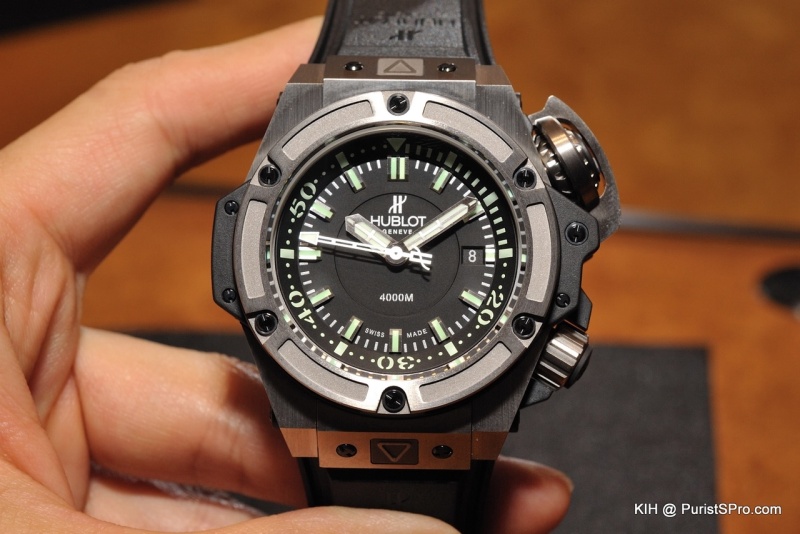
Definitely Hublot DNA


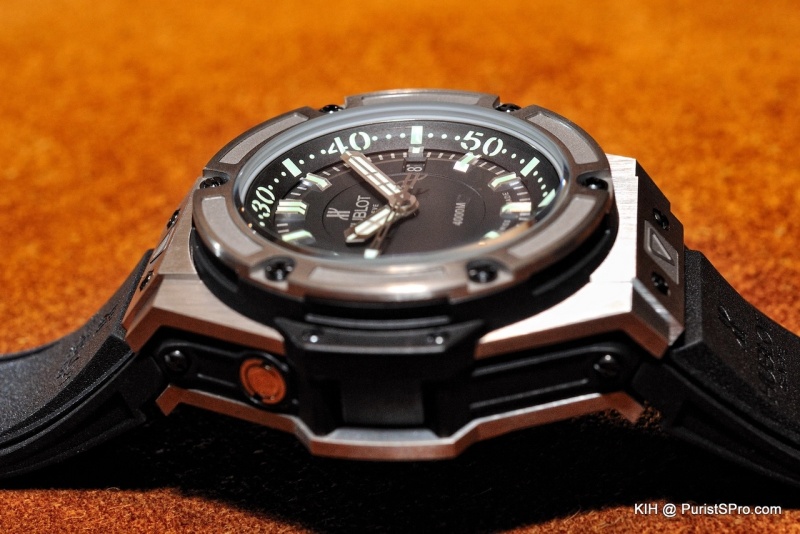
Thick! But can’t help - the thickness of the sapphire glass alone is 6.5 mm.

The screw back is made of grade 2 titanium – extremely strong material


The anti-reflective coating is very well done. No greenish reflection.
Special mentions:
As you have read in the press release, it took Hublot 18 months of research, development and testing to produce this model, and has been certified as a diving watch in line with the requirements of Swiss international watchmaking standards (NIHS).
1. Screw-in crowns:


There are two crowns, both of which are screwed-in. One at the 2 o’clock is for the flange rotation (unidirectional). The rotation gear is disengaged once it is pushed down to screw-in, so no unwanted move of the flange. The flange crown is also protected by the “cage”. One at the 4 o’clock is for setting time and date, also screw-in type. The "cage" securely protects the flange rotation crown.
2. Helium gas escape valve (shiny SS round cover at 10 o'clock):


This is a feature required for any deep sea diving watch. During the compression period, gas enters the watch just like it is absorbed by the human body tissue. And while the divers are kept in the decompression process, the gas which entered the watch MUST be let out (otherwise it would explode…).
3. SuperLuminovaTM:


It is the requirement by NIHS, it has to be legible from 25 cm in darkness. The hands and the flange have larger area and treated with SuperLuminovaTM.
4. Clip-on strap:


This model is, unlike most other Hublot, equipped with tang buckle only. I am a deployant buckle fan, but considering the purpose of this watch, it may be more secure as it has less parts and screws. After all, the wet suit and/or glove thickness may vary mission by mission and it would be cumbersome to change the hole each time. Also another special mention is that the straps can be detached by pushing the triangle marked button – just clip on/ off. May look just a frill, but when one strap is broken before the mission, this feature may come in handy.
Wrist shots:


My humble opinion:
This is a big watch under normal circumstances. Even in the Hublot boutique, it looked big due to its thickness. But when you go for such deep dive and wear thick suits and gloves and need to see the time clearly, the size and thickness should not be such an issue. Would we need watches capable of 4000 meters pressure? I don’t know. But like I said, when you challenge 1000 meters, you wouldn’t want to go with the watch capable of just 1000 meters pressure. But, then again, many people prefer and own chronograph even though they don’t really need it, or diving watches even though they don't dive. Need has little to do with hobbies – if you are looking for a cool looking diving watch, this can be one of the candidates.
Limited Edition:
Titanium model (featured in this review) – 1000 pieces, 1/1000 to 1000/1000
Forged Carbon model – 500 pieces, 1/500 to 500/500
Special thanks to Fukui-san at Hublot Ginza Boutique.
Thank you for reading.
Ken
FYI
Other posts that may be of interest:
hublot.watchprosite.com
hublot.watchprosite.com
awesome post! will have to re-read this. Have to say that Hublot is really making leaps and bounds with their recent pieces. Ask me a year ago if I would consider Hublot and I would have said no--but now..... As always, thanks for your observations Jason
... indeed! Thank you, Jason! Ken
But sadly, I don't like this watch: too bulky, too thick... Thanks for the review! Fx
... as always, YMMV Ken
If you really want to get a dive watch that goes deep... buy a Pita Oceana that goes as deep as 5,000 meters. But for normal wearing I still find this watch ridiculously thick. I think Hublot makes better watches, that do look good on the wrist.
... not much difference from this one. There are variety of people in this hobby, thus any brand has to make variety of watches We do respect different opinions here and that makes this world a bit more interesting. Thank you! Ken
This thread is active on the Hublot forum with 34 replies. Share your knowledge with fellow collectors.
Join the Discussion →