Review
iim7v7im7 shares his acquisition of the IWC Spitfire Chronograph, Ref. IW387804, offering a detailed review of its design and technical innovations. His post highlights the watch's appeal, particularly its manageable 43mm size and the advanced in-house caliber, addressing a common concern among IWC collectors regarding watch dimensions.


Hi,
I wanted to share my new arrival with fellow
Purists. It is an IWC Spitfire Chronograph (IW387804). I had really been
avoiding most of IWC’s recent efforts due to their large size (many recent
pilot watches were 46 mm). This one
however, was only 43 mm, so it caught my eye.
I had been wanting a pilots watch ever since I had sold my Sinn a few
years ago.

The watch is stunning in the steel. The mixture of satin and brushed case with polished bezel and chrono pushers is stunning.
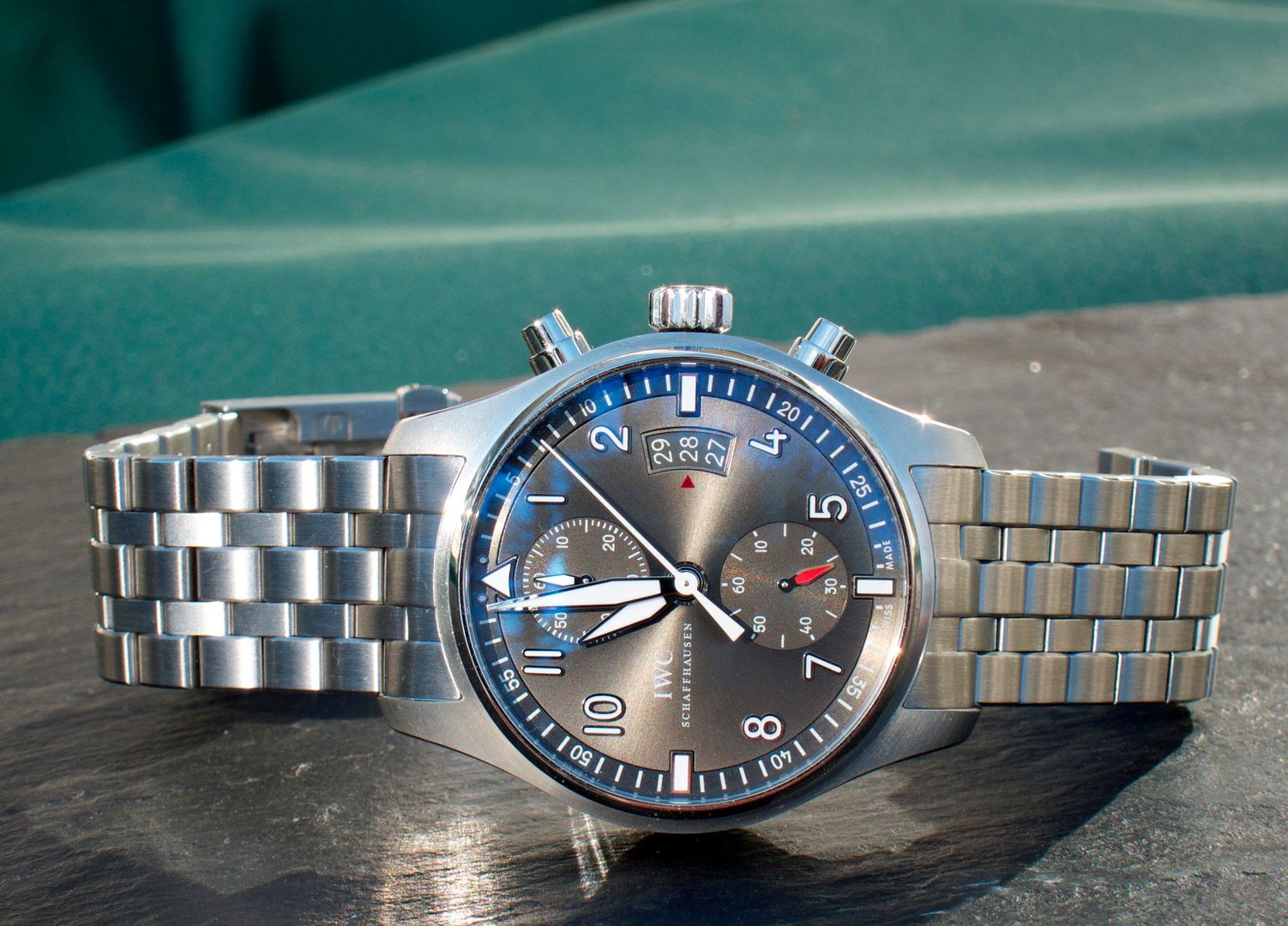
The sunray brushed ardoise dial is both legible and has richness in depth that is enhanced by the raised Arabic's and markers in the chapter ring. The red accents on the seconds hands and calendar pointer are a nice touch. The hours and minute hands with the inset luminova is a nice detail as well. While I am not sure that I like the open date window (I need to live with it a while), I do like the implementation without the day like in other references.

It is an interesting caliber that took IWC 4-years to develop. It appears to sized similarly to a ETA 7750 (13.3 ligne, 30.0 x 7.5 mm). It has an interesting adaptation of the Pellaton winding system that achieves 68 hours from a single barrel. For shock resistance, there is an automatic spring bridge, a further development of what was used in the Ingenieur’s calibre 80110. But the winding system's pawl design, originally developed by Albert Pellaton, has been completely revamped. It uses two double-winding pawls, totaling four, arranged in pairs. Rather than controlled by a cam or a heart disc on the rotor arbor, they now use a “crankshaft” The repositioning of the pawls has increased winding efficiency by nearly 30%. It operates at 28,800 bph and has 35 jewels. At its heart, it is an integrated vertical clutch, column wheel chronograph with a flyback mechanism and stop seconds. I have included an image from the Internet below (credit to Shing from IWC Forum).
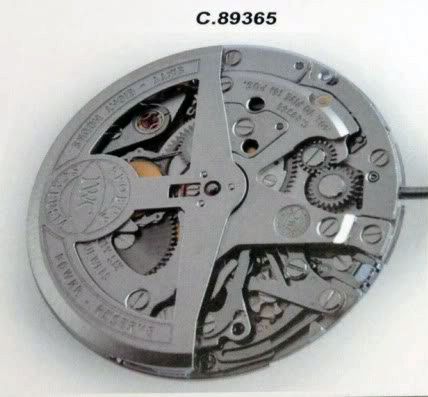
Calibre 89365 is a simplified verson of Calibre 89365. Calibre 89361 has an a register that records both hours and minutes and the Calibre 89365 only has a register for minutes. Additionally, Calibre 89365 appears to have little in finishing beyond what is functional and lacks the modest decoration (Cotes de Geneve, polished screw heads and the gold gelt engraving etc.). Likely some cost savings for a movement housed within a non-display back case.It has a somewhat noisy, but smooth winding feel to it. The crown is a great size and threads smoothly and easily. The chrono pushers are crisp, requiring a low force to engage with no lag. This is a great improvement over my last 7750 based chronograph (Sinn 756 Diapal). I suspect they will wear in and become even smoother over time.
The new IWC bracelet is solid and well designed
like they always have been. A very easy link exchange system with a solid
two-button clasp.

The micro adjust is a welcomed addition and operates similarly to my GO. It allows for up to 6 mm of adjustment with a push of the hidden button (polished square with IWC logo).

Regards,
Bob
HEUER Reference 756
The HEUER reference 756 represents the brand s entry into dive watch production, featuring a rotating diving bezel and 200-meter water resistance. Produced in 1979, this 28mm reference occupies a compact position within HEUER s sports watch offerings of the period.
The stainless steel case measures 28mm in diameter and houses an automatic AS 5103/ETA caliber movement delivering 38-42 hours of power reserve. The watch features a unidirectional diving bezel and has been fitted with a sapphire crystal replacement. The timepiece is completed with a rubber strap appropriate for underwater activities.
This reference appeals to collectors seeking HEUER s dive watch production from the late 1970s. The compact 28mm case size and diving specifications distinguish it within the brand s catalog. The AS 5103/ETA movement represents HEUER s reliance on established Swiss movement suppliers during this production period, offering collectors an accessible entry point into the brand s sports watch heritage.
Congratulations! This to stay the decision on the choice of a different shape? ;-) Richard
Yes, after thinking about my collection, I had 6 dressier pieces and only 3 sports watches, which is a bit out of sync with my day to day lifestyle. I also had 5 light dials and 4 dark dials. So when I was looking at rectangular/square/tonneau shaped watches, I was looking to further diversify by adding a new shape and brand. As I looked at each watch under consideration, I had some small issues with each. This watch, did not introduce a new shape or brand. It did however add another sports watc
That is a great pick up - perfect size and will suit nearly every wearing situation. -- Sancerre
This Chronograph has a superb dial. Thanks for your comprehensive presentation of the watch! Fx
I didn't knew that now the Spitfire is powered by an in house movement. Thanks for sharing and congratulations for this beautiful piece. Cheers, Nilo
This thread is active on the IWC forum with 11 replies. Share your knowledge with fellow collectors.
Join the Discussion →