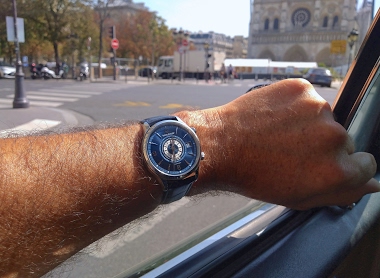
The Deep Sea Alarm was the very first JLC Diving Watch, while the Navy Seals is the latest creation form " La Grande Maison ", as an hommage to this historic model, born 50 years ago.
The Deep Sea Alarm:

The Navy Seals Alarm:

Obviously, aesthetically and mechanically speaking, the Navy Seals Alarm may be considered as a kind of reincarnation of the Deep Sea Alarm, an original Diving Watch offering the combination of an Alarm into a Diving watch, with some improvements:
1/ Presented as a Diving Watch, the Deep Sea Alarm, strangely, didn't receive a turning bezel ( !!! ) .
2/ The bezel didn't resist to Time, because it is very fragile.
3/ The minute and hour hands ( at the exception of the pointed skeleton ) weren't very legible as wells as the second hand.
4/ The Deep Sea Alarm didn't get screw in crowns, and its water resistance was limited to 100 Meters.
5/ The movement of this very first JLC Vintage Diving watch, the Cal 815, an automatic one, with this delicious bumper system, was not as modern as the one used in the later Memovoxes ( E 870, E 875, Polaris II, for example ), with its bi directional rotor beating at 28 800 vibrations per hour for a better precision ( instead of the 18 000 vph of the Cal 815 ).
Let's see all these points and improvements in detail:
1/ Aesthetically speaking, the inspiration from the Past is noticeable.
And this inspiration can't be only summed to the Deep Sea Alarm, as we will see.
- The Alarm Disk, with the characteristic Triangle Symbol to set the Alarm Hour.
Here, on the Vintage ( European Version )

And here, on the Navy Seals:

On the defitinive Navy Seals Alarm watches, the wording is not engraved on the crystal ( as it was the case on the protos introduced in Geneva ), but located on the disk, as on the US Deep Sea Alarm:


- The shape of the luminous indexes, which is very close to the european Deep Sea Alarm, although bigger and larger:
The Vintage:

The Modern:

Some exceptions, actually:
The Hour numbers didn't exist on the Deep Sea Alarm, but seem to take their inspiration from the Polaris, and look much bigger than on this last one.
Here, the Polaris:

The Polaris, which clearly inspired the Designer of the Master Compressor Memovox.
You will notice the bigger ( and closer to the Navy Seals ) index and index numbers:


- The Minute and Second hands are really specific to the Navy Seals Alarm.
The Minute hand, ending by a large arrow, is not a novelty for Jaeger Diving Watches, as you can see on these pictures:


You will also see that the the end of the Second hand has a kind of ressemblance with the one on the Navy Seals Alarm.

- The Date, located at " 3 ", which didn't exist on the Deep Sea Alarm.
- The Case is bigger on the Navy Seals, and thicker, too ( 44 mm instead of 39 mm, and I'd say 4 mm thicker ).
The shape of the Navy Seals Case is nice, although less elegant and original than the Deep Sea Alarm.
In fact, the N.S.A Case is closer to the Polaris ( in terms of volumes and shape ) than to the Deep Sea Alarm.
The case back on the D.S.A and on the N.S.A are both engraved, with a nice draw of a Diver in action ( D.S.A ) and the Navy Seals Symbol ( N.S.A, of course ).
The Case Back of the D.S.A:

The N.S.A:

2/ The Functionality:
From the very first JLC Vintage Diving to the Latest one, things have changed, not only on the aesthetical playground, or, let's say that these changes were made for some efficient reasons.
In fact, they were not any other solution, if you want to conceive a modern Diving watch, as some rules have to be respected.
- The Legibility has been dramatically improved, as shown above, by the use of larger indexes, and hands.
- The biggest flaw of the Deep Sea Alarm, its non turning and fragile bezel, has been solved, as JLC opted for a matt finished ceramic turning bezel, which is graduated till " 15 " for a more precise use in underwater conditions.
Let's add that the use of ceramic for the bezel is really interesting, as it is not only very nice, but it will also helps to avoid scratches, when its owner will dive with it.

- The crowns don't have this special look anymore ( oignion shaped for the one located at " 2 " like on the Deep Sea Alarm ), but are using the Compressor Technology, firstly used on the Master Compressor Memovox, in 2002.

How does it work?
When you turn the key in order to show the white arrow, it means that the joints are compressed, and that you don't have to fear any water resistance problem.
When the double red arrows appear, the joints are decompressed, and you'd better not manipulate the crown under the water.
Here, you loose in Beauty what you gain in functionality, obviously, as we don't have to forget that the D.S.A didn't have screw in crowns.
BUT, with these 2 crowns symetricaly disposed, the outcome is not ugly, and once again, reminds the original Memovox Look, in a more modern configuration.
I managed to take some comparison pictures of the Deep Sea Alarm and the Navy Seals Alarm, to enlighten the differences between these 2 watches ( Case and Crowns ):


The Case back is screwed, and with the use of a sapphire glass, you will get a 300 meters Water Resistance, which is more secure than the Deep Sea Alarm ( 100 meters ).
The use of Titanium Grade 5 for the case will allow a gain of weight on the N.S.A, which is a good point on a 44 mm watch, and will protect it from some unavoidable scratches during water activities.
3/ The Evolution in Movement, or the Movements in Evolution?
Both!

Since 1956, and the first introduction of an automatic alarm movement ( the Cal 815, followed 3 years later by the Cal 825, which is exactly the same movement, but with the Date function ) , there were some important improvements.
The Cal 815 was a 17 jewels 14 lines bumper automatic movement, beating at 18 000 vibrations per hour, with a hammer alarm which has an autonomy of 20 seconds, while the power reserve of the watch is around 45 hours.
Here, an " éclaté " of this movement, showing the bumper ( above, legend Nr 13 ), and the hammer ( down on your right, Legend Nr 6 ).

And a picture of the assembled movement, now:

The production of the Cal 815 ended in 1966, while the Cal 825 was discontinued in 1969, replaced by the new Cal 916, another 17 jewels automatic alarm movement .
Here no more bumper, but a 360 degrees rotor, suspended by ball bearings.
The Vibrations per Hour " climbs " to 28 800 for a better precision, while the power reserve of the watch and the alarm are basically the same.
Here, a picture of the Cal 916 showing the 360 degrees rotor and the ball bearings at its center.

Produced till 1978, it may be considered as the " grandfather " of the modern Cal 918, born in 1994 and firstly housed in the Master Reveil before being used in the Master Compressor Memovox, with a big dfference, the sound of the Alarm, closer to a School Bell than a Cricket ( Cal 916 ) or a Frog ( 815 / 825 ).
The Explanation?
Let me quote the JLC Catalogue ( Edition 2002 / 2003 ) :
" The very pure chime, which sounds when the tiny hammer causes the gong suspended inside its caseto vibrate, is an exceptional combination of effectivenessand discretion.
Such sound quality rests on the discovery of a special alloy and the invention of a special shape for the steel gong... "
Here, a gorgeous pic of the Cal 918 ( Credit pic: Al )

Then, last evolution, the Cal 956, which is developed from the Cal 912 ( Extrem World Alarm, introduced at the SIHH 2007 ), firstly housed in the Tribute To Polaris in 2008, and now, in the Navy Seals Alarm.
On the pics of the movement ( I have to thank my contact at the Manufacture, as I didn't find any picture of the movement, elsewhere ), you will appreciate the correct, honest finish that we expect from such a toolwatch:


And a nice pic of the movement dial side, to be complete:

The Calibre 956 features a suspended gong and a 45 hour power reserve, a variable-inertia balance beating at a frequency of 28,800 vibrations per hour, an oscillating weight equipped with ceramic ball bearings and a total of 268 parts.
Besides these numbers and characteristics, the interesting thing is that this movement offers some friendly improvements, as the quick set of the date ( Finally ! ), and a very musical Alarm, more crystalline than with the Cal 918.
Conclusion:
From their first steps in the Diving Watch World to nowadays, JLC continually improved their watches.
The weak points have been solved with a certain brio, lie the non turning bezel or the movement, to adapt the time keepers to an evident functionality.
The last opus, the Navy Seals Alarm, is a very good example.
The choice of materials like the titanium grade 5 for the case, avoiding a certain weight to this big watch, and the ceramic for the bezel, which makes it more resistant to scratches, contributes to the interest of this watch, whose originality is, again, to be an Alarm Diving Watch, faithful to what may be now called a Tradition at JLC.
Is this a perfect watch, so far?
In terms of legibility, and functionality, it is a very good watch.
In terms of aesthetics, I would have dreamt about a ceramic case, to make it even more bestial.
The Titanium grade 5 allows to wear it in different circumstances, and you can also play with the cordura leather strap, or the Nato, which are, to me, the best straps for this watch.


The Nato is not a real Nato, as you don't have this double system which is just under the case back, so you will have to use a tool to change your strap, as you do it with any other watch.
But, you can hunt a real Nato quite easily..
The buckle on the Cordura strap is in polished Stainless Steel, which is a negative point, to me, as it mismatches with the titanium case, while the Nato strap receives a dark buckle...
In both cases, Cordura or Nato, the Navy Seals Alarm is very comfortable to wear, with a nice presence on the wrist:

The good point is the very nice matt ceramic bezel, which nicely works with the whole watch, and this dark matt dial.
As for the compressor crowns, you like them or hate them, but in this case, they don't ruin the balance of the watch, as you only have 2 crowns.
Therefore, the rubber crowns offer a very smooth feeling.
In fact, the only controversial point, to me, is the writing, which was engraved on the dial on the prototypes, and which is now on the dial, on the definitive watches.

The thing is that the writing will turn with the alarm disk, like on the Deep Sea Alarm US, as said above...
Even if the writing is done in a discret clear grey color, it may be disturbing for some people, indeed.
No watch is perfect, I think, and this Navy Seals Alarm doesn't make an exception to the rule, but, in my opinion, it is a good, lovely and pleasant continuation of the JLC Diving chapter.


To be followed?
Best,
Nicolas
This message has been edited by amanico on 2009-09-21 04:17:37 This message has been edited by amanico on 2009-09-26 01:26:31