here the story of Part -2 continues.
Had a great companion on my wrist: Geophysic UT - Then a quick cup of coffee
great JLC visit & guide Team - all a pleasure to meet & listen to
What was different, yet really unexpected was the rather new strict
rule of No photography, in all workng areas and Ateliers, Nothing, Nada !
This new policy has been introduced for various security & safety aspects,
we were told.
Now, as much as I can understand this, it limits me here to only a rather comprehensive
report, and no pics from inside the Métiers des arts; especially no details
of most processes for creating, composing, compiling, emailing,
painting and assemblng these small wonders.
What has been successfully done however,is to coordinate all groups working
for a common goal, let's say Grandes Complications, but also on more
mundane watch types into "Ateliers". These are circumvented by glass walls, with
controlled pressure system, to keep dust out.
What is nice that within a major section, visitors will find a central goass walled island, with
seatings and a large, really large round table encasing a screen in the middle.
From there a very sophisticated tv-circuit system, rh by a tablet is connected
to the working spaces of different work-steps, with the microscopes;
and the observer can now see with the eye of the watchmaker,
the painter etc. This obviously has helped JLC to canalize but also improve
the visual experience for the guests. More importantly it also prevents
disturbance of the artist.
Furthermore, one of these obvervation islands/ sections houses a special
auto-focus electronic microscope, also connected by a video link to
a big tv screen on the wall of one the "cockpit" areas, where visitors can sur & see,
talk & also ask questions to the Master
The guide, mostly one of the Master Watchmakers,can take a given watch,
magnifies it via electronic Microscope, connected to TV camera for
optimal enlargement and can introduce & explain step-by-step.
This all to be enabled to pinpoint at very small parts of movements, case or dial details, or
ways of decorum , such as Côtes des Geneve & de soleil, Perlage & Anglage or Cloisonné
even often are not that clear with a regular standard loupe. - That system therefore is also
a great teaching & demonstration tool.
We were also shown ateliers, where some of these fine pieces are created or compiled.

Miniature work, often done by female specialists: the glueing of anchors with "Shellack"
Back to the watches:
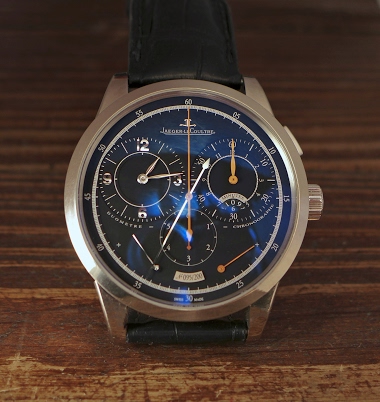
We were shown several from the Master & Reverso series but - big luck for us - quite
many in the collection were from the Duométre family, which was absolutely stunning,
when explained and demonstrated by the Master watchmakers.
- Actually in the end of the day, we then were given ample opportunity to see,
touch & handle some ofthese fascinating pieces.
Finally, just wanted to mention, that there is a big department with metal work, melting,
turning, drilling and generating larger, even complex parts, steered by CAD driven
precision machines. Also there are still several, old, traditional machinery devices,
hand-designed for very specialized steps of work, still doing great duty.
It also is important, that all the time, at many, many intermediate steps
of the process quality control steps are performed, followed in the end with
the encased movement by the well known JLC 1000 hour control test.
Ok, guess that this is enough of my lengthy general dwellings, but you have to take these
descriptions for the actual work areas & departments.
The following imagery part will then highlight & illustrate, the partial demonstration out of
the 2016 collection, but also some stunnng Haute Horlogerie pieces, mostly
seen for the first time.
It also contains one or two elements of humble personal interest,
but that might well be another little story here in the future..
Interesting Verso side: with Clous de Paris and central white rays & central turning movement disc
1st time ever seen & touched, handled and worn.. Quite an experience..