Vintage
SJX's post offers a compelling historical overview of the Luftwaffe Fliegerchronograph, a lesser-known but historically significant military timepiece from World War II. This article highlights the contributions of Hanhart and Tutima, detailing the common design traits and variations that defined these pilot's chronographs. SJX provides valuable context for collectors interested in military watches beyond the more commonly recognized Beobachtungsuhr.
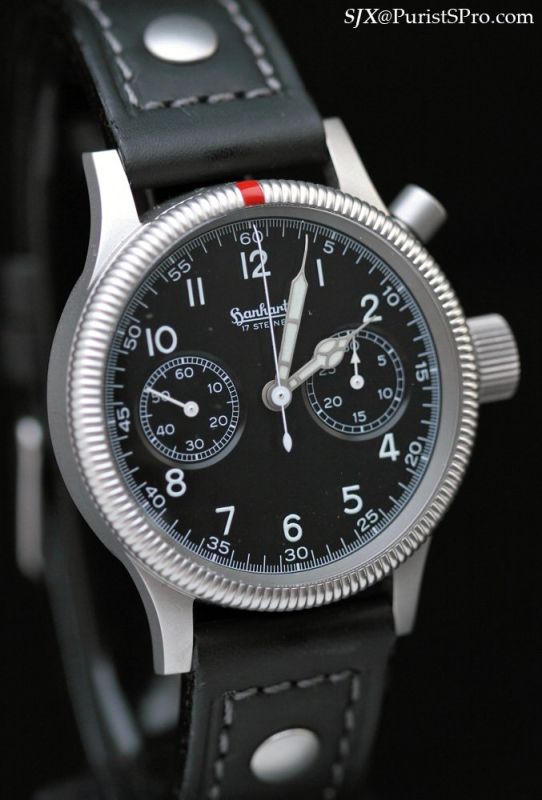
When I was younger I was a World War II history buff. My bookshelves still contain too many history books and I still remember lots of useless trivia. For example, the Germans built a tank that weighed over 100 tonnes and named it the ‘Maus’ (mouse). Naturally, an extension of that interest was military timepieces.
My favourite military watch of WWII was the Luftwaffe Fliegerchronograph. It is not especially well known, especially compared to the 55 mm Beobachtungsuhr that is often seen as the quintessential WWII pilots’ watch thanks to brands like IWC, Stowa, Laco that have reinterpreted the design and marketed it wisely.
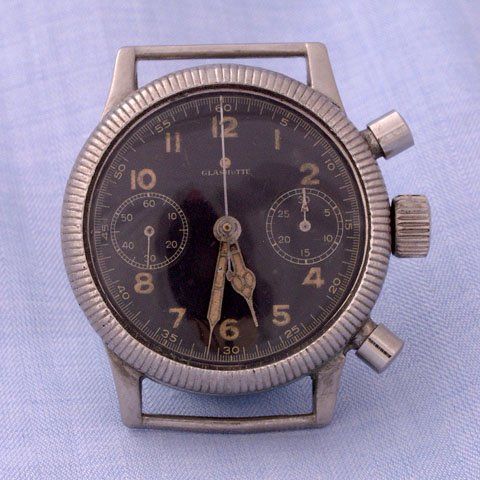
This chronograph was issued to Luftwaffe pilots, notably pilots of the Stuka diver bomber. Two companies, Hanhart and Tutima, which was then known as UROFA-UFAG (Uhren-Rohwerke-Fabrik Glashütte A.G-Uhrenfabrik Glashütte A.G, produced chronographs in this style. Hanhart began making these chronographs in 1939 while Tutima followed in 1941.

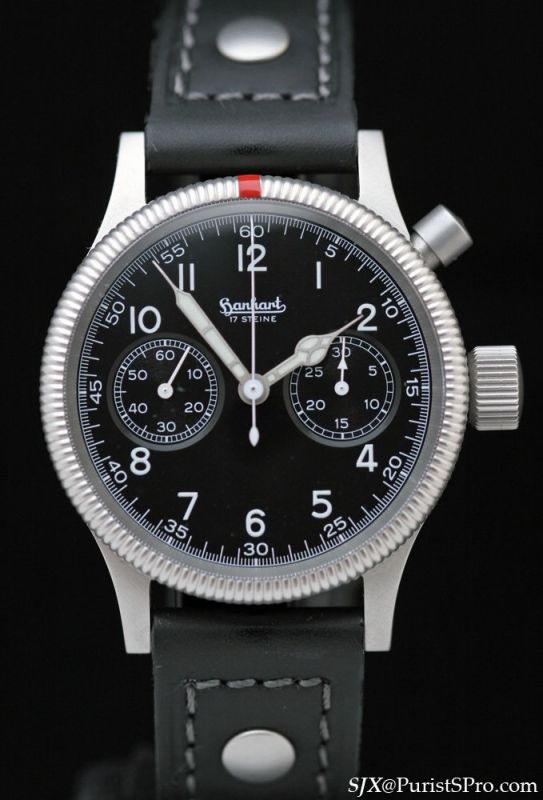
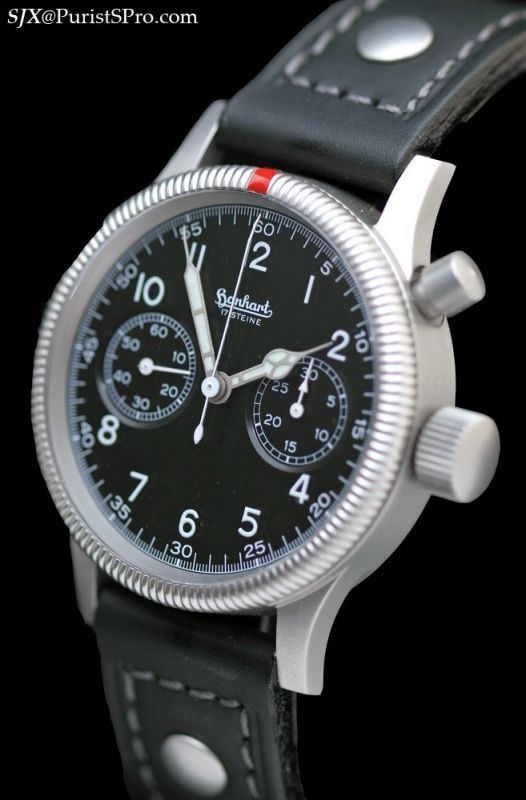
Modern Hanhart Primus single-button chronograph
Several versions of the watch were made by both firms, though the most well known is the two-button flyback chronograph, the cal. 41 and cal. 59 by Hanhart and Tutima respectively. Hanhart also produced a monopusher chronograph using its cal. 40. Despite the variations, these chronographs typically had several traits in common: black dial with Arabic numerals, a 30-minute counter and poire squelette (skeleton pear) hands. Although the knurled rotating bezel is more distinctive, the chronographs were also made with fixed, smooth bezels.

Glashütte (Tutima) flyback chronograph, c. 1941
Photo courtesy Mark Gordon
Other variations of the chronographs were made, including specimens with red-coated chronograph buttons or red telemetric scales on the dial, those were Kriegsmarine (Germany navy) watches; the telemetric scales were for naval guns. Also, white dial versions of these chronographs were apparently sold as civilian watches and worn by Luftwaffe officers off duty.
One unfortunate characteristic shared by these WWII era chronographs is their nickel-plated brass cases. As a result, today they are almost uniformly in terrible condition with brass showing through the worn plating. Even in poor shape these watches are valuable, though their prices have yet to reach the feverish level commanded by other better recognised military watches like the IWC Mark XI or the B-uhrs.
After the war, these watches continued to be produced for the Allies. Hanhart in the Black Forest continued making the watches under the Vixa label and delivered them to the French air force as one of the makers of the Type XX chronograph; Breguet is of course the best known supplier of the Type XX. When the Bundesluftwaffe was established in 1955, it also received these Hanhart Type XX chronographs. Importantly, unlike the originals these post-war Hanhart chronographs used steel cases which have survived the years better.
But by the 1960s, Hanhart stopped production of its wristwatch chronographs and concentrated on making mechanical and digital stopwatches. It grew successful as a maker of sporting timers, but it could not escape the competition from lower priced Japanese products in the 70s and 80s. Thus the decision was made in 1996 to revive the classic pilot’s chronograph. That was unveiled as a 2500 piece limited edition in 1997, followed by other models based on the originals in subsequent years.
On the other hand, Tutima, as a result of its being in Glashütte in East Germany, was packed up and shipped to Moscow after the war. In 1947, the 1st Moscow Watch Factory used Tutima components to make chronographs under its own brand, but by 1949 it began to produce watches in Moscow using the requisitioned equipment, an example of which is shown below.

1st Moscow Watch Factory Kirov, c. 1949
Photo courtesy Mark Gordon
However, Dr Ernst Kurtz, the head of Tutima, managed to leave Glashütte to Lower Saxony where he re-established the company. The company limped along in the 70s but in 1985 it created a chronograph that has made it famous amongst military watch aficionados, the Military Chronograph with its distinctive integrated pushers. That watch was one of the standard issue mechanical chronographs for pilots of the Western German air force, along with similar chronographs made by Sinn and Orfina Porsche Design, all of which used the Lemania 5100 movement. In 1999 Tutima reissued its classic chronograph as the Fliegerchronograph 1941.

Tutima Classic Flieger Chronograph
Each brand has taken a different approach to its collection. Tutima only makes one reissue of the original pilot’s chronograph, with the rest of the collection being various styles of aviator watches. In contrast, Hanhart makes a full range of chronographs based on the original, ranging from the single-button Primus to the white dial Admiral.
Both brands use Valjoux 7750- or 7760-based calibres in the remakes, but between the two, Hanhart’s reissue is marginally more faithful to the originals. Like the originals the Hanhart has asymmetrical pushers (the start-top pusher is further from the crown than the reset pusher) and a sandblasted case, while the Tutima has a brushed case and symmetrical pushers. Their dimensions are also marginally different: the Tutima is 38.7 mm in diameter, while the Hanhart is 40 mm.


Many thanks to Mark Gordon for his invaluable input and photos.
Sources:
Hanhart USA. www.hanhartusa.com .
Sugiyama, Stephen. The Type 20: French Military Chronographs. www.qahill.com .
Knirm, Konrad. Vol I: Military Timepieces, 150 Years Watches and Clocks of German Forces.
Knirim, Konrad. Military Timepieces. www.knirim.de .
La montre Flieger chronograph 1941. www.chevallet.eu .
Gordon, Mark. USSR Time. www.ussrtime.com .
Cremers, Alf. The Red Dawn. Watchtime June 2002.
Two sources in particular deserve special mention for the depth and width of information – Konrad Knirim’s book and website, and Mark Gordon’s website.
This message has been edited by SJX on 2009-02-14 23:45:11 This message has been edited by SJX on 2009-02-14 23:46:27The Omega Speedmaster Mark II, introduced in 1969, represented a significant design departure from the original Speedmaster Professional. It was conceived as a potential successor, featuring a distinctive tonneau-shaped case and an integrated tachymeter scale beneath the crystal. This model was part of Omega's effort to update the Speedmaster line while retaining its core chronograph functionality.
The Mark II houses the manually wound Omega Caliber 861, a cam-actuated chronograph movement operating at 21,600 vibrations per hour. Its robust case design offered enhanced water resistance of 120 meters, a notable improvement over its predecessor. The dial variations included a standard black, a grey with orange accents (known as the 'Racing' dial), and a rarer gold-plated version.
For collectors, the Speedmaster Mark II offers a distinct aesthetic from the more common Professional models, embodying late 1960s and early 1970s watch design. Its relatively short production run from 1969 to 1972 contributes to its appeal, particularly for those seeking a vintage Omega chronograph with a unique case profile and the reliable Caliber 861 movement.
thanks for sharing the background of this interesting piece. Interesting to say the least. Love the detail about it being sandblasted which I feel completes the look more than if it were polished. Thanks again for sharing...
but the civilian versions with white dials had polished cases. - SJX
This was a very good read about the history of pilot watches. It is my understanding that IWC made watches for both the German Luftwaffe and also for the British Royal Air Force RAF. Excellent post!
Thanks for writing this post! Massi
Thanks Jia Xian for a most comprehensive coverage of these exquisite German beauties. Can you find them in Singapore? It will be most interesting to view them ,now that German made watches are coming up fast.
This thread is active on the Horological Meandering forum with 18 replies. Share your knowledge with fellow collectors.
Join the Discussion →