MINASE Factory Visit: Japan's New Old Brand
Manufacture

MINASE Factory Visit: Japan's New Old Brand

By KIH · Apr 15, 2014 · 23 replies
KIH
WPS member · Horological Meandering forum
23 replies10580 views0 photos
f 𝕏 in 💬 🔗

KIH provides an exclusive factory visit report on MINASE, a Japanese brand aiming for global recognition as a manufacture watch brand. The article highlights MINASE's deep roots in precision tool manufacturing, tracing its evolution from a supplier to major watch brands to an independent watchmaker. This report offers a rare glimpse into the brand's history, manufacturing processes, and unique approach to watchmaking.

23 collectors discussing this on the WatchProSite forumJoin the Conversation →
Factory visit report - MINASE [mi-nah-sei] : Japan's new old brand with true qualification.

I was fortunately invited to MINASE factory together with others - including a watch journalist, PR specialist, and a photographer.  Minase is trying to notch up its brand image and get to the next level to get widely accepted and respected as a manufacture watch brand.  But the truth is that Minase is already doing quite well in the watch making in Japan, just that fact is very little known.


0. Factory and surroundings


The nearest station - Yuzawa Station (about an hour ride from Omagari station where we got off Tohoku Shinkansen or bullet train, to which it takes 3 and a half hours from Tokyo Station, at the speed of 320km/h).  And from this station, it takes again about 30 minutes to the factory - quite a trip, but well worth it.


Reminded me of the road from Geneva to Valle de Joux....


The factory houses 26 workers.  With no brand or sign of the watch factory....


At the entrance of the factory.  HiZ series, VY03.


1. Let me start from its history.


The name of the company is Kyowa Precision , a precision tool manufacturer, founded in 1963 by Mr. Kouichi Suzuki.  Kyowa developed the special "step drill" to be used to open the hole for the crown of the watches and it sold quite well to the big watch brands.  And then, those watch brands started asking Kyowa to make the watch cases altogether including of course drilling the hole for the crown stem.  Along the way, Kyowa acquired the skill set for the high-end watch case making.

The time flies and the watch brands shifted case subcontractors to other countries.  It was sort of a "crisis", but Kyowa then decided to make watches by themselves with the skill set they already possessed (except for the movement).  Kyowa built the watch factory in Minase, Akita prefecture (north western part of Japan) in 1988, and the name of the location - Minase - became the brand name.  Aside from MINASE brand watches, Kyowa provides OEM watches to several fashion and jewelry brands (cannot mention the names here, but you would be surprised.... both mechanical and quartz) and that is doing quite well.


The advantage of Kyowa/ Minase is clearly the precision tools they make - Even a few very, very big and respected Swiss watch brands buy their tools!   Again, you would be surprised at who use Kyowa/ Minase tools....   Also note that Kyowa has its tool manufacturing factory nearby, where we did not visit this time.


2. How they make the cases - forging, honing, polishing, buffing and finishing.

(1) Forging:

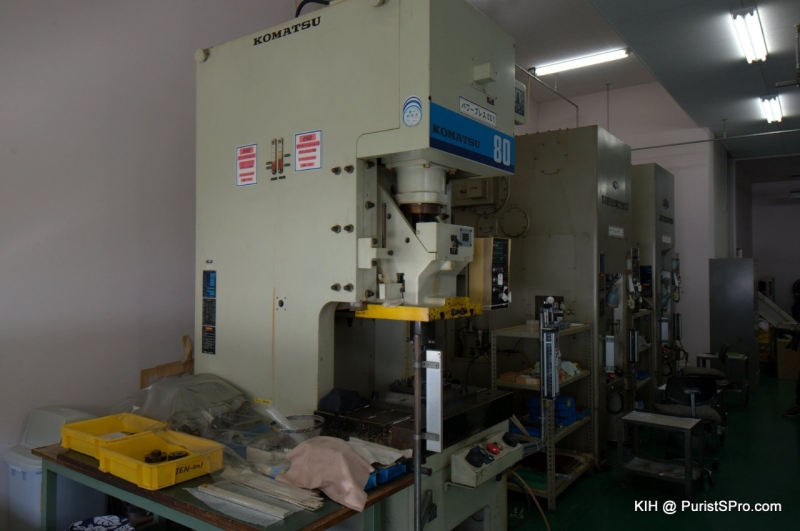
They have various press machines -


160 ton machine x 2


80 ton x 1


35 ton x 2


The actual forging.  This is the 7th time of these cases (the photos show OEM watch case making) out of total 13 to 15 times.


At the load of 72 tons!


And then they are brought to the heating machine (1,120C) for 20 - 25 minutes.  Then go back to the press machine - repeats 15 times.


These machines may all look pretty old, but for small quantity order, older machines are more efficient to adjust and handle.


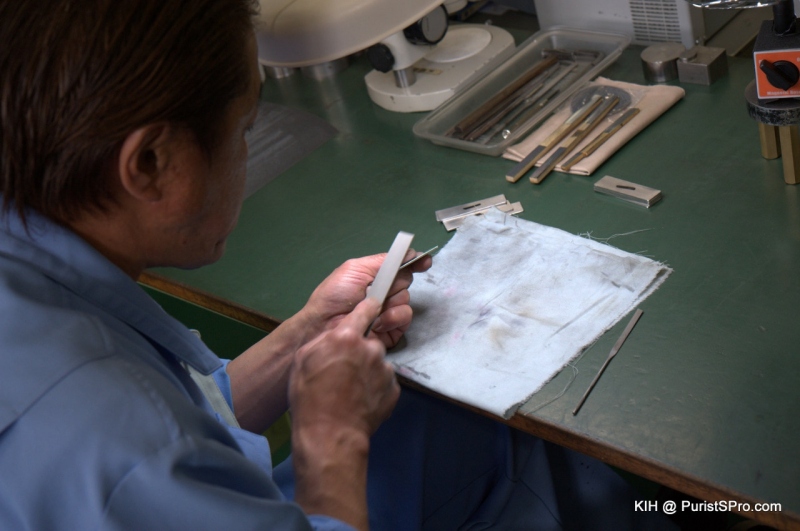
(2) Polishing

This is the model whose case and other parts are polished as shown below.  Interesting design called "Case in case" structure.


First stage - raw after forging.


Second - a bit of softening the rough edges.


Third - after honing.


Fourth - After Salaz polish on the top surface (bezel)
(* "Salaz" was the name of the polishing machine brand which has been widely used by the case makers, thus now the name "Salaz" is used as one method or process of polishing)


Fifth - After buffing the top surface


Final - all 14 surfaces (!) after Salaz polish and buffing.  Sharp edges are intact.


The final one from the side - mirror like surface with sharp edges left: extremely time consuming process.  Needless to say, the holes on the side and the crown are done with Kyowa tools.


Left half is after Salaz polish only, the right half is after final buffing.


  Polishing Machine


Salaz polishing (polishing against the hard board of file - three times for each surface, from rough to fine) - leaves the sharp angles.
Index part of the above model.


The dial inside - the process for polishing this part is even more jaw dropping.
a. Honing the surface
b. Polish the fan-shape date window with the leutor by hand
c. Salaz for the chamfering (0.7mm width), and then hair line finish for the outer dial and the side.


(3) Other notable equipment
Electrical Discharge Machine and Wire-Electrical Discharge Machine have been used since 1985.  Some Swiss brands just started using this type of machines.
They make their own metal mold here.


3. Putting the sapphire glasses on the case


Syringe is used to put on the special UV glue.


Then use Q tips to apply the glue equally


These are all the Sapphire glasses to be put on the case...


Finished.....


4. Assembling the "case in case"


Putting the hands on it....


5. Perlage


Not just another ETA2824.  Spare no time and effort.


After


Before


End of Part 1
Please read Part 2 for their models, and Part 3 for the interview with the Brand CEO, in-house movement.


This message has been edited by KIH on 2014-04-15 19:05:08 This message has been edited by AndrewD on 2014-04-16 17:32:30 This message has been edited by AndrewD on 2014-04-19 15:31:11

Key Points from the Discussion

Advertisement
The Discussion
KI
KIH
Apr 11, 2014

There are two series - Master Craft Series and HiZ Series. 1. Master Craft Series MORE (Minase Original Rebuilding Equation) Structure - many small parts are each polished and assembled: time consuming high-quality finish, also so that the repair can be done with the least parts replacement as well as re-polishing with the expectation of very long time serviceability and long life product. Screw head has "M" signature. And here is another "M" on the 12h index. 39mm diameter Beautifully made case

KI
KIH
Apr 11, 2014

Interview with the Brand CEO of MINASE, Mr. Tsuyoshi Suzuki. KIH: Would you tell us more about yourself? Tsuyoshi Suzuki ("TS"): After college, I worked for an office equipment wholesale company, sales division. At that time, Kyowa was not in such a good shape (after bubble) and I didn't even dream about joining or being told by my father to join Kyowa. But as the time goes by, Kyowa came back strong and I was told to come back in 1998. I was first assigned to the IT (beginning of the "intranet"

MA
Marcus Hanke
Apr 16, 2014

... when designing their high quality watches? A Grand Seiko movement in a Minase outfit - this would indeed be a magnificent watch! Thank you, Ken, for permitting us to discover this unknown, but fascinating facet of the Japanese watch industry. Marcus

PA
patrick_y
Apr 16, 2014

The HiZ model is by far the more unique model and the one that represents MINASE. The round model does appear to need a little more work with the design (the design is a little bland for me). It'd be interesting to see how this company evolves in the coming years. Thank you for showing this to us Ken!

DO
DonCorson
Apr 16, 2014

Thank you for bringing to our attention this brand. I really like what they are doing. They are not the only recent brand that is coming from a machine tool heritage. You know that Japanese machine tools are also very prized in the Swiss watch industry. It is sometimes funny, in Swiss production the CNC milling machines are almost all Swiss or German, but the CNC lathes are almost always Japanese. It appears that the Japanese machines are the best. A qustion: does Minase have any sales outside o

DR
Dr No
Apr 17, 2014

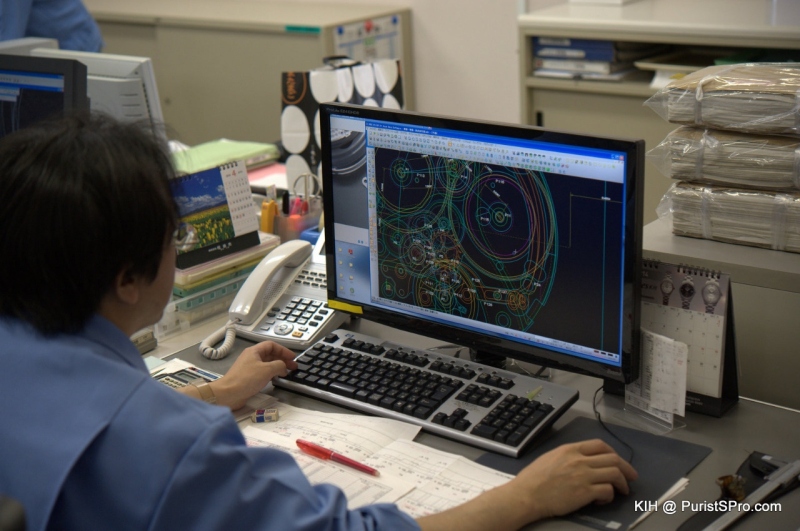
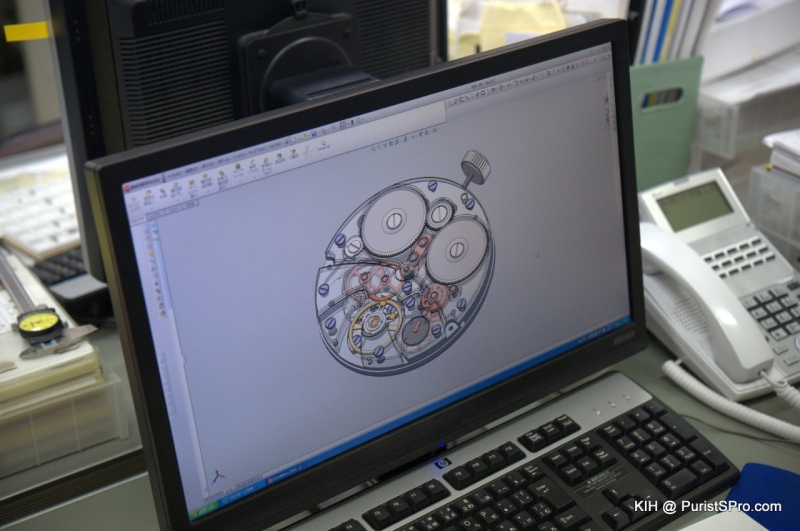
. . . comes to light, Ken; my awareness of Minase was nil until just now. Good to see they're developing a manual winding movement, judging by the CAD image; even better if a movement shaped to fit their rectangular cases is in the works. Can you give us an idea of their pricing? Say, as compared to GS: rather more, less, or around the same? Thanks very much for this groundbreaking report! Art

Advertisement

Continue the conversation

This thread is active on the Horological Meandering forum with 23 replies. Share your knowledge with fellow collectors.

Join the Discussion →