Omega Baselworld 2013: Aqua Terra 15,000 Gauss
Innovation

Omega Baselworld 2013: Aqua Terra 15,000 Gauss

By Marcus Hanke · Jun 3, 2013 · 13 replies
Marcus Hanke
WPS member · Omega forum
13 replies10766 views0 photos
f 𝕏 in 💬 ✉ 🔗

Marcus Hanke's Baselworld 2013 report for Omega highlights significant innovations, particularly the groundbreaking Seamaster Aqua Terra 15,000 Gauss. He delves into Omega's pioneering approach to anti-magnetism, moving beyond traditional soft iron cages to entirely amagnetic movements. This report offers a critical look at how Omega is addressing modern challenges for mechanical watches and introduces other notable releases.


Omega at Baselworld 2013
presented by Marcus Hanke


Thrilling news without a completely new movement? Of course, for Omega this is possible. This year, there are many novelties that will immediately find avid fans, even if they are “only” new shapes, dials and/or materials.

However, there is a real innovation, that justifies a moment of contemplation: the Seamaster AquaTerra 15,000 Gauss :


Watches that are not influenced by magnetic fields always have been a desideratum of the watch industry. However, what in the age of IWC’s first “Ingenieur” was important for technicians or pilots only, is of increasing importance for all of us, in everyday life. As a matter of fact, we are surrounded by more and more electromagnetic fields. Some years ago, these were mostly limited to loudspeakers and TV sets, but now, we keep the sources of those fields extremely close to ourselves: cell phones, notebooks, pads, just to mention a few. Even if not strong, those magnetic fields are present all the time, and our mechanical watches are subjected to them.

Consequently, the protection of movements from magnetism demands increasing attention. Even better, however, is the production of movements and escapement systems that do not need any protection, since they themselves are completely amagnetic.

Other watch manufacturers are concentrating on the protection aspect, mostly by means of soft iron cages within the watch cases. This makes the watch clumsier than it would have to be, and also hides the movement from the owner’s view, which today is a serious disadvantage in the shops. Omega took the other direction with its 15,000 Gauss: Similar to the famous 1984 IWC Ocean 2000 BUND Amagnetic, its movement is completely unimpressed by even extremely strong magnetic fields. Thirty years ago, this technology was extremely difficult to achieve, causing such high costs that even the German armed forces would afford only a few of them for very special purposes. Today, modern silicium technology permits the series production at a fraction of this cost.


The AquaTerra 15,000 Gauss has a seemingly standard 41.5mm case, even with a displayback, a feature hitherto considered impossible for a magnetically shielded watch. The only clue on its uniqueness aside the decent print on the dial is the black and yellow striped second hand. Some might consider this a bit gaudy, but I think it is more serious than a lightning-shaped second hand.

Magnetically neutral movements are a technology that will eventually become standard even with mechanical timepieces, at least for those that are seen as solid everyday watches. The 15,000 Gauss will be known as one of the amagnetic pioneers in the future. Meanwhile, I seriously consider testing one in the 1.5 Tesla magnetic resonance tomograph my wife is working with. I’ll let you know about the results ...

Another innovation in material technology is represented by the Constellation Sedna , an elegant timepiece with an 18k pink gold case. Similar to Rolex’ Everose gold alloy, Sedna has the purpose to assure that the copper component responsible for the beautiful pink colour of this gold alloy does not oxidise and change its colour. Responsible for this is a mixture, consisting to the largest part of palladium, a white precious metal that is very popular in the production of jewellery.


The Seamaster Planet Ocean 600M GoodPlanet is a result of Omega’s cooperation with the Good Planet foundation and thought to support funding a project for the rescue of the South-East Asian mangrove forests.


The attractive GMT watch has a blue lacquered dial and 24 hours bezel, is rated watertight down to 600 meters and is powered by the cal. 8605 co-axial movement. As a sign of its commitment to sustainability, it is delivered in a special box made from regrowing bamboo wood. Well, at least it would be sign if Omega decided to deliver all its watches in such boxes ...


Another Seamaster AquaTerra variant is the new DayDate, showing the weekday in a curved window at 12. In order to balance it, the date window has been relocated to 6. It is very apparent which competitor is targeted by Omega with this watch, the solution made even easier when I was shown the all-golden variant first.


The case diameter is very decent at 41.5mm, and aside red gold, it is available in stainless steel (here shown with a striking blue dial).


In several variants available is the new Seamaster AquaTerra Chronograph GMT, now also based on the new cal. 9xxx movement family. The GMT version of the movement bears the designation cal. 9605 and is unique by not having a central 24 hours hand, but a small one at 9, which is concentric with the permanent second. At 3, we find the concentric hours and minutes counter hands typical for this chronograph movement. Here I show the steel/18k pink gold variant, full gold and steel are also offered, as are various dial colours.


Since I made the switch to the chronographs, I will show the other ones: One of Omega’s most popular showpieces this year is without doubt the all-black Speedmaster Ceramic, dubbed the “Dark Side of the Moon”. Its ceramic case, without doubt to be credited to the specialists at Rado, is 44.25mm wide and highly attractive, due to its mixture of shining smooth and flat surfaces.


Not only the case, but also the dial, crown, pushers and the bezel are made from ceramics. The latter would worry me a bit: if you are familiar the Speedmaster bezel ring, you know that it protrudes high from the case, to stand out as an isolated and rather thin ring, practically begging for rough contact with the environment. The original has an aluminum bezel ring, which is soft and cheap to replace. I am aware that Rado invested many years to make its ceramics harder and more solid; with success. but still, it cannot bypass physics, and it is still brittle - more brittle at least than aluminum. this means, the “Dark Side’s” bezel ring would simply bend on impact - but break, at least under shocks it cannot withstand.


However, this does by no means compromise the piece’s attractiveness, and the long warranty period of four years might also help. By the way, all markers and hands, save that of the chronograph second, are made from 18k white gold.


The Speedmaster family gets a new member, the Speedmaster ’57 Chronograph. Designed with the style of the late fifties in mind, it is highly attractive and at the same time changes two issues of the “big” cal. 9300-based Speedmasters that some might have seen as disadvantageous: First, the Speedmaster ’57 is considerably smaller, with a diameter of 41.5mm vs. 44.25mm. Second, its stop hour and minute counter at 3 is larger, thereby massively improving the accurate reading of the measured time.


The Speedmaster ’57 is available in a large variety of case and dial options, in 18k gold, steel/gold, steel and titanium. Here I only show the stainless steel version with black dial:


And, finally, my favourite, that is currently stealing my sleep: Before Basel, I was definitely certain not to purchase a cal. 9300-based chronograph, but to go for the sleeker and more beautiful cal. 33xx instead. However, this beauty with a metallic blue dial and its bright orange chronograph hands, made me overthrow this decision in an instant. Dubbed the “Italian” by the Omega staff, it is simply gorgeous!


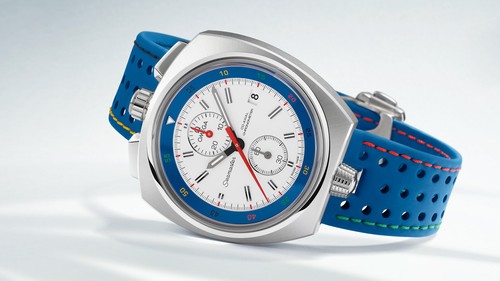
To be delivered in fall this year, the new “Bullhead” chronograph has been talked about a lot at the fair. It is not difficult to guess where this chronograph got its name from, with the edgy long case with the pushers protruding like horns at 12.


Of the various dial colours available, I was shown one in bright white, and another in pure metal with a highly attractive perlage grinding. The crown and pushers are located at 12, while a second crown at 6 is responsible for rotating the inner bezel ring. As a special feature, the crown has a bayonet-type locking mechanism, assuring its Omega logo to be always lined up correctly.


I was quoted the cal. 3113 to be the bullhead’s movement, which is completely unknown to me and I am unable to find any information about. At first, I believed it to be a misspelled cal. 3313, but I was confirmed the former designation. I assume it to be the bi-compax variant of the familiar 3313.


And now something completely different, the ladies’ timepieces. Some of the watches subsequently presented will not be available before the end of the year and were therefore not included in the press information supplied by Omega.

The first is an attractive Ladies’ Constellation with diamonds on the bezel. What makes it more special, though, are the stars spread over the metallic blue dial. Only on close inspection one realises that some of the stars are applied, while the others are depressed into the dial surface. Once again an amazing care for tiny details!


The Ladymatic is now available as bicolour version with steel and either pink or yellow gold, with or without diamonds on the mother of pearl dial and the bezel:


In my opinion more attractive is this version where the central bracelet links are covered with mother of pearl elements as well:


A special designation for selected timepieces is “luxury dial”, where Omega offers specific dials in design and material, that make out the unique charm of the watches decorated by them. Here is the Ladymatic Luxury Dial, but more appropriately dubbed “Flower” by the Omega staff. Please note that the “flower” outlines applied onto the mother of pearl and partially filled with diamonds are composed from five Greek “Omega” symbols. Altogether, no less than 399 diamonds are set on dial, case and lugs.


The DeVille Prestige Co-axial Luxury Dial, internally called “Butterfly”, for an apparent reason: The outlines of dozens of butterflies are engraved into the mother of pearl. Some of them, however, have additionally applied frames in gold and are filled with dark mother of pearl - or with diamonds; a really romantic timepiece!


Finally, a huge step for Omega towards what is called “haute joaillerie”, the jewellery counterpart to our valued “high horology”: the Ladymatic “Diamonds & Pearls”. Besides being a COSC certified automatic chronometer and having diamonds on dial and case, the really amazing part of this watch is the bracelet: It consists of 310 diamonds and 52 Akoya pearls in various sizes, all of which are individually set and connected with movable links. The result is a highly flexible piece of jewellery that comforts any contour it is attached to. Apparently, the acquisition of the jewellery expert Harry Winston by the Swatch Group in January this year already pays off.


Its most perfect presentation the “Diamonds & Pearls” had on May 15, 2013, when Nicole Kidman, actress and Omega ambassador, wore the timepiece when she arrived together with director Steven Spielberg at the movie festival in Cannes.


This message has been edited by Marcus Hanke on 2013-06-03 13:05:56


This message has been edited by AnthonyTsai on 2013-06-03 17:42:03 This message has been edited by AnthonyTsai on 2013-07-01 20:46:06

About the IWC 18.01 Ref. Ocean2000

The IWC Ocean 2000, reference 18.01, represents a significant development in high-performance tool watches, distinguished by its robust construction and functional design. It was developed in collaboration with Porsche Design, marking a period of innovative material use and engineering in watchmaking. This model is notable for its substantial water resistance while maintaining a profile that was considered relatively slender for its capabilities at the time of its introduction. It stands as a testament to the era's pursuit of extreme utility in wristwatches.

This reference features a case crafted from titanium, a material chosen for its strength-to-weight ratio and corrosion resistance, particularly advantageous for watches intended for demanding environments. The watch is powered by an automatic movement, ensuring reliable timekeeping. Its crystal is designed to withstand the pressures associated with its high water resistance rating, contributing to the overall integrity of the timepiece. The design prioritizes legibility and durability, reflecting its purpose as a precision instrument.

For collectors, the Ocean 2000 holds interest as a product of the IWC and Porsche Design collaboration, representing a specific chapter in the evolution of professional-grade watches. Its technical specifications and material choices appeal to those who value engineering and practical application in watch design. The model's historical context and its influence on subsequent designs contribute to its relevance within the broader landscape of modern watch collecting, particularly for enthusiasts of technically advanced timepieces.

Specifications

Caliber
Cal. 37521
Case
Titanium
Diameter
42mm
Dial
Black
Water Resist.
2000m
Crystal
Sapphire

Key Points from the Discussion

Advertisement
The Discussion
AM
amanico
Jun 3, 2013

The Blue Speed is not bad looking at all! Other than that, well, the 2013 collection will not be a dangerous year for my wallet... Best, Nicolas

NI
nilomis
Jun 3, 2013

Marcus, Thank you very much, for this great report. My 2cs: The 15000 Gauss is very interesting, when we consider that we are full of magnetic devices but it could be much better if they change this ugly seconds hand painting. The day-date ... where we all saw this design? Hint: Is from a company that starts wirh a R. The "italian", I agree with you is the king of the show. I have no worries with the 33xx. As soon it arrives here, I will visit the recent opened Omega boutique to see in metal. Ch

KI
KIH
Jun 3, 2013

... anti-magnetic seems interesting. Blue dial Speedmaster is also gorgeous... Very nice collection and thanks for the report! Ken

ED
Ed. W
Jun 4, 2013

calibers. The antimagnetic watch, with 1.5T resistance, has the potential of making magnetism largely a nonissue, just as incabloc/KIF/diashock has done so for daily shocks to the balance staff.

RU
Ruckdee
Jun 4, 2013

1) Is the wooden box of the PO GMT GoodPlanet actually bamboo? Local boutique staffs said they would bring me the bamboo box. I thought they were making a joke or something, and that the box was made of some other kind of wood. So when you specifically said "bamboo", I am inclined to believe they were not kidding. The bamboo bit is not mentioned in the product presentation on Omega's web site. Would I be correct to assume that it was mentioned verbally by Omega at Baselworld? 2) Similarly, the i

MA
Marcus Hanke
Jun 4, 2013

and was confirmed to me by the staff presenting the watches. From the colour of the wood, this appeared reasonable to me, but I admit having no experience with bamboo furniture other than that typical colonial-style stuff in our winter garden. Regarding the ceramic case: The Rado connection was my assumption. Looking at the high level of details on the Speedmaster casework, the changes of smooth and flat surfaces, I assumed that the supplier of this case must be the same as for the zirconium oxi

Advertisement

Continue the conversation

This thread is active on the Omega forum with 13 replies. Share your knowledge with fellow collectors.

Join the Discussion →