Vintage
Andrew (aroma) challenges his own collecting philosophy by venturing into the realm of 1970s Omega 'electric watches,' specifically the tuning fork variety. His post provides a detailed historical and technical overview of these transitional movements, highlighting their unique characteristics and significance in Omega's history before the quartz era. This exploration offers a fresh perspective on a period often overlooked by vintage collectors.


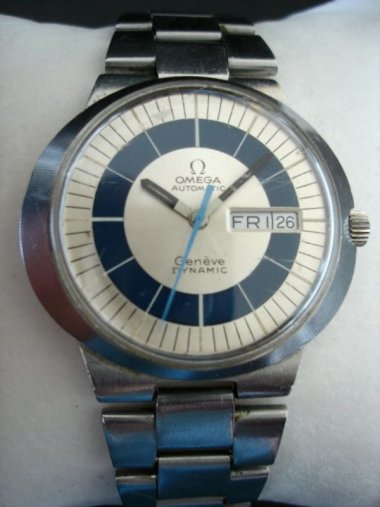
OK, I realize that I might be committing sacrilege but here goes. I have a number of vintage Omegas dating from 1935 to 1969 and have always restricted my collection to pre 70s as, in my humble opinion, that was the hey day of Omega. Everything downstream of the 70s was a shadow of Omega’s former self (arguably until recently). However, lately have become enchanted by the short period of ‘electric watches’ – not quartz but the tuning fork variety. Electric watches were introduced way back in 1957 by Hamilton but the tuning fork variety was a Bulova invention and introduced in 1960.
Like many other manufacturers, Omega used the ESA licensed, Bulova tuning fork mechanism – mainly the 9162 (date) and 9164 (day/date) and these are known as the F300 models because 300Hz was the frequency of the tuning fork. These mechanisms (calibres 1250 and 1260) were very well made (Omega copper plated all their movements instead of the ESA standard nickel plating) and were regarded by many as the Rolls-Royce of tuning fork mechanisms. They were designed by Max Hetzel who previously worked for Bulova. A characteristic of tuning fork watches is that they don’t tick, they hummmmm and the second hand moves continuously.
These mechanisms were fitted to Constellation, Seamaster and Geneve models for only a short period between 1970 and 1976 – after that, quartz took over. As the movements fitted in these models are the same, they all operate to chronometer standards even though some are not all marked as such.
Omega did develop a superior version of the tuning fork watch using an asymmetrical tuning fork vibrating at 720 Hz and using magnetic gears to drive the movement (the Megasonic) but I’m not up to understanding that yet!!
This is my latest acquisition - a 1972 Seamaster (198.001) which is COSC rated. It is in fabulous un-molested, original condition with all the brushed surfaces intact and recently serviced.


Has anyone else out there got something similar?
But I was a big collector of Accutron 214s and 218s for years. Still have a couple 214s and one 218. These movements were reliable and extremely accurate.
Hi aroma, The shape of the case strongly reminds me of the cal. 751 SM chronometers of Ref. 168.023 nice design! regards erich
i love tuning forks and owned up to 40 at one time which included several Omegas including the Speedsonic speedmaster chronograph. they are great watches which are extremely accurate, more accurate in fact than the original Bulova's which are called 'accutron' because the were 'accurate and electronic'. if its good enough for the apollo moon landing and the cockpit of concorde then its good enough for me. the down side is that there are fewer and fewer people who can service them and it costs a
This thread is active on the Omega forum with 3 replies. Share your knowledge with fellow collectors.
Join the Discussion →