
Vintage
DrStrong celebrates the acquisition of his Omega Railmaster reference 2914, a long-sought-after grail piece. His post not only showcases his specific 'tropical' dial example but also provides a historical overview of the Railmaster's place within Omega's iconic 1957 trilogy. This article highlights the technical innovations that made the Railmaster a pioneer in anti-magnetic watchmaking.


As you may know, I am a big fan of Omega sports watches. I have an early Speedmaster and a Seamaster for quite some time now, but the Railmaster was on my wishlist for years…Maybe I was just waiting for the good one to show up !
Born in 1957, the Railmaster reference 2914 is part of the famous trilogy of "technical" watches: The Speedmaster was designed for the sporty man, eager to measure short time. The Seamaster addressed unquestionably amateur or professional scuba diving, thanks to a new crown to increased tightness. Finally the Railmaster, was more specifically invoking an impressive resistance to magnetic fields. In summary, the trilogy of "technical" Omega was not addressed to Mr. everybody, but in a market segment played by the dynamic Man, that was efficient to identify and strongly assert "niche" worn by model. Marketing strategies of our time have therefore invented anything in this regard.

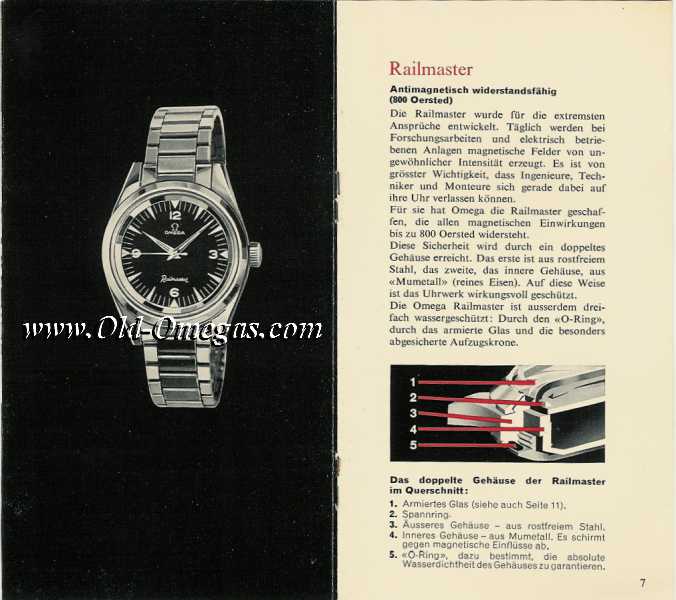
The Railmaster was designed to withstand magnetic fields of about 1000 gauss. Technically, this performance was made ??possible by several features. These include double box. The first and second steel (within the first) soft iron called Mumetal insensitive to the effects of magnetism. It does not say advertising is that the dial itself has a thickness of about 1 mm against 0.4 mm for a "normal" dial.
Now at last, here’s my watch. As I am a fool for “tropical” dials, I needed to find an example with a special dial color… Even if it’s quite uneven, I like it a lot: It has a lot of “wabi” and a character of its own.

My watch is a reference 2914-2, it has the “broad arrow” hands that were fitted from 2914-1 to 2914-3 (2914-3 to 4 had dauphine hands).

The Railmaster has a great case: 39mm is quite large for a 1950’s watch, especially with such a large dial “opening”. Because of the anti-magnetic structure, the watch is also quite thick and feels bullet proof on the wrist. I love the case of my watch, which has kept its sharp bevels.


The watch still has its original naiad crown, a very sexy detail to me. The theoretical water resistance of the Railmaster is 60 meters.

The first Railmaster - until 2914-2 - did not have any Seahorse on the backcase, as you can see on this picture. The inside caseback has the usual Omega engravings.


The movement in my watch is the cal. 284 - created in 1955 - with central sweep-second hand and 17 jewels. Other Railmaster references are fitted with either cal. 285 created in 1958, or cal. 286 created in 1961

In conclusion, the Railmaster is now one of the favourite watches in my collection. I like the character of my example and also the philosophy of the model, especially designed for scientists, technicians, electricians, etc…working within close distance of powerful electric currents. In 1954, Rolex introduced its Milgauss model. In 1955, IWC countered with the Ingenieur . And in 1957, Omega joined the anti-magnetic party with the Railmaster. What was the attraction of these fiercly anti-magnetic watches? Was it inspired by the Cold War and Space Race, when science was pushing limits and making news? We don’t know for sure, but we love the watches.

The Omega Railmaster reference 2914 is a notable antimagnetic timepiece from the brand's mid-20th century professional collection. Positioned alongside the Seamaster and Speedmaster, the Railmaster was engineered for professionals working in environments with strong magnetic fields, such as scientists, engineers, and technicians. Its design prioritizes legibility and robust performance, reflecting a utilitarian approach to watchmaking that characterized many tool watches of its era. This reference is recognized for its clean aesthetic and technical specifications tailored for specific occupational demands.
This particular reference features a stainless steel case, designed to house a movement protected by an inner soft iron cage, a common method for achieving antimagnetic properties. The movement is a manual-winding caliber, known for its reliability and precision. The crystal protecting the dial is typically made of Hesalite, a durable acrylic material. The case dimensions are characteristic of professional watches from this period, offering a balanced presence on the wrist while ensuring comfort and practicality.
For collectors, the reference 2914 holds significance as an early example of Omega's commitment to specialized tool watches. It appeals to those interested in the historical development of antimagnetic technology in wristwatches and the evolution of professional timekeeping instruments. Variants of this reference may exist with subtle differences in dial markings or caseback engravings, which are points of interest for detailed study and authentication within the collecting community.
Desirable vintage Omegas, along with the 33.3 and the Seamaster... Now you have the holy Trinity! Here is the PAF, to welcome yours. BRAVO! Nicolas
What a fantastic dial! I love these tropical beauties! Matt
A wonderufl reference with a lot of "strength" and you got yourself a stunning dial ! Superbe , enjoy François
....and i understand totally the need to have this one. Congrats Jeff
with its original radium. The naiad star on the crown is the cherry on the cake.
Looks to be in terrific condition. I really like the movement too. What a special piece!
This thread is active on the Omega forum with 41 replies. Share your knowledge with fellow collectors.
Join the Discussion →


