Vintage
DrStrong explores the intriguing history of the Omega Ranchero, a watch line from 1958 that, despite its short production run, has become a coveted collector's item. The post details its design inspirations, the cultural misunderstanding that led to its discontinuation, and its unexpected rise in value.


In 1958, Omega created a watch line called Ranchero. It was inspired by the Railmaster, the Seamaster 300 and the arrowhead hand of the 1957 Speedmaster, so there was no mistaking its lineage. Ranchero: sound of freedom, adventure and virility.. Omega’s cowboy should have become the entry-level model in the late 1950’s. But the watch encountered resistance in Spanish-speaking countries, from potential customers who were put off by its name that means “ranch hand” in Spanish. As a result, the Rancheros, were discontinued and are quite rare today; the watch was only made for two years (1957 & 1958), and sold for two (1958 & 1959). Ironically, this scarcity has led to high prices in the vintage watch market and the once modest Ranchero has become quite the collector’s item, as collectors began to realize that the combination of these rare hands and the short production span were all the makings of a classic. The name had a short revival in 1976 but only in Belgium. The revival was short lived and the Ranchero is destaned to be one of the most famous of the lost line !
Funnily enough, Ranchero was also the name of a Ford pick up from the same era !
Now lets’ study this peculiar watch in more details...
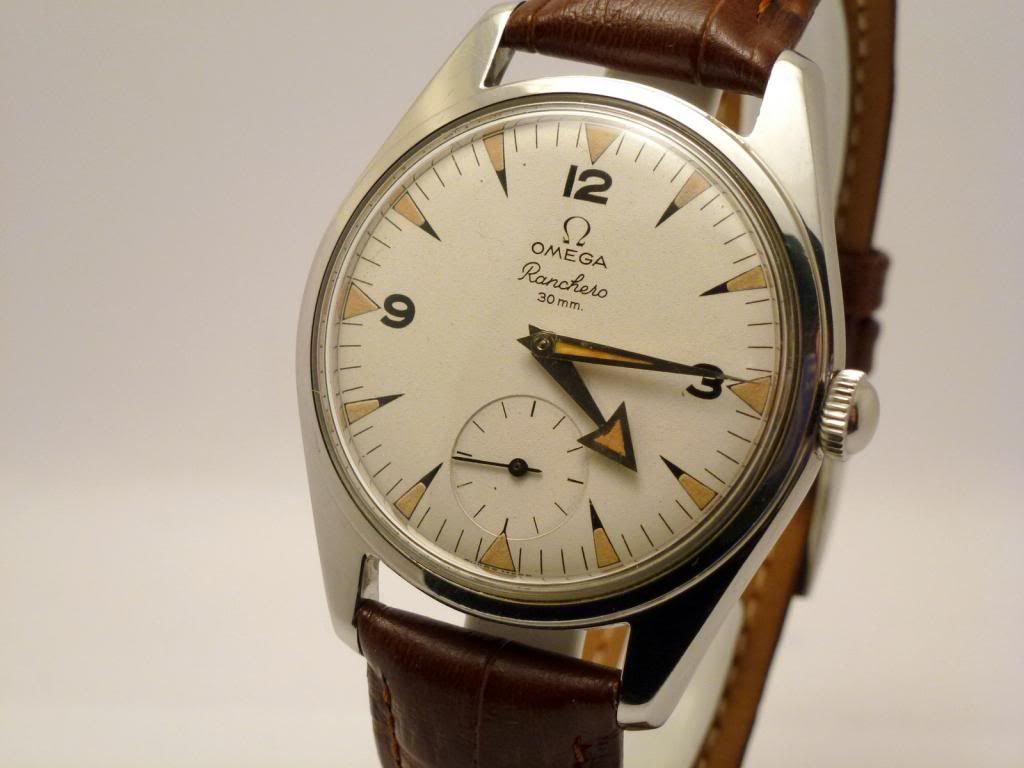
Here’s my ex example of the ck2990 Ranchero. You see that the 36mm case is quite flat and the large dial makes the watch look reasonable large. The dial definitely looks similar to the Seamaster, Railmaster and Speedmaster from the 1950’s, while the case is more like a “normal” Omega from the 1950’s.

The crown has an unusual shape and is different from the other sports models. Again, it looks more like a crown of a regular Seamaster, or a dress watch.

The caseback is a snap-on type and has a specific “waterproof” engraving. Again, this is completely different from the sports models and you understand what makes the watch the entry level model as it is probably much less waterproof than the Railmaster, Speedmaster and of course Seamaster.

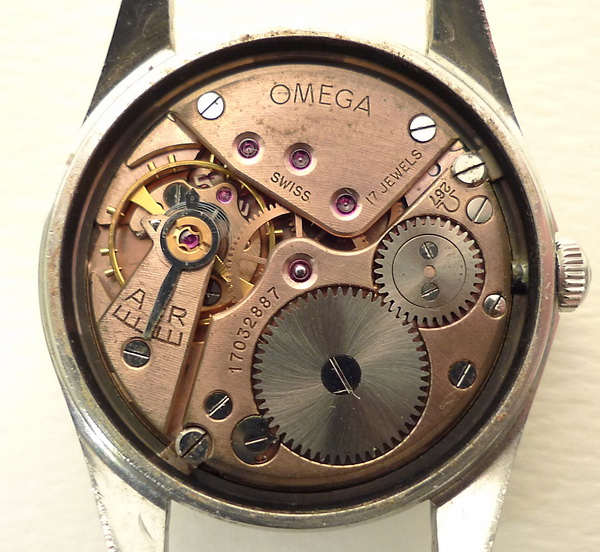
The movement is the Omega manual wound cal. 267 with 17 jewels that was created in 1956 and whose diameter is 30mm (hence the printing on the Ranchero dial)
No doubt, with suc a dial, the watch looks really great in the sun !

As you can see on the next picture, the Extract from the Records sent by the Omega Museum states that my watch was sold in Italy in 1959.

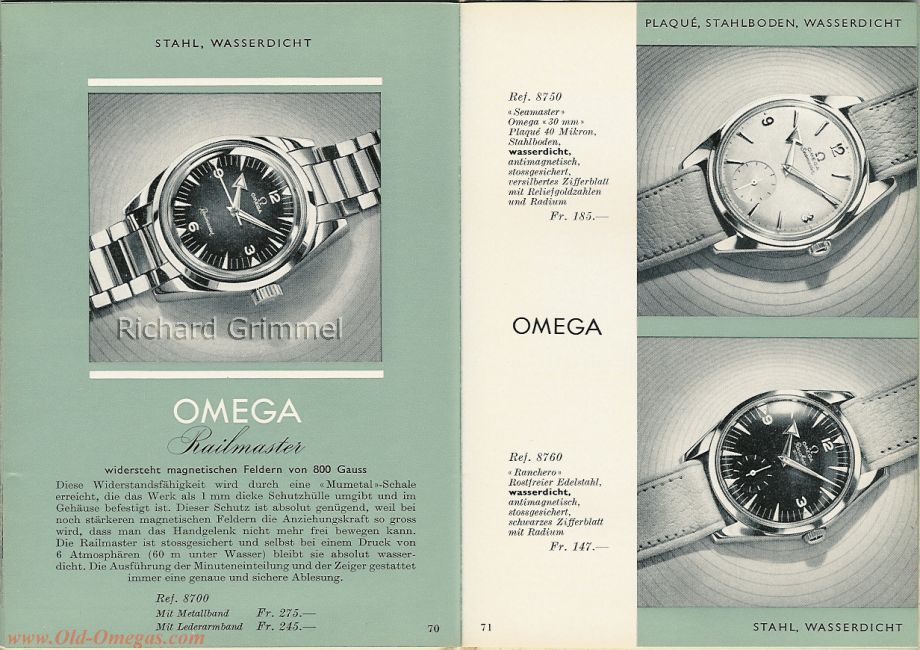
Here’s an extract from the first 1959 catalog. You can see that the Ranchero was the least expensive watch listed and came in both regular (sub second) and sweep second versions.
Beside the stainless steel model, there are some quite surprising variations of the Ranchero.
Here’s a white dial 2990-1 that was bought by a fellow Purist some years ago
here are a couple of gold capped models with different dials

(credit: Omegaforum)
So there's definitely a Ranchero variation for every Omega collector !
The Seamaster 300 reference is a re-edition that draws inspiration from Omega's historical dive watches. It is characterized by its robust construction and design elements that pay homage to early professional timepieces, while incorporating modern watchmaking advancements. This reference is positioned as a contemporary interpretation for enthusiasts who appreciate vintage aesthetics combined with current performance standards.
This particular Seamaster 300 features a stainless steel case, typically measuring 41 mm in diameter. It is equipped with an automatic movement, often a Master Co-Axial caliber, providing a substantial power reserve. The watch is fitted with a domed sapphire crystal, contributing to its vintage appearance while offering enhanced scratch resistance. Its construction ensures a high degree of water resistance suitable for aquatic activities.
For collectors, this reference appeals to those seeking a blend of historical design and modern technical specifications. It represents Omega's commitment to its heritage while offering a reliable and well-engineered timepiece. The Seamaster 300 is a significant part of the brand's contemporary collection, offering a distinct alternative to other models within the Seamaster family.
Superb Watch, and nice post, Jeff. Here is a white dialed one I could see some months ago. I didn't take it, I regret it.... Very cool Watch! Best, Nicolas
... often thought of as a "poor brother" of the Railmaster. I would love to find one, very rare here in my Country. It´s a pity many have had their dials replaced as this destroyed their collectors value as well as its charm I feel. Estanciero is the name given in Mexico to the owner of the Rancho (ranch). Here in my Country -Argentina- we call Estanciero to the owner of the big Estancias (ranches) of the past. The Ford Ranchero was a very popular vehicle here, though it had a different body and
... Look after me so I don t do any nonsense and concentrate un that Pp! Thank you my friend! I know I have to focus my mind and reprime any temptation! Un abrazo! Abel.
4,314 Omega listings are live on the eBay market and 362 collector listings on the WatchProSite marketplace.
This thread is active on the Omega forum with 23 replies. Share your knowledge with fellow collectors.
Join the Discussion →