
New Release
nitediver provides an exclusive first look at the Omega Seamaster Planet Ocean "Deep Black" collection, captured during its global tour stop in Zurich. This post offers a detailed overview of the four distinct ceramic GMT versions, highlighting their technical specifications and aesthetic variations. nitediver's insights are crucial for understanding Omega's innovative use of ceramic and rubber in this significant release.



The new Planet Ocean Deep Black collection is currently touring the world. The Zurich event was taking place at Quai 61, a restaurant at the shores of Lake Zurich. Not quite the Ocean, but as close as it gets in Switzerland.

We were presented the new ceramic cased Seamaster Planet Ocean GMT versions.
The full name of this new product line is “Planet Ocean 600 M Omega Co-axial Master CHRONOMETER GMT 45.5 mm DEEP BLACK”. Obviously, there is no way anybody will be able to call the watches in its full name, so let’s just call them “Deep Black” or Planet Ocean Deep Black. They feature a 45.5 mm case in ceramic, a helium escape valve, the GMT function and a unidirectional rotating bezel.
The four versions come in different colour schemes:

Ceramic case with black ceramic bezel. Brushed finish on ceramic case and bezel.

Black ceramic case, black ceramic bezel with red rubber inserts. Brushed finish on ceramic case and bezel.

Black ceramic case, black ceramic bezel with blue rubber inserts. Brushed finish on ceramic case and bezel.

Black and 18K Sedna gold Version: This is the only one which comes with a polished black ceramic case. Polished Ceragold bezel and Sedna gold crowns.

This tray displays the various steps of manufacturing the cases. The top row shows the process steps for ceramic cases, and the lower row shows the steps for Titanium cases. I will post a separate report on case making, I must say I found this most interesting and enlightening to learn how much work actually goes into a modern watch case.

Case and bezel of the Sedna Gold version. Looking impressive!

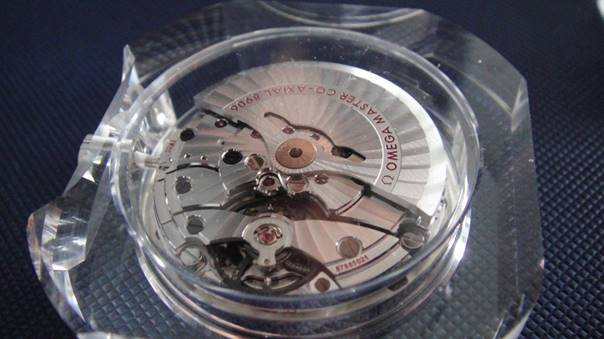
Coaxial Calibre 8906

I guess you have read before about the 15’000 Gauss antimagnetic movement and the METAS testing . If not, please check the excellent reports by Ornatus Mundi:

Silicium balance wheel with white gold screws and Silicium balance spring.

Dial of the blue version. I particularly like that the 24 hour indication is integrated nicely in the rehaut, and is not disturbing the clean dial.

Glossy dial of the Sedna gold version.

Testing the accuracy of the cased watch – and the level of accuracy achieved is impressive. Not shown here, but maybe even more impressive is the demonstration of the influence of a magnet field on the watch. A magnet was brought in close contact with an automatic movement watch of another company. At the outset, the watch was running at 19.6 sec , after exposure to the magnet field, it was off by + 3 min 27 sec!
Not so for the antimagnetic movement of the Planet Ocean, there was no influence on the accuracy of the watch.
A few more shots of the Planet Ocean Deep Black

Note the extra cool rubber strap with a textile look and matching stitching.


I must say the Sedna gold version has a very strong presence– very hard to take off the wrist. The combination of the black ceramic case and the gold details is stunning.

The new Deep Black versions are reaching the retailers by October 2016.
Best
Stefan
The Sedna. I know that I will be singing on an invisible choir but I'm afraid about those rubber inserts. Thank you for another great post. Cheers, Nilo
Omega did certainly not choose a simple process to get the rubber inserts done, but a rather sophisticated one. seems very well done. But time will tell. Best Stefan
This thread is active on the Omega forum with 3 replies. Share your knowledge with fellow collectors.
Join the Discussion →


