Vintage
DCC challenges modern watch sizing trends by exploring Patek Philippe's history of 'large' and 'oversized' vintage wristwatches. This insightful article contrasts contemporary preferences with historical norms, highlighting how Patek Philippe's approach to case dimensions has evolved while maintaining iconic status for many of its larger vintage references.


Introduction
Let me put the things straight. Modern oversized watches are not my cup of tea. Anything above a 40 mm diameter hardly gets my attention.
I still remember that, 15 years, ago the 37 mm 5107 reference was called the ‘Calatrava Grande Taille‘ i.e. the ‘Large Size Calatrava’. The 42 mm diameter of the 5070 chronograph was such a bold move by Patek Philippe that it shocked some aficionados. Its older brothers at the time, the 3970 and 5004 references had just a 36 mm diameter!
I somehow regret the move to larger cases. Give me a 33 mm 3939 or a 38 mm 5078 over a 42 mm 5074 minute repeater at anytime. As most of the current movements were developed at the time where the cases were smaller, larger watches mean some twists with the case and the dial lay out. Patek Philippe might be very smart at that game but there will always be a flaw somewhere. Just compare the ‘old’ 5050 and the ‘new’ 5496 perpetual calendar references with the retrograde date indication. On the 5496’s dial, you will notice the leap year aperture cutting the 15 and 17 on the retrograde date indication while the dial of the 5050 is pure harmony (the same finding applies to the 5013 and 5016 references versus their respective new iterations i.e. the 5213 and 5216 references). Don’t ask me what I think about the Grand Master Chime. It is a pocket watch in disguise.
In the past, small meant beautiful. A small and complicated caliber was considered as craftsmanship at its best. The one off 3615 reference which was the first true grand complication wristwatch ever produced by Patek Philippe (i.e. Perpetual Calendar, Chronograph and Minute Repeater) had just a 33,9 mm diameter while the current production, the 5208 reference, shows a bulky 42 mm. Pure elegance and understatement versus somehow show off pieces.

There was a time where the norm was between 30 and 33 mm. However Patek Philippe produced many larger references. Though considered as large at the time they were produced, these watches are still relatively small as per today’s standards. Some of these references are regarded as iconic watches and are highly sought after by vintage watch lovers. But Patek Philippe also produced a very small quantity of oversized watches.
I have arbitrarily put the ‘large’ vintage watches into three categories:
1. Large vintage watches
I have considered the time only watches, the chronographs and other complicated watches.
The below list is not exhaustive and is just a summary of some of the best-known references in that category.
Time only watches
The 570 reference in steel (36 mm)

The 2510 reference (37.3 mm)
With a diameter of 37 mm, thee 2481 and 2482 references are worth being mentioned. Because of their large size, they were used for the beautiful enamel cloisonné dials (I will come back on these references in a future article)

Less known than its smaller sister (the 3417), the 3460 Amagnetic reference has an impressive diameter of 37.5 mm.

Other references worth mentioning are: 2511 (36.5 mm), 2458 (36 mm), 2459 (37 mm) and 3485 (36 mm).
A 2511 reference:

There is a special 2458 reference in platinum fitted with an observatory movement that belonged to JB Champion and that achieved a record price of USD 3,992,858 at Christie’s on 12 November 2012. This is to date, the most expensive time only watch.

Chronographs
The 530 reference (36.4 mm)

The 1506 reference (36 mm)

The 1554 reference (36 mm)

The 1579 reference (36 mm)

The unique perpetual calendar chronograph 1527 reference (37.6mm)

The sublime perpetual calendar chronograph reference 2499 (37.7 mm)
The perpetual calendar chronograph 2499 reference is true a work of art. I could not resist posting the one that belonged to Eric Clapton, one of the two only examples in platinum. The other can be seen at the Patek Philippe Museum

Other Complicated watches
Most of the vintage perpetual calendars (manually wound and automatic) were actually quite gigantic with diameters in the range of 37 mm. We are talking about the following reference in sequential orders: 2497 (36.7 mm), 2438 (37.2 mm), 3449 (37.5 mm), 3448 (37.5 mm) and 3450 (37.7 mm). All shown below in the sequential orders (credit Huber & Banbery) The current production is no match against these beauties.


2. Larger but not oversized vintage watches
If you re looking for more than 38 mm in vintage watches, then the list is shrinking. With the exception of the Chronograph 2499, most of the below references are one off watches or were produced in extremely small quantities (non exhaustive list):
Officer watch (38,3 mm)

The 2571 split second perpetual calendar chronograph (39.9 mm)

The unique round tourbillon 3699 reference (38.6 mm)

The observatory watches 2556 (38.2 mm). Apparently the reference 2556, which is exhibited at the Patek Philippe Museum, is larger than the other famous observatory watch that belonged to JB Champion, as the latter is a 2458 reference with a diameter of 36 mm.

The dual time 3452 and 3452/1 references developed by Louis Cottier (39 mm)

For shaped watches, if a minimum length of 45 mm is considered as the threshold for large watches, the list is even smaller (non exhaustive):
The Patek Philippe Museum mentions two Chronometro Gondolo & Labouriau watches and one similar ‘Curvex’ watch, all with a length above 50 mm (Gondolo & Labouriau 51.1 by 30 mm, Gondolo & Labouriau 52.3 by 30 mm and ‘Curvex’ 50.9 by 30 mm).

There is of course the beautiful 2834 reference fitted with a shaped tourbillon. The rectangular case measures 47.7 by 29.4 mm. As mentioned in my article on shaped calibers, there are two known examples of this reference.

Finally, there is also the unique ‘Graves’ oversized platinum watch, which measures 47 by 39 mm. Sotheby’s sold it on 14 June 2012 for USD 362,500. According to Sotheby’s, Henry Graves bought it directly from Tiffany & Co in late 1947 for a price of USD 1,500. The reason for the high cost of this particular watch was the specially made and extremely heavy platinum case. The movement of this watch was completed and sold to HSWA in 1942. The 12 lignes movement was chosen for its observatory-quality finish and accuracy. Stamped twice with the seal of Geneva, the movement represented the highest quality of Patek Philippe's wristwatch calibers.

But let’s face it, all the abovementioned watches are still relatively small as none of them are reaching a diameter of at least 40 mm which is actually the diameter of the larger watch I own i.e. my beloved 5970 chronograph.
3. Oversized vintage watches
If you want to think big and consider XXL in Philippe Patek terms, you will need to look for watches with a diameter greater than 45 mm. The ‘Supersize Me’ vintage Patek Philippe watches do exist. There are just a handful of pieces known to this date. To the best of my knowledge, there are five oversized wristwatches.
Two Aviator watches
Aviator watches were worn over the sleeve of the pilot’s jacket. They also needed to be highly readable hence their size. Patek Philippe only produced two hour angle wristwatches.
Movement number 170 383
The first aviator watch is an hour angle wristwatch with black dial and fitted with simple centre seconds hand only, is extensively described and illustrated in the Huber & Banbery book (pp. 252 & 253). Sold at public auction in 1991, it is now on permanent exhibit at Patek Philippe Museum.

Movement number 170 381
The second aviator watch is even more intriguing. It is an hour angle wristwatch with black dial and splittable centre seconds (actually a split angular minute hand). It was sold at Christie’s on 11 May 2009 where it reached a price tag of USD 1,710,690.

The note of the May 2009 Christie’s auction provides very valuable details on these watches. It indicates that in spring of 1936 both Patek Philippe and Vacheron Constantin were approached by a private to develop, produce and supply a very small series of hour angle wristwatches for testing.
With a diameter of 56 mm, these are the largest wristwatches ever produced by Patek Philippe.
Two chronographs
The ‘Trossi’ mono pusher chronograph

This yellow gold oversized monopusher chronograph was produced in 1932 on special order for Carlo Felice Trossi, the president of the Scuderia Ferrari. In the below picture, we see Carlo Felice Trossi wearing this 46 mm single button chronograph on his sleeve, where he presumably wore it for the benefit of easier access as he was timing laps. Sotheby’s sold the watch in May 2008 for $2.24 million.

The oversized split second chronograph 2512 reference
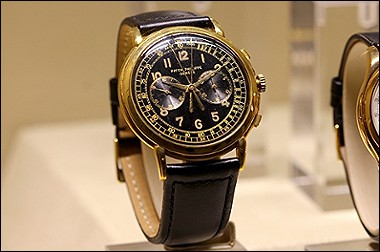
This yellow gold with a black dial split second chronograph is very well known as it was the direct inspiration for the revered 5070 chronograph. It is exhibited at the Patek Philippe Museum. With a diameter of 46.2 mm, it is bold and impressive. Somehow the pushers are relatively too small compared to the size of the case.

One time only watch
With the same reference number as the oversized split second chronograph, the 2512/1 reference is the sole oversized time only watch. It achieved a price tag of USD 962,500 at Sotheby’s on 4 December 2012.
Like the chronograph bearing the same reference number, it shows a substantial 46.2 mm diameter. Likewise, the dial is black and the yellow gold case shows a similar design.

Conclusion
Interestingly, Patek Philippe produced many references that could be considered as large at the time they were manufactured. Not surprisingly, these watches are catching the collectors’ interest.
In absolute terms, the oversized watches were UFO’s in the whole Patek Philippe production. This explains their attractiveness and the prices they achieved at auction.
But I rest my case. I prefer smaller watches. Luckily, the current production still offers some nice and elegant references meeting my expectations. The fact that the new world timer is even smaller than its predecessor is a very smart move and I hope that Patek Philippe will pursue that trend.
The Patek Philippe reference 570 is a classic Calatrava-style dress watch, representing a significant period in the brand's production of time-only pieces. It is distinguished by its clean lines and minimalist aesthetic, embodying the traditional design principles that Patek Philippe is known for in its non-complicated watches. The reference 570 was offered in various metals and dial configurations, making each example unique within the broader series of Patek Philippe's round cased watches from the mid-20th century.
This particular example features an 18k white gold case with a diameter of 38mm. It is fitted with a sapphire crystal, protecting a silver dial. The watch is powered by a manual wind movement, reflecting the common practice for high-end dress watches of its era. The water resistance is rated at 30 meters, typical for a watch of this type and period.
The reference 570 appeals to collectors seeking a pure expression of Patek Philippe's watchmaking heritage, particularly those interested in the brand's foundational dress watch designs. Its various iterations, including different case materials and dial finishes, offer a range of options for discerning collectors. The enduring appeal of the 570 lies in its understated elegance and its representation of a specific era of Patek Philippe's design philosophy.
My size is 37-40 (+) mm. I find 5960 perfect while 5905 is a bit too big already. Then 5070 is another story but that's 5070. Probably for my 8 inches wrist 39 mm is about ideal but a lot depends on the lugs. Best, Kari
One other thing I have noticed is that PP made a lot more to the specific orders of the customers in the past. I am not aware that such trend still continues, at least not to the same extent as what it was in the past.
I now have a rule on watch size.... I won't buy a watch over 40mm. I have some in my collection marginally above 40mm, but of new additions, 40mm is the maximum. In an ideal world, I would aim at 37-38mm for a watch as I feel that size is most comfortable for my wrist, but it really does depend on the lugs and the depth of the case. I would readily consider a watch at 35-36mm too, but when it gets to that size, I need the watch to be very plain time-only as that tends to enhance the appearance o
Thanks for this great post Dcc, very interesting to have this overall view on the subject concerning vintage pieces. I had a long read among the chronographs from 40's to the 80's and looking at the sizes was interesting, not always going the same direction by the way. To me, it is a quite subjective impression as it will depend on the wearer's wrist size of course but also on what he was used to seing on his wrist. Furthermore, I feel the size is one element among others and that, though I like
thanks for putting together this well researched post. Great sunday afternoon read. I think watch sizes are slowly creeping their way back down but perhaps the best approach is the one Ralph Lauren is taking by offering choices, he produces each model in two sizes for example the sporting case models in 39mm and 45mm with everything else being exactly the same. edward chang
The 570, the 3460, the 2512, and the pilot watch, if I won the lottery. Did the 3460 exist in white metal? Best, and thank you for another nice article. Nicolas
This thread is active on the Patek Philippe forum with 14 replies. Share your knowledge with fellow collectors.
Join the Discussion →


