Foversta offers a captivating look at the Piaget Emperador Coussin Grande Lune "Planisphère," a unique timepiece that masterfully blends horological complication with artistic enamel work. His detailed analysis highlights why this specific model, featuring an enamel dial by Anita Porchet, stands out as a significant achievement for Piaget, demonstrating how the brand thoughtfully integrates high artistry into its designs.
I don't know how this Emperador Coussin Grande Lune "Planisphère" managed to land in Paris but it was great news for me! This Piece Unique (for the time being) is truly gorgeous because it combines to great effect the main complication of the watch with a superlative artistic achievement.
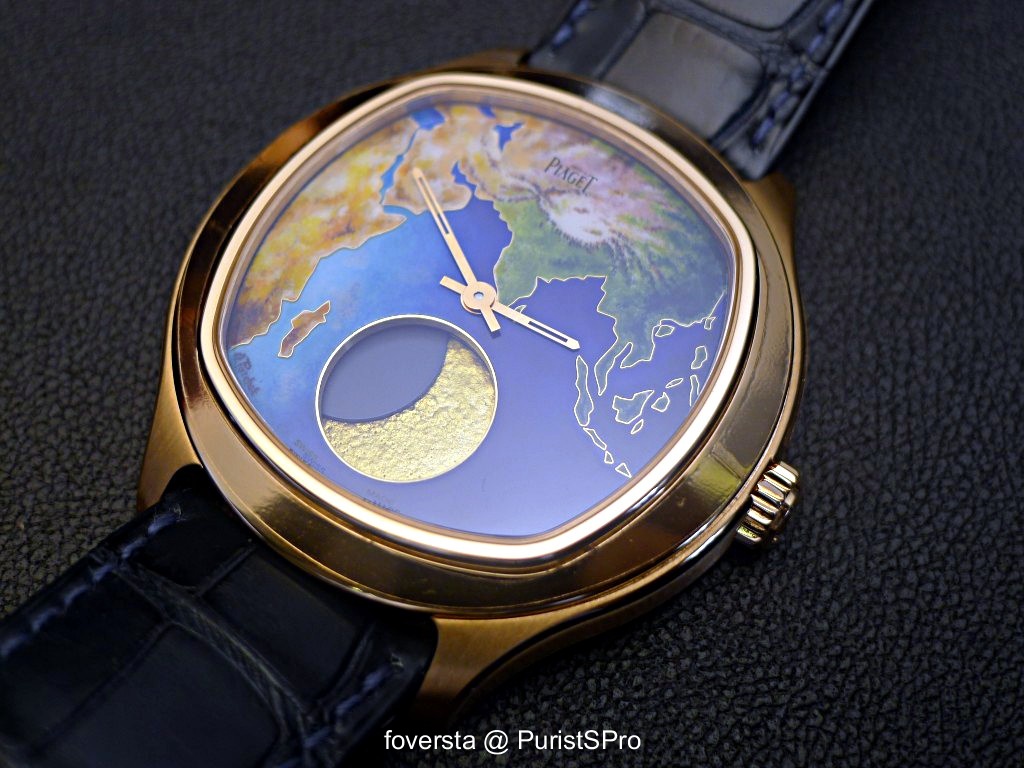
I will not tell you that this watch is my fav version of the Emperador Coussin Grande Lune, I believe that nothing will be able to replace the WG one in my heart. But the "Planisphère" with its large enamel dial has something which makes it very charming.
Sometimes, brands use enamel dials in inappropriate contexts, just to say: "well guys, here it comes, this is our enamel dial watch!". But we don't have to be afraid of this kind of attitude with Piaget. Piaget is one of the few brands which manage to propose the suitable scene for such artistic show. And the Emperador Coussin Grande Lune is without any doubt a perfect watch for this kind of evolution.

I can see two main reasons:
* the first one is because the watch is simple. Don't get me wrong: the main complication is not that simple but there is only one in addition to the hours and minutes display. Your eyes won't be disturbed by something moving fast on the dial: it is totally peaceful! No second hand, no retrograde hand, no, only the very quiet movement of the two hands and of the mask over the Moon.
* the second one is because the watch is large: the Emperador Coussin Grande Lune has a 46,5mm case giving a generous room to the artist to express her talent.

I say "her talent" because as you may guess it by viewing the pictures, this enamel dial with cloisons (or cells if you prefer) was created by Anita Porchet.
Madagascar, Indonesia... give to Anita Porchet the opportunity to create small cloisons on the dial. The main continent is also surrounded by the thin gold line which creates a wonderful contrast with the Ocean. I love the use of colours and the change of atmosphere between the eastern part of Africa and SE Asia: there is a sort of constant evolution betwen the warm colours left side of the dial and the more fertile ones on the right. Colours also change on the Ocean, the deeper... the darker...

In fact, this watch is a great achievement because the enamel dial enhances the beauty of the moonphase display. Or maybe it is the opposite? As you know, each Moon surface is unique due to the method to produce it (a heated gold plate which symbolizes the craters). I would have use a different colour for the mobile mask though. Anita Porchet signed the dial (below Madagascar) and I found her signature a bit too large. I would have prefered the enamel dial without it.

Piaget didn't use for this watch the same pair of hands and these ones, simpler and smaller, were hollowed to preserve the view on the dial.
If we turn over the watch, we obviously find again the 860P movement and its sober and flawless finishings "à la Piaget". There is nothing desmontratif here, the show is located dial side. Anyway, I still love the balance bridge of this movement: the 860P is a very circular movement... like the Moon!

This watch makes me think about the Master Grand Tourbillon by JLC: an unique complication, the depiction of a continent, a similar range of colours... Miklos Merczel or Anita Porchet, it is always a fruitful approach when such artists use the dial of a watch to express their talents.

Thanks a lot to the staff of the Piaget Boutique in Paris.
Fr.Xavier
This message has been edited by AnthonyTsai on 2011-09-27 14:29:30 


