Review
WHL's exploration of the Piaget Emperador Coussin Perpetual Calendar (GOA33019) offers a deep dive into a collection often overshadowed by the Altiplano and Polo lines. This article highlights Piaget's commitment to complicated watchmaking within the distinctive Emperador Coussin case, a design that masterfully blends round and cushion shapes. Readers will gain insight into the unique aesthetic and technical prowess of this particular reference.
When thinking about men’s Piaget watches, my thoughts first go to the Altiplano collection, and I like just about every model in that group. My second thought is to the Polo collection, which are outstanding luxury sport watches worthy of consideration alongside Royal Oak, Overseas, and Nautilus models from the other high end manufactures. These are both well-defined collections from Piaget with a lot of history behind them. The Black Tie collection houses three distinct groups, each with a distinct shape: Gouverneur, Emperador, and Emperador Coussin, and each of which is based on historical pieces from Piaget’s rich catalog. The Gouverneur was launched in 1987 and the Emperador in 1957, with the Emperador Coussin coming in 1994.
The Emperador Coussin is the home of Piaget’s complicated watches, and includes a minute repeater, a tourbillon, a perpetual calendar, a moonphase, and a dual time, with prices starting at $30,800 and rise to $285,000 (and this excludes the diamond set pieces!). The focus of this review is the Emperador Coussin Perpetual Calendar, GOA33019 ($86,000).

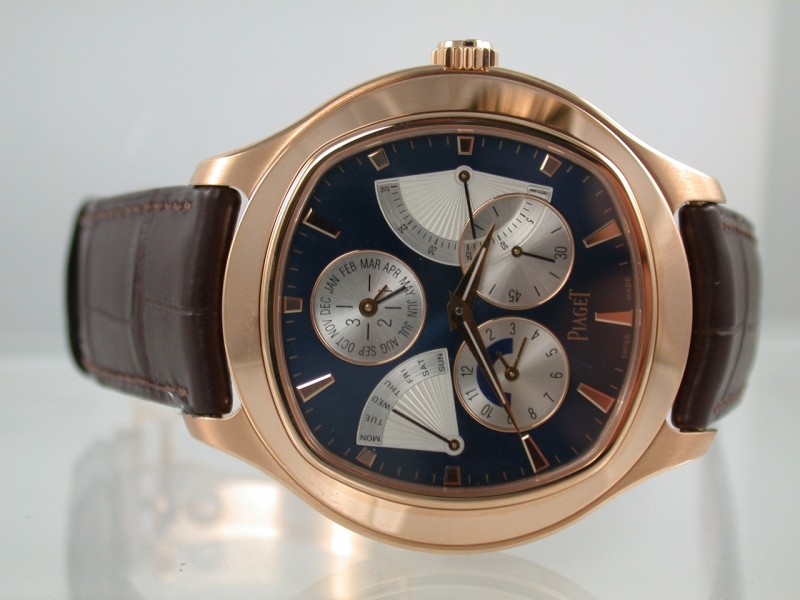
As in the Gouvernuer, which playfully integrates circular and oval shapes into the design, the Emperador Coussin mixes round and cushion shapes. The 46.5 mm red gold case is round, as is the outer edge of the bezel, but the bezel morphs to a cushion shaped on its interior, steps up, and frames the cushion dial.

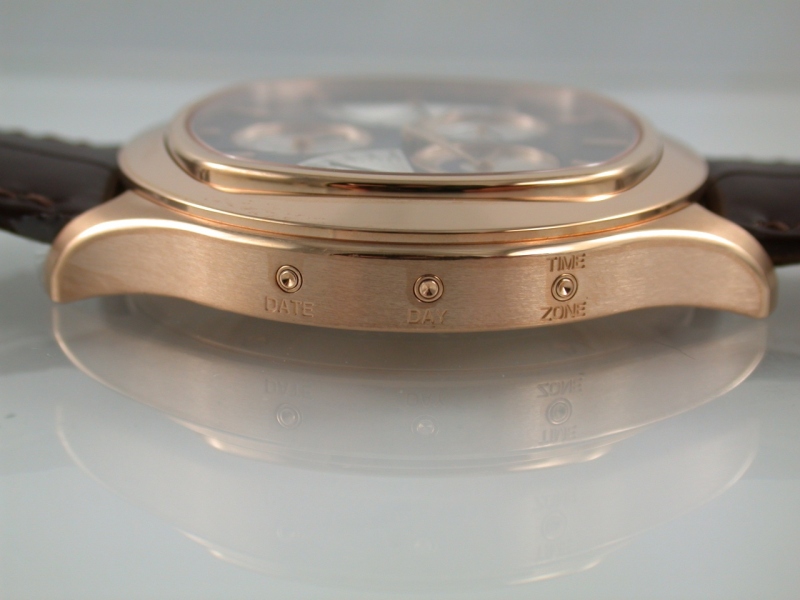
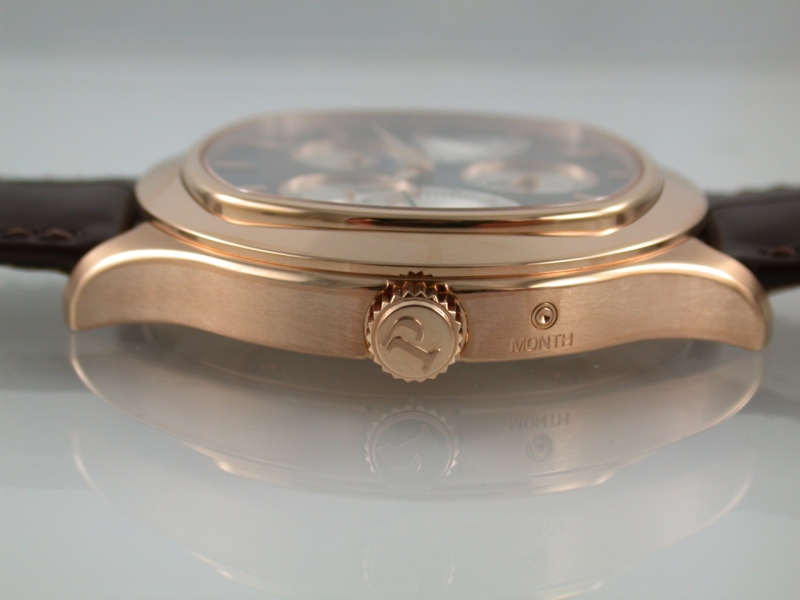
The sides of the case have a nice satin finish to contrast with the high polish of the face of the watch.
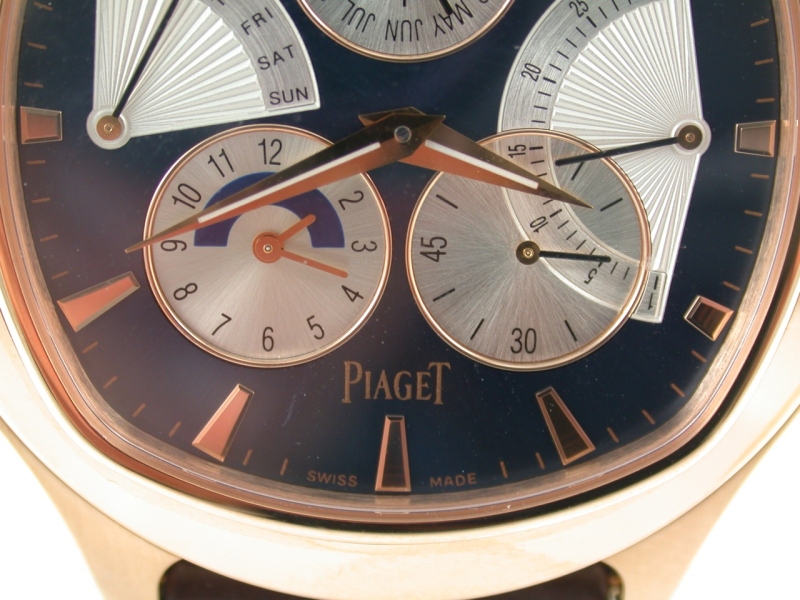
The dial is a very rich blue (hard to capture accurately in photos), with applied index markers and gold Dauphine hands to indicate the hours and minutes. The sundials for the calendar functions, second time zone, and small seconds are all silvered, and outlined with a thin gold line. The small seconds are at 4 o’clock. The GMT is at 8 o’clock. The day and date have the additional complication of retrograde display, with the day between 9 and 10, and the date between 2 and 4. The month and leap year cycle are at 12 o’clock.

These two arcs have a nice radiating guilloche.
The correctors for the calendar function are on the side of the case, and I appreciate the fact that they are labeled, eliminating any guesswork about what function one is correcting.


Piaget is well regarded for its ultra thin movements, and the caliber 855P inside is all of 5.6 mm thick, and keeps the thickness of the entire watch to a slim 10.4 mm.
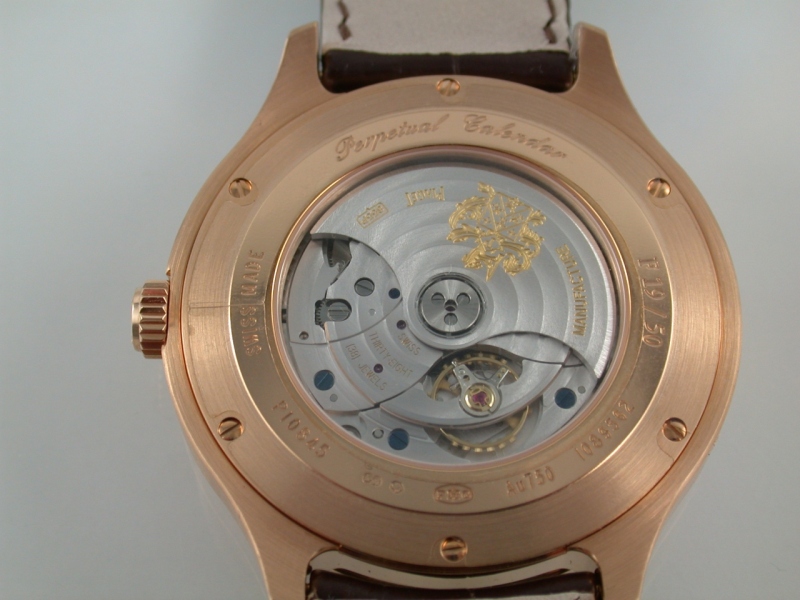
The self-winding movement is visible through the sapphire crystal case back, and has all of the hallmarks of Piaget’s fine finishing with circular Geneva waves and blued screws.

Not all 46 mm watches are wearable, but I found the Emperador Coussin to be comfortable on the wrist. While reading the time is easy enough, the calendar information is harder to discern, especially the date where the small seconds shares space with the date arc.
Piaget doesn’t blare it out in its marketing, but this particular piece is from a set of only 50 numbered pieces.
Bill
Thanks Bill. The Piaget Emperador Coussin Perpetual Calendar is a connoisseur's watch. It has a unique case shape that some like...some don't. it is very thin for a perpetual calendar. The movement is exclusive to Piaget. It does not shout' "I'm very special" despite the large dial area because the thinness of the watch reduces the bling value, unless you actually add bling to it! Then, it does some serious shouting..... ;) MTF
It is a very manly & sophisticated watch. Don't have a piaget watch yet but your post tell me that it is a good brand. Thanks. best geross
2,917 Patek Philippe listings are live on the eBay market and 1722 collector listings on the WatchProSite marketplace.
This thread is active on the Piaget forum with 3 replies. Share your knowledge with fellow collectors.
Join the Discussion →