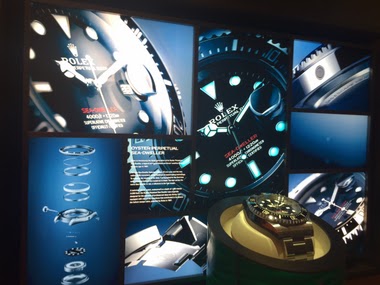
Here, I took advantage of having a Royal Oak Offshore Titanium (ref: 26170TI.00.1000TI.01) on hand for the "comparison" to Daytona (ref: 116520)
So we attack with the movements and their specificities:
Audemars Piguet: 3126/3840 (module)
Thickness: 7.00mm
Diameter: 29.92mm
Balance frequency: 3Hz (21,600 alt / hour)
Type of spiral: Flat
Power reserve: 55 h
Number of jewels: 59 rubis
Number of components: 365
Chronograph mechanism: shuttle(cam)
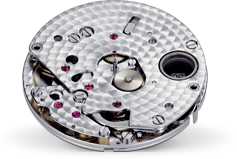
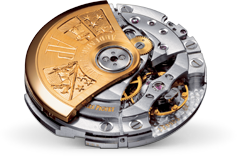
Credit Audemars Piguet
Rolex: 4130
Thickness: 6.5 mm
Diameter: 30.5 mm
Frequency of the pendulum: 4Hz (28800alt/heure)
Type of spiral: Parachrom, micro stella screw
Power reserve: 72 hours, 66 hours chrono switched
Number of jewels: 44 rubis
Number of components: 201
Chronograph mechanism: columns wheel
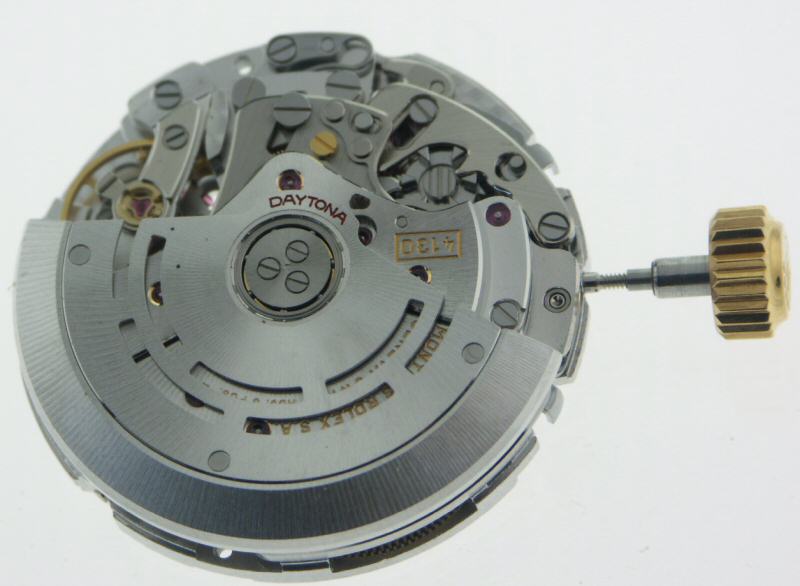
Credit ForumaMontres
So what?
It may be noted that the AP is the Calibre 3126 which we added 3840 chronograph module, however, the thickness is contained, because it is barely thicker than the 4130 Rolex.
However, the 4130 has much more autonomy, and that even if it runs faster (28800 VS 21600 to AP)
There are fewer components on the movement of Daytona, which implies a faster response time than the movement of the ROO.
Last, we have a column wheel Rolex when you have a cam system (shuttle) in AUDEMARS.
Of course most observers have noticed the beautiful decorations of 3126 with its engraved oscillating weight, 22-carat gold mounted on ceramic ball bearings.
Some pictures
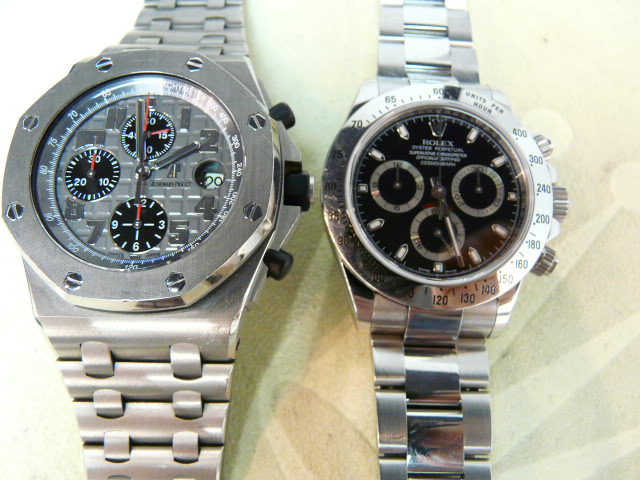
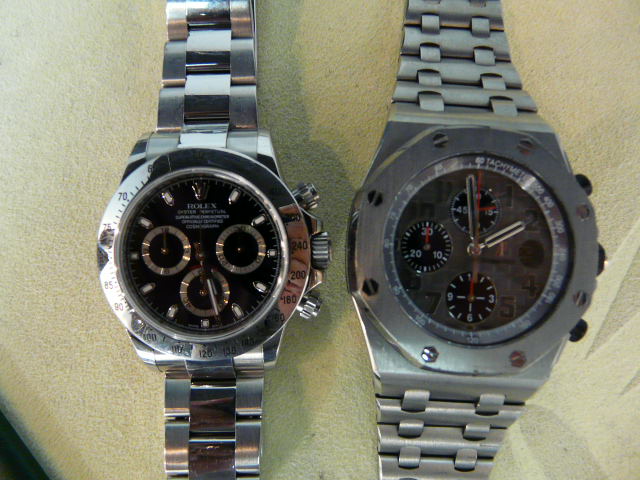

Frankly, the ROO possesses a dial "great tapestry" which is the bomb!
It has a sportier look resolutely than the Dayto which is more traditional, red hands and large numbers encourage a sense of masculinity.

For Dayto: immortal, timeless, inimitable, I'm tempted to say. "No comment"


The cases are quite fine, however the bezel of the ROO is thickest (this does not bother me, I'm used to big, I mean watches, not girls

)
Titanium brushed on the Audemars Piguet is undoubtedly less sensitive to tiny scratches than 904L steel of Daytona.
Pushers+swrew on Daytona, rubber-coated steel on the ROO.
The waterproofing is 100m for two boxes, so no worries if you're going to dip this summer

Wrist shot
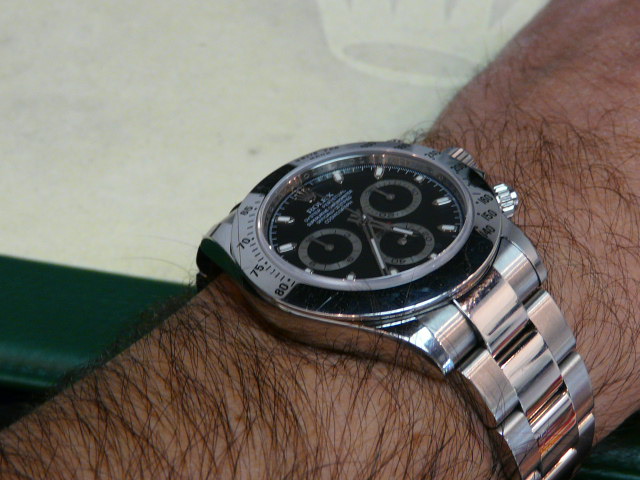

As comfortable as the other one, although for my part, I find the ROO slightly less balanced, this is probably her bracelet was very light (titanium, I think).
But suffice it to adjust well to not ride it on the wrist.

Beautiful dial, it smells like testosterone has full nose!
The inclined flange houses the tachometer.
It is probably more readable than the Daytona, the date is very discrete in his lens integrated in the glass (very clever)
The case is given to 42mm for the ROO, 40mm for Daytona.

I repeat, here we are not in the ornaments, it is effective, but in short: pure Rolex.
To finish:
In fact, it is very difficult to put a Daytona in a comparative, has already compared it raises, both from the point of view of the 'purists' as the point of view of 'detractors', it all started around 1963 with 6239, others followed, and critics as well as congratulations have not stopped.
Audemars model presents a true sports chronograph very typed, which emanates a real personality, and then we should not kid ourselves, it is nonetheless rare to encounter a ROO (which is Titanium) than a 116520
.
So if you had decided (that I would not, I'll leave this difficult task to you
) there would be an important criterion to consider: the price.
And yes, because you must know, in the catalog, a Dayto is € 8,835 against € 22,570, a ratio of 2.55 in favor of the crown.
But, you know, when you love, you do not count
Here, I await your reactions and comments, I thank Nico of Rilogi, who once again opened his doors for me, and allowed me to shoot this beautiful ROO Titanium.