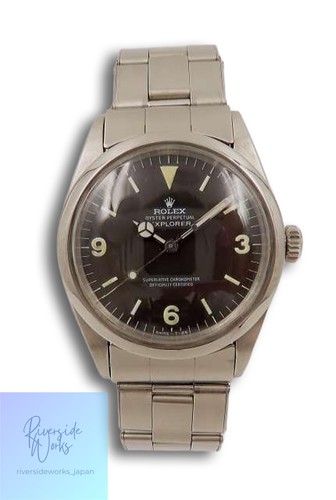
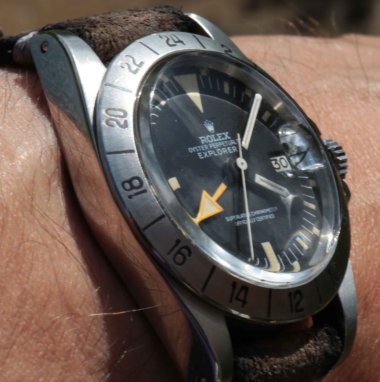
Vintage
DrStrong's insightful post challenges the popular narrative surrounding the Rolex Explorer I and its connection to the 1953 Everest expedition. He meticulously details the watch's true origins, tracing its evolution from early prototypes to the iconic references known today. This article provides crucial historical context for collectors and enthusiasts, distinguishing fact from common myth.


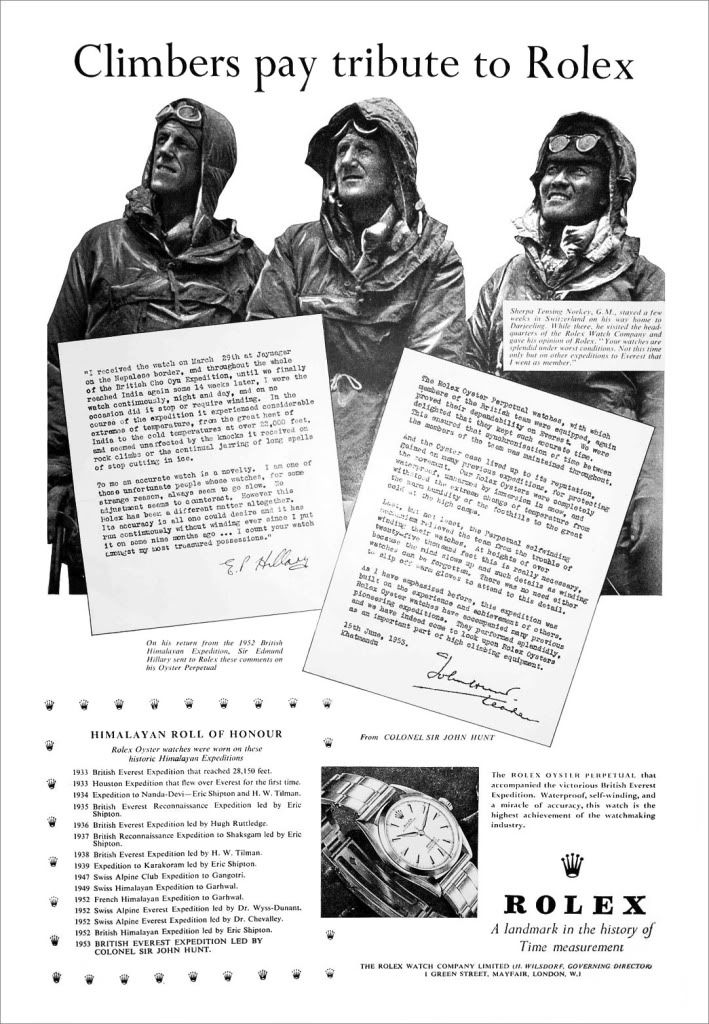
1950's Rolex ad for the Explorer (Credit: Jake's Rolex Watch Blog)
Most people believe that the Explorer I was launched by Rolex for commemorating the Everest expedition and that this watch was with British explorer team consisting of Edmund Hillary and Sherpa Tenzing Norgay etc on 29th, May of 1953, achieving a great task of human being climbing. This story is definitely magic and attractive, but it still has a certain distance to the real fact. Rolex indeed had supported Himalayan expedition since 1933, and later in Everest expeditions, Rolex had been always the official supporters, so Rolex supported each explorer team with its wristwatch. However, Rolex was not the only supporter: it is said that when Edmund Hillary climbed up on the top of Everest, what he wore was a watch from the British supporter Smith. But what Tenzing Norgay wore was indeed an Explorer.
The Explorer was based on the already existing tough and hard wearing bubbleback, which has been modified by Rolex for the more active and adventurous customer. In 1952, the references 6098 and 6150 (both using the A296 movement) were in fact the first prototypes of Explorer to be used by climbers; they were watches with white dials and leaf shaped hands and did not bear the name Explorer yet.
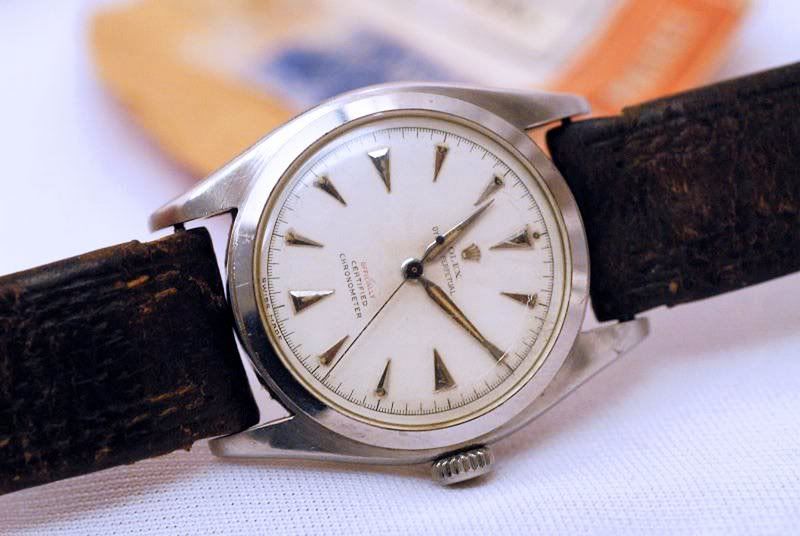
Edmund Hillary’s Rolex
In 1953, these models became the references 6298 and 6350 when they were fitted with the typical Explorer-type 3-6-9 Arabic dial and later with the Mercedes hands.
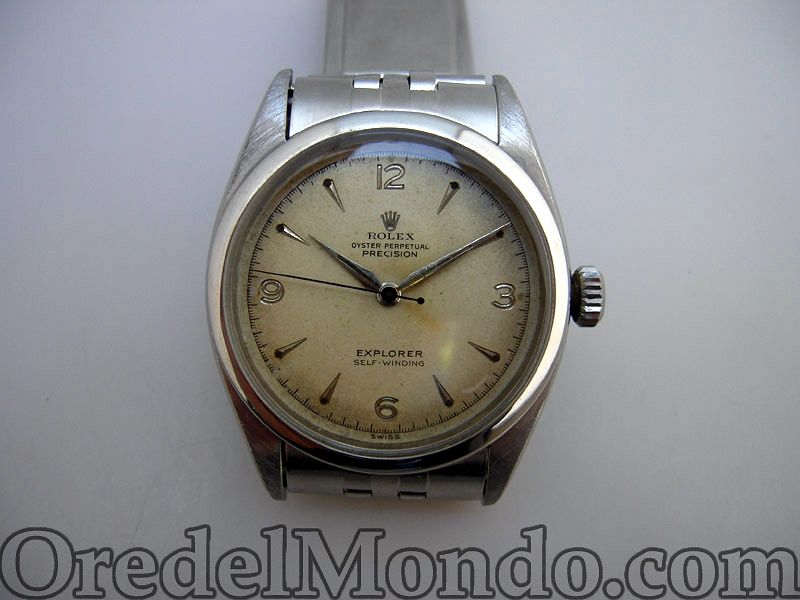
Rolex reference 6298 (Photo: OreDelMondo)
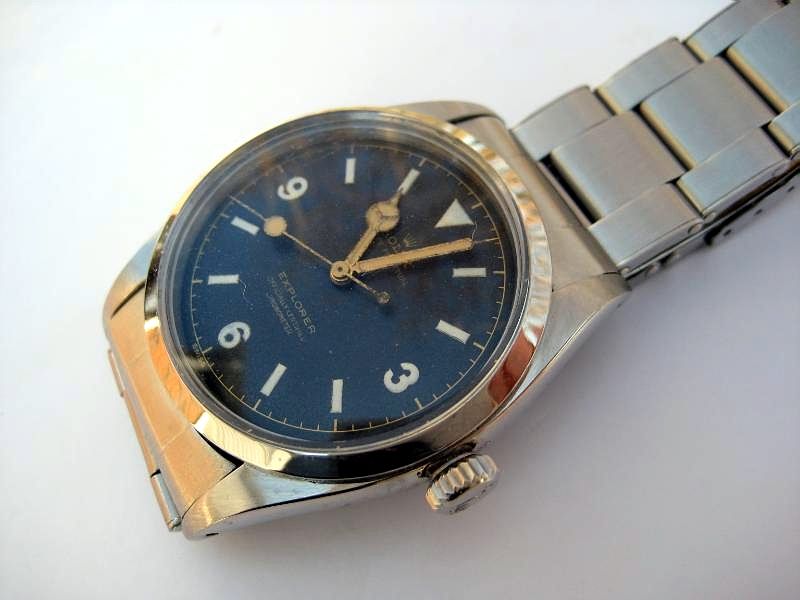
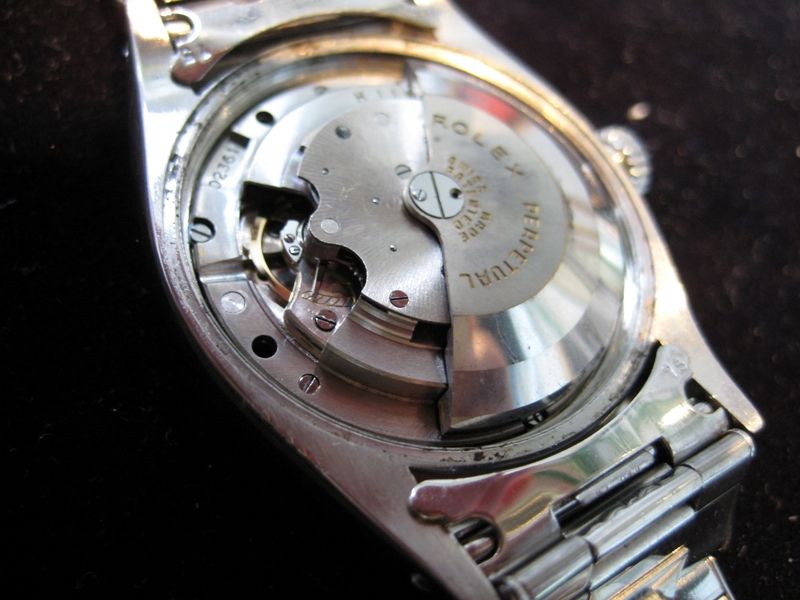
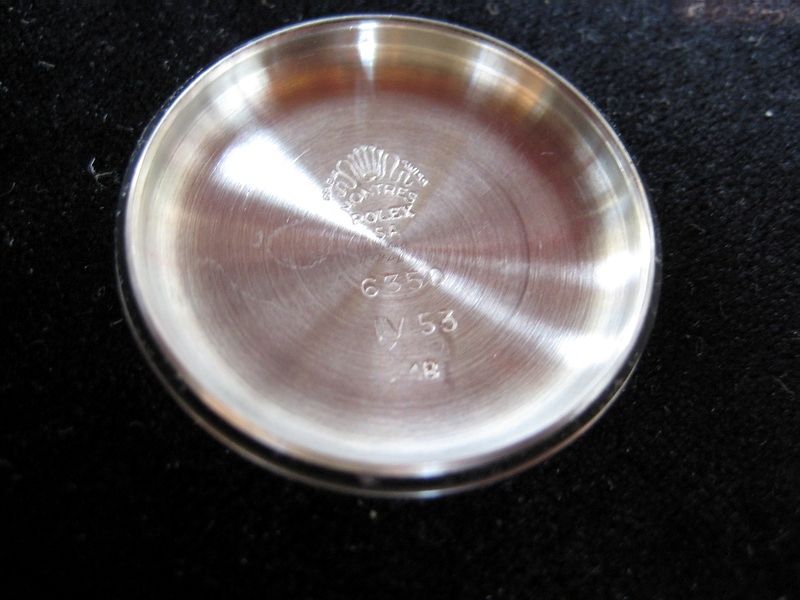
Rolex Explorer reference 6350
So you can see that before Hillary and Norgay climbed on the top of Everest, Rolex did not name their watches as Explorer. Although Rolex had registered the trade mark of Explorer in Geneva on 26th, Jan of 1953, the Explorer gained its name after Hillary and Norgay climbing up Everest, that is, “Explorer” began to be added on Ref.6350 after the successful climbing of 1953.
Anyway, Ref. 6350 was indeed specially made for Explorers by Rolex: it has a highly readable dial design, and its case is also specially strengthened and uses special lubricant making this watch usable between -20° C and +40° C. Ref. 6150 was stopped in 1959 and replaced by Ref. 6610. Ref. 6610 and Ref. 6150 are almost the same, but since Ref. 6610 used the new Cal. 1030 movement, the back is more flat.
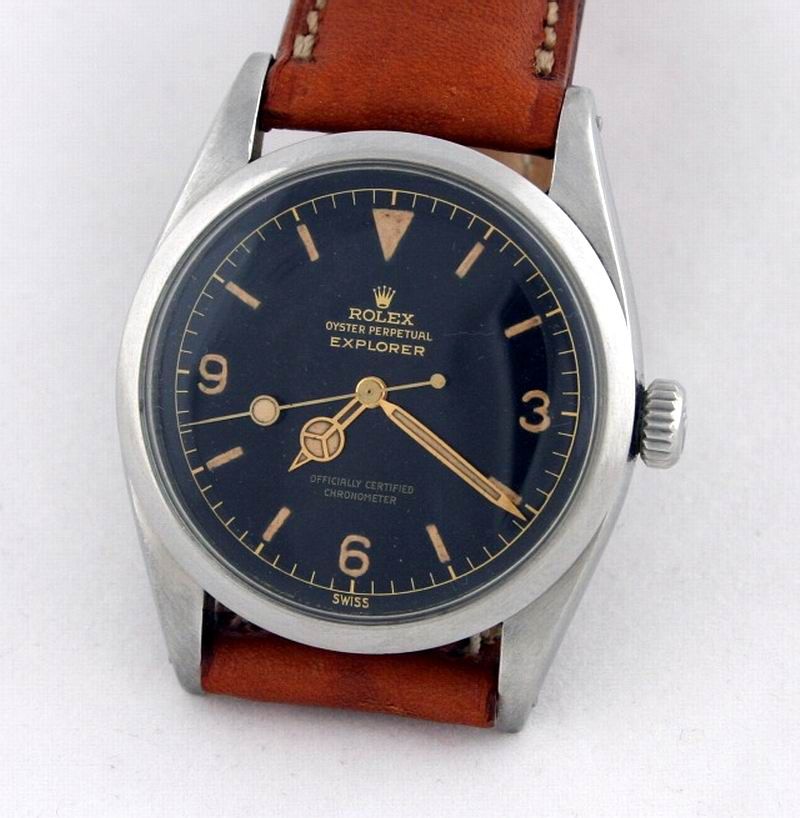
Rolex Explorer reference 6610 (Photo: Cars and Watches)
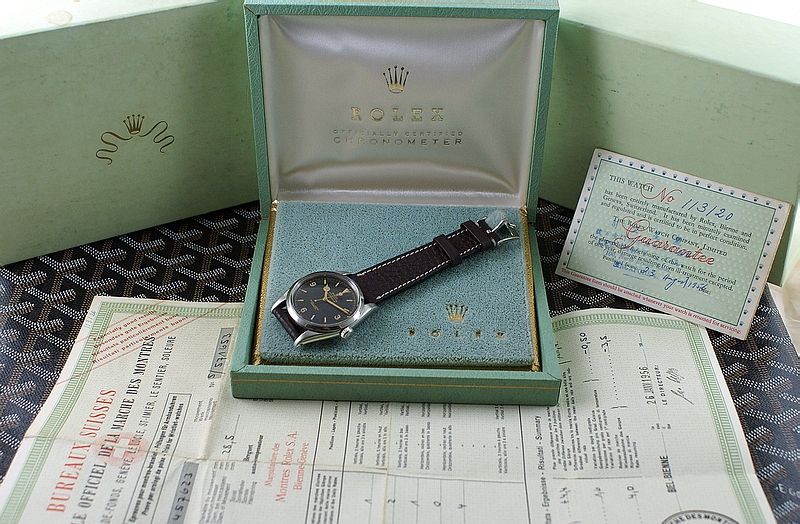
Rolex Explorer reference 6610 with box and papers (Photo: Eric Ku)
After five years production of Ref. 6610, Ref. 1016 replaced its production in 1963. Ref. 1016 is the most famous edition with the longest production in all the Explorers, until Ref. 14270 replaced it. Explorer Ref. 1016 looks like Ref. 6610 from semblance, but its movement changed to use Cal. 1560 and its water resistant increased from 50m to 100m. During the long production of 26 years, the Explorer Ref. 1016 also changed quite a lot...
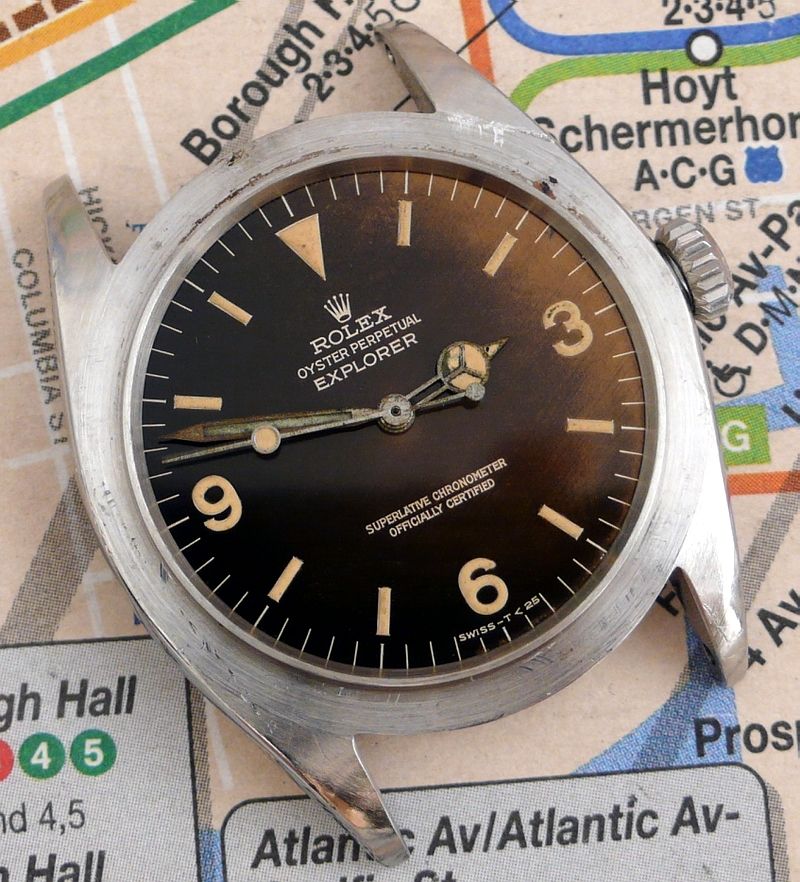
Early Rolex Explorer reference 1016 with gilt dial (Photo: Andrew Shear)
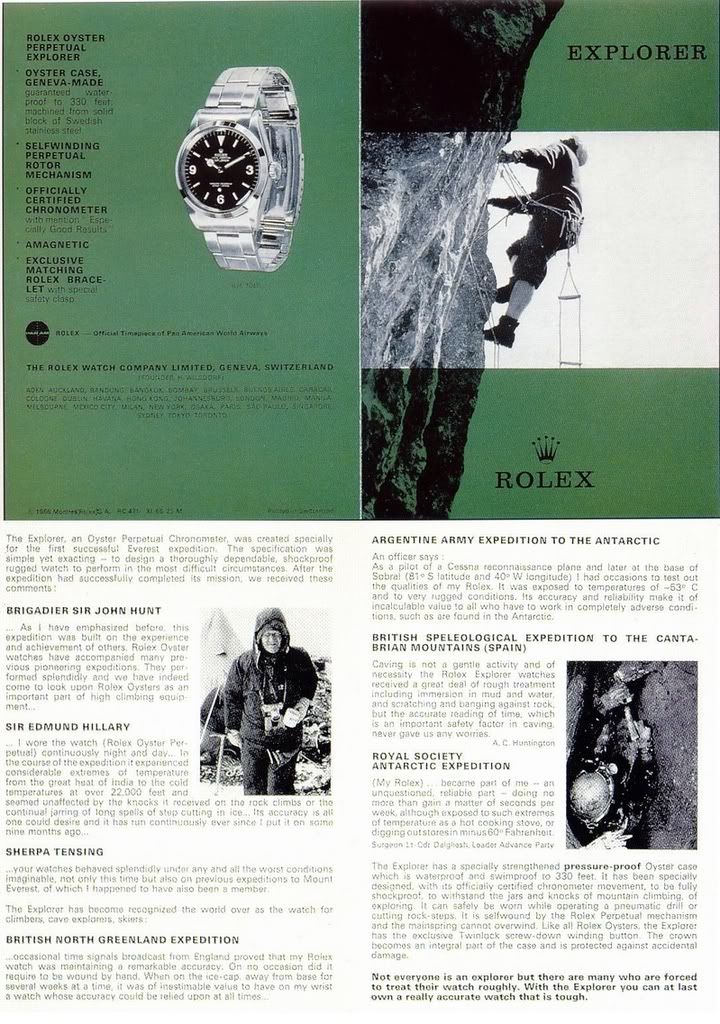
Booklet for the Explorer ref 1016
The Space Dweller is a variation of ref. 1016 that was launched in 1963 to commemorate a visit to Japan of the NASA astronauts. The production run is very small.
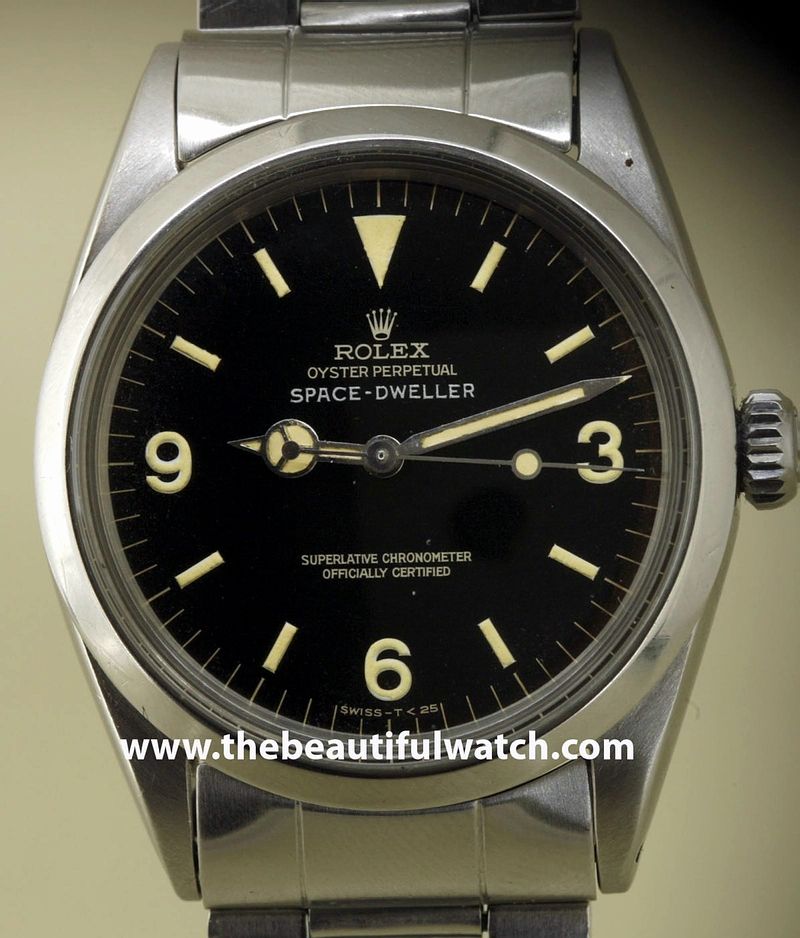
Rolex Space Dweller (Photo: The Beautiful Watch)
In 1989, Ref. 14270 came to the market with surprise. Apart from remaining the name of Explorer and mercedes hands, the conception of Ref. 14270 was completely different from Ref. 1016: the movement is Cal. 3000 with higher frequency, the crystal is sapphire, the case is designed again and the dial changes quite a lot. Such a change definitely makes the style of 14270 have a feeling of elegance and modern, but the pure sports and explorer style of Ref. 1016 actually made most watch lovers hard to forget. In 2001, the reference 114270 replaced 14270 to use Cal. 3130 and it is still in production.
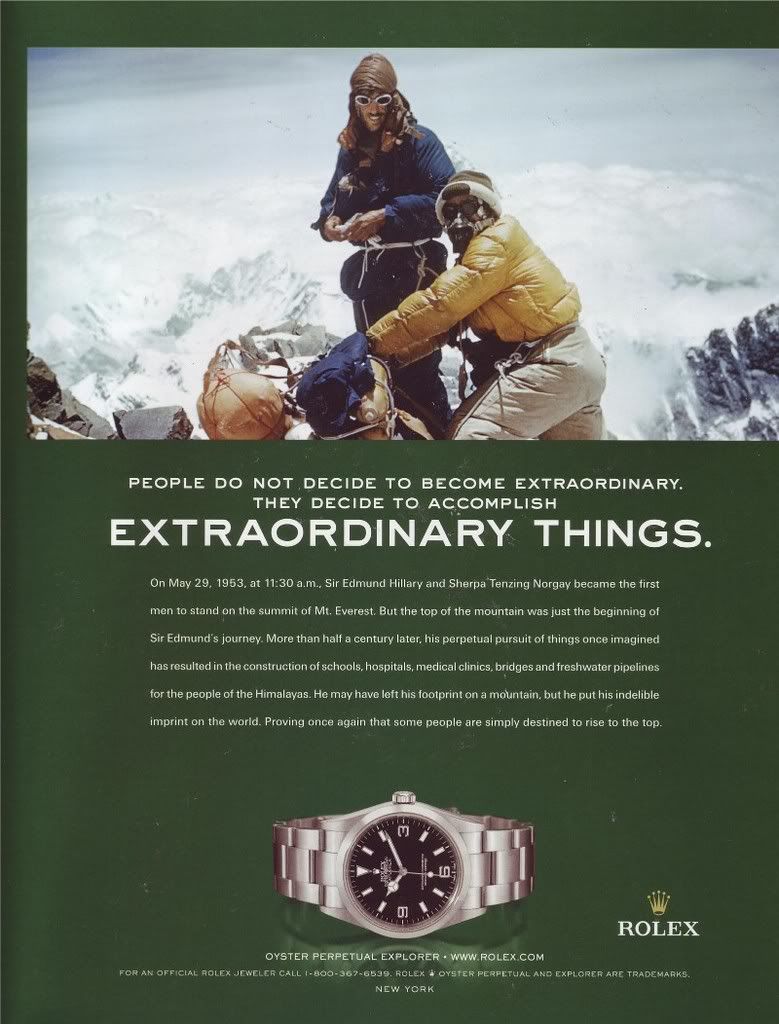
Rolex ad for ref. 114270
Acknowledgements: Bill Clinton
This message has been edited by DrStrong on 2009-10-26 05:02:55 This message has been edited by DrStrong on 2009-10-28 05:25:27 This message has been edited by amanico on 2009-11-02 07:54:59
The reference 1016 is a notable iteration of the Explorer model, recognized for its robust design and clear legibility. It represents a period of consistent design language for the Explorer line, maintaining core aesthetic principles while incorporating incremental technical refinements. This reference is particularly distinguished by its long production run, allowing for various dial and case nuances across its manufacturing years.
This reference features a 36 mm stainless steel Oyster case, providing a durable and functional enclosure for the automatic caliber 1570 movement. The movement offers a power reserve of approximately 42-48 hours. The watch is fitted with an acrylic crystal, contributing to its vintage appeal and period-correct specifications. Water resistance is rated at 100 meters, underscoring its design for practical use.
For collectors, the reference 1016 holds interest due to its enduring design and the variations found within its production. Different dial types, such as gilt and matte, are observed, each appealing to specific collecting preferences. Its straightforward time-only display and tool-watch aesthetic make it a representative example of the Explorer series' foundational principles.
Superb work, which will certainly be appreciated by all the Explorers Lovers! Thanks a lot! Just one question about the size of the 6610... 36mm, too? I thought that the 1016 bwas launched before 63...In fact I believed that it was introduced in '59... The more you learn, the less you know! Best, Nicolas
some sources mention 1959 as the birth of ref. 1016, but I have never seen any of these watches with a production date before 1963. If you have examples I would be happy to add this to the post. Cheers Jeff
The Explorer I is the next Rolex on my list. - SJX
No message body
Thks for sharing
No message body
This thread is active on the Rolex forum with 37 replies. Share your knowledge with fellow collectors.
Join the Discussion →