Review
Baron - Mr Red provides an in-depth review of the Rolex Explorer II Ref. 1655, specifically focusing on the first-generation 'Straight-hand' variant. Drawing on years of ownership and building upon previous community insights, he explores why this reference, despite its unique design and adventurous spirit, was initially overlooked by collectors.

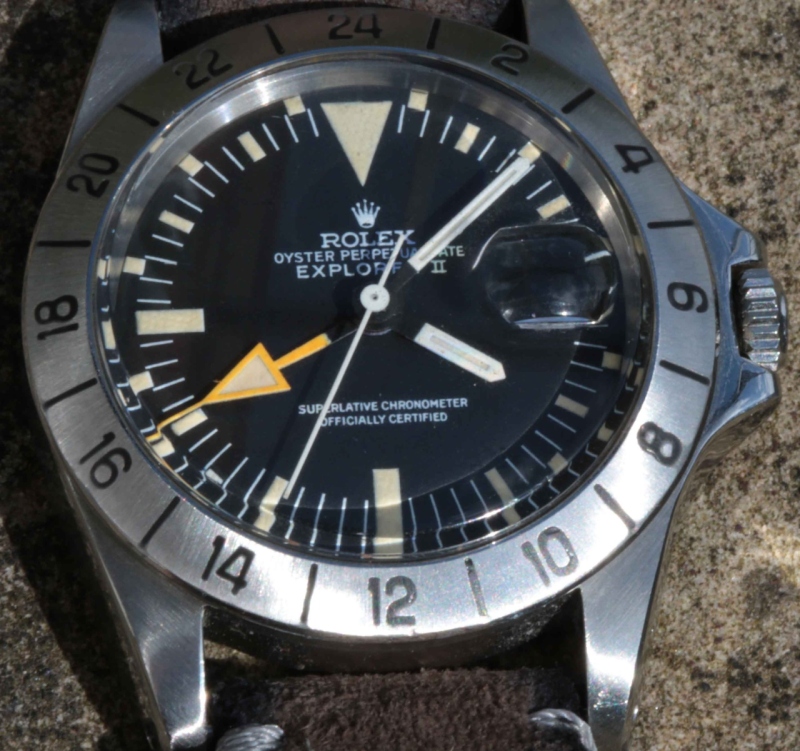

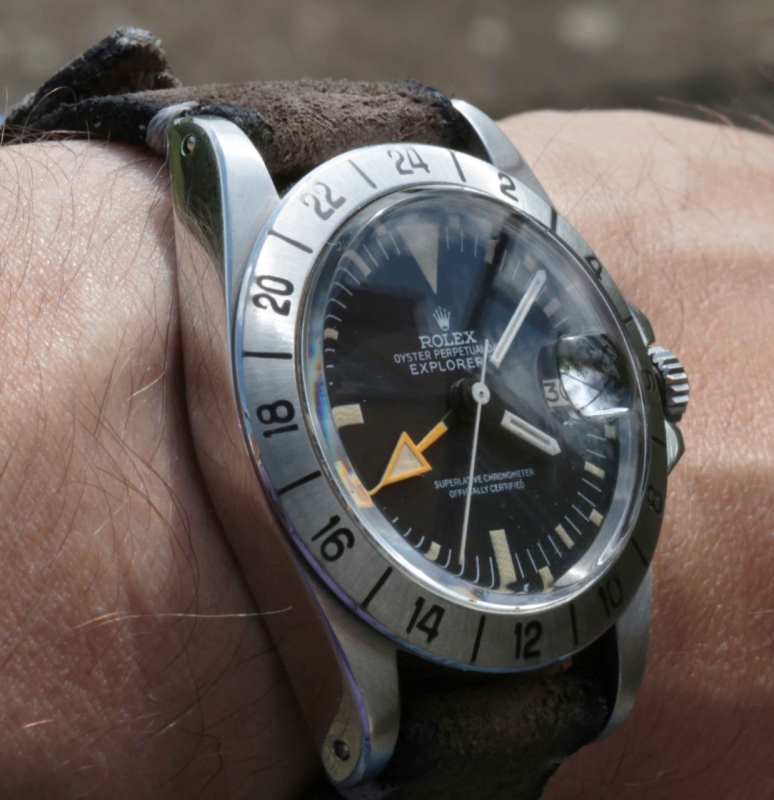
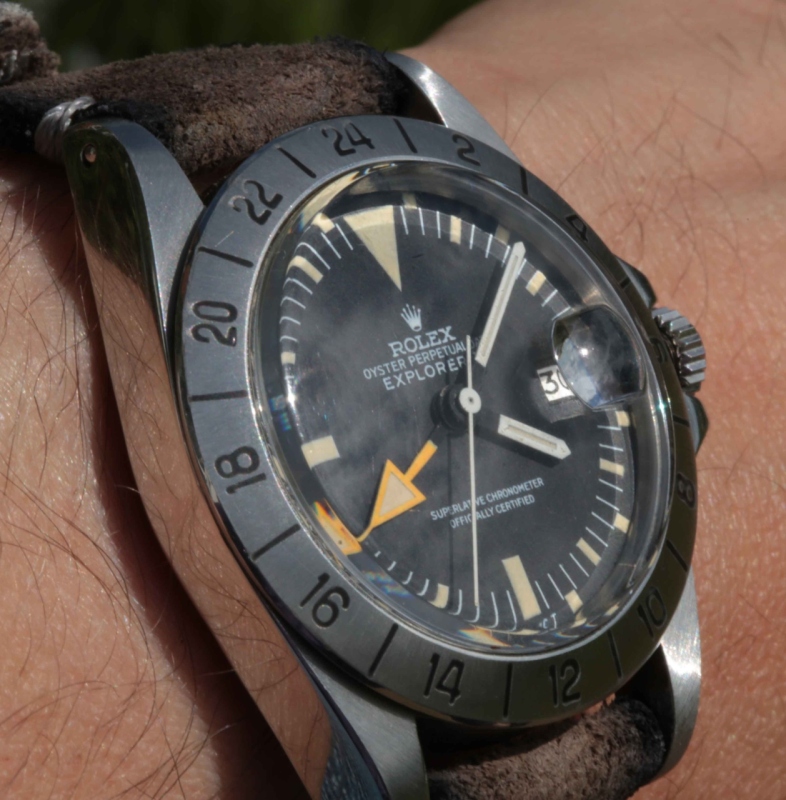
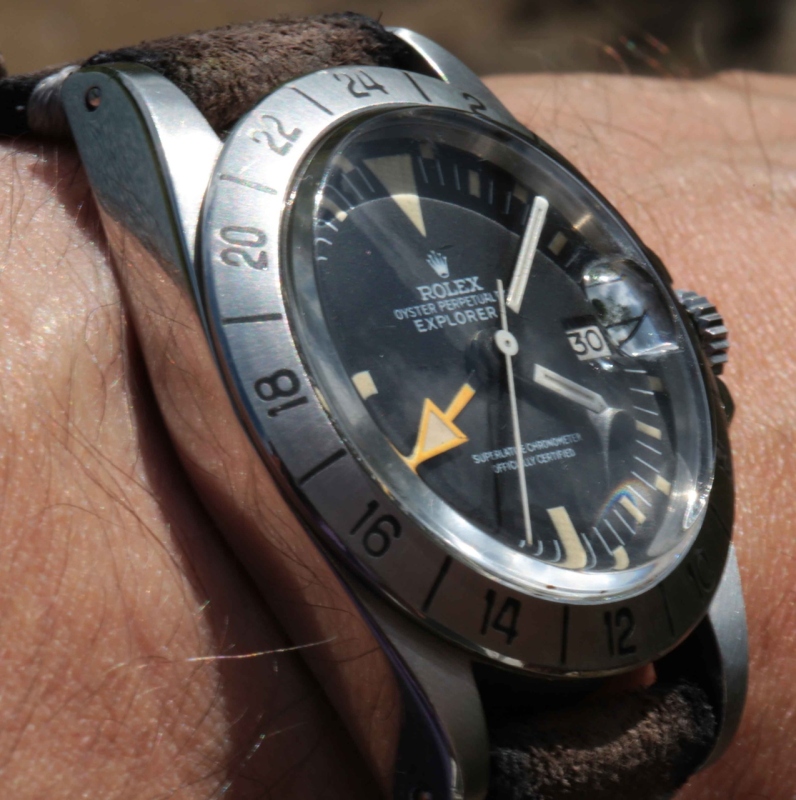
Rolex has the world of the adventurer covered. For under the seas we have the Submariner. For above the skies we have the GMT. And for adventures everywhere in between, we have the Explorer! There have been many styles of Explorer produced by Rolex. In fact, a lot more than many realise; 6098, 6298, 6150, 6350, 6610, 6552, 5506, 5500, 5501, 1016, 14270, 114270, 214270, 5700, 1655, 16550, 16570, 216570. Surprising how many variations there have been! This review will be of the 1655 courtesy of the fact that I have owned one for a number of years and so feel at least partially capable of fairly evaluating it. Nicolas did a tremendous review of the 1655 several years ago, and I am indebted to that review as I have used it extensively to build this updated version. In the list of Explorer references cited above, the 1655 represents the very first of the Explorer II range, with all references before being Explorer I. Specifically, this review will focus on the first generation 1655 - The Straight-hand.

The 1655 was produced between 1971 and 1984. During its years of production, it was not a popular watch for Rolex collectors. I think there are a number reasons for this lack of popularity. First, the years of production coincided with a period when quartz watches really took off in terms of popularity. I have the first quartz watch produced in 1969, and by 1980 quartz had dominated the watch world. As a starting point, then, the 1655 was produced during an era when mechanical watches were just not in fashion.
Second, Rolex pitched this watch at a very specific market segment. Submariners for sea. GMTs for air. Explorers for scientific expeditions….into caves, volcanoes etc. To quote from the Rolex website…..
“Extreme environments, such as the polar regions, have always been new testing laboratories for the Oyster watches. In 1971, Rolex broke new ground, in terms of chronometric precision, robustness, autonomy and legibility, with the launch of the Explorer II.”
Yes, this would certainly capture the spirit of the adventurer but plausibly it will have restricted the target audience considerably. One could also argue that the existence of rugged plastic quartz might have been seen as more suitable for such usage too. It is perhaps this lack of popularity that spurred Rolex to start using celebrity names in order to brand their watches. In the past, the sheer quality and status of the Rolex watch was enough to position it as the tool watch of choice for the adventurer. However, and plausibly alongside the rise of the quartz, the 1655 saw with it the advent of the celebrity endorsement. Nicolas’s article highlights the use of Jean Claude Killy, the olympic ski champion, to promote the 1655. Oddly, Steve McQueen’s name also became attached to the 1655, though how this happened has never been clearly understood. The nickname, the “Steve McQueen” has certainly stood the test of time, though there is no evidence that links the actor with the watch itself!

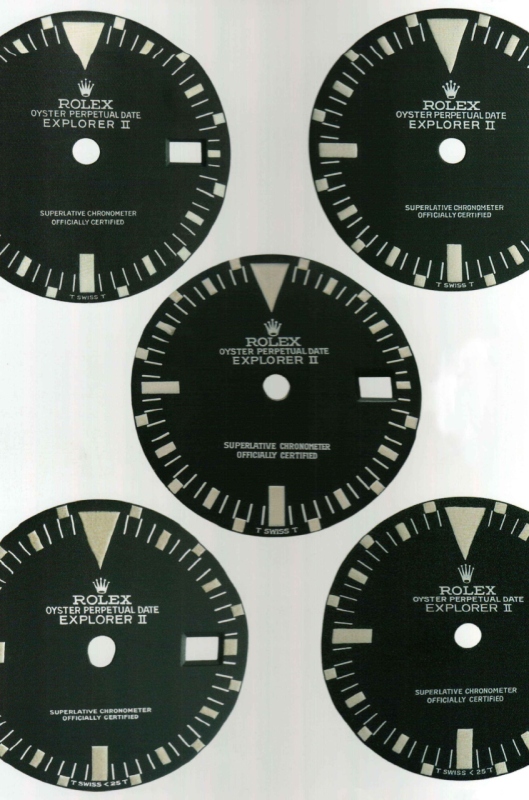
Now to the watch itself. Unsurprisingly, for Rolex, features on the dial changed over the years of production. The following picture shows the various series of dials. At first glance, there may not seem to be many differences. Closer examination, however, shows key markers. Obviously, the “Rail Dial” in the middle stands out with its rail-alignment. The bottom two dials have T Swiss < 25 T compared with the top dials showing T Swiss T. A minutiae examination of the various different generation dials, however, is not the purpose here. This review will focus on the first generation dial, the one that came to be known as the “Straight-Hand”....this one is top left. The Mk2 dial is top right. Just for completeness, however, and for those who wonder what the difference is between Mk1 and Mk2 dials…..take a look at the length of the writing of the word “perpetual”…..longer for Mk1 than Mk2!

Picture courtesy of Guido Mondani Editore
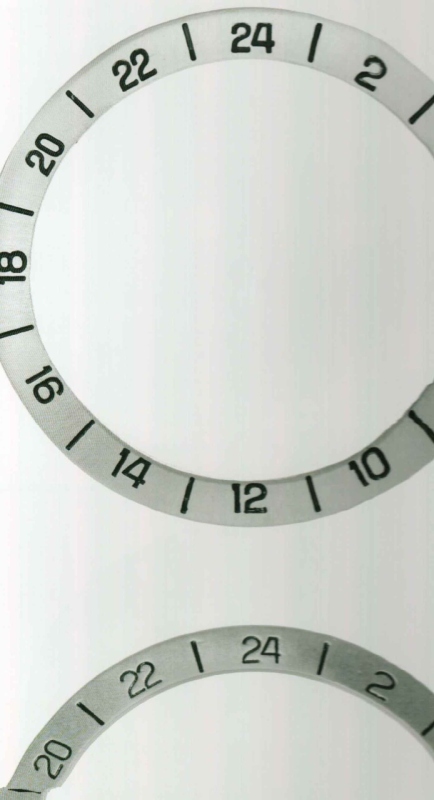
Differences between the various 1655s doesn’t stop at the dial. Take a look at the bezels. Each one has variations ranging from the degree to which the font is centred to the thickness of the font. The Mk1 1655, pictured top left, has the thick font style. Its not always easy to pick this out unless comparing it side-by-side with the thin font variant. The top bezel in the following scan clearly has the thicker font.

One further marker that highlights the first generation 1655 is the second hand…and it is from this that the watch gets its nickname. Later generation 1655s have lollipop hands. Only the first generation 1655 has a second hand that is completely straight. So, now time to take a look at the watch.

What did Rolex do with this 1655 that made it differentiate it from their Explorer I series?
Larger case - the 1655 came with a 39mm case. Presumably, it was seen as more legible.
Movement - with a larger case came the 1575 GMT movement. Not really a surprise to see this movement in the Explorer II as the watch introduced a new twist to the Explorer reference via its orange hand.
Orange hand - this was a new twist for the Explorer. Rather than apply the movement to a GMT function, the purpose of the orange hand in conjunction with the fixed 24hr bezel is to provide the user the means of determining quickly whether it was daytime or night-time. Imagine being in a cave for a prolonged period, or in darkness, the hour hand may say its 4’o clock, but if it is dark, how do you know if it is very early in the morning or the afternoon? By seeing where the orange hand is pointing, one can see immediately whether it is AM or PM. A superb function for someone who ends up in such a situation. Bearing in mind that the watch was targeted for scientific expeditions where multi-day periods in the dark were expected, one can see how it would be used. Once again, however, one can also see how the digital watch would also be seen as a competitor.

Protected crown guards - unlike the Explorer I, the 1655 introduced protected crown guards. Again, this would have been as part and parcel of the concept of robustness for the adventurer. A watch that would withstand a true battering.
It is always difficult to be too precise regarding serial numbers for this first generation 1655. My best guess is that the Mk1 straight hand has a serial range between 2.7m-3.3m. It would be good to see other Mk1s to see whether this serial range is verified.
So now we have the watch introduced the watch, explained some of its differences and also some of the rationale behind its introduction. Now some more scans.....to fully appreciate this unusual Rolex.


The Rolex Air-King reference 5506 is a notable variant within the Air-King lineage, distinguished by its unique position in Rolex's catalog during its production era. While sharing the fundamental design language of the Air-King series, this reference often featured specific dial configurations and case finishes that set it apart from its more common counterparts, appealing to collectors seeking less frequently encountered examples of the model. It represents a period when Rolex explored subtle variations within its established lines.
This reference typically features a case crafted from stainless steel, maintaining the robust and understated aesthetic characteristic of the Air-King. It houses a self-winding mechanical movement, a hallmark of Rolex's commitment to precision and reliability. The watch is commonly fitted with a durable crystal, designed to protect the dial while maintaining clarity. Its dimensions contribute to a comfortable and versatile wear experience, suitable for a range of wrist sizes.
For collectors, the reference 5506 holds interest due to its relative scarcity compared to other Air-King references. Its inclusion in lists of Explorer references, as noted in some enthusiast discussions, highlights the historical overlap and shared design elements that occasionally blurred the lines between Rolex's tool watch families. This particular reference offers a glimpse into Rolex's production strategies and the subtle distinctions that define collector-grade variations within its extensive catalog.
A Watch, a reference and a version which deserves much more attention from collectors, or simply, Watch lovers. A true character in the Rolex World. A review to bookmark and to re read as a reference. Thank you, Joe. Nicolas
......but yes, SO many different Explorer references ... and with the 1655, so many different variants too.
I can not play here, but please let me add some scans from my library... 1977 1980 1982 Best Blomman
.....always good to document these watches and dig a little deeper
Thank you for the detailed review Joe. It has certainly piqued my interest in this reference which was never there as much previously.. Always thought my next vintage R would be a gilt 1016 but this throws a spanner of sorts.. If I could ask you to pick one between say a gilt CR 1016 or 6610, against a straight hand 1655, what would be your pick?
But the answer is, by definition, subjective. I adore the 6610. To me, it would be my top target of the three. Then the 1655. Then the 1016. If you want a good 1016, you will find by the end of the week. If you want a good 1655, you will find by the end of next week. If you want a good 6610, that may take longer. I did a review of the 6610 red. Do a forum search to take a look. Best Joe
This thread is active on the Rolex forum with 15 replies. Share your knowledge with fellow collectors.
Join the Discussion →