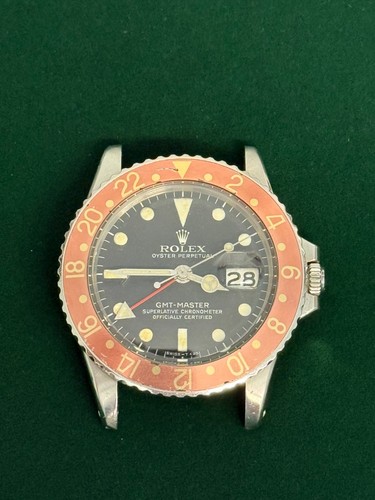
CR's meticulous investigation into the radioactivity of vintage Rolex GMT-Master references 6542 and 1675 offers invaluable insights for collectors. By leveraging specialized equipment at a nuclear reactor, CR provides empirical data on radiation levels and material composition, directly addressing common concerns about wearing these iconic timepieces. This work not only clarifies the presence of Radium-226 but also quantifies potential exposure, making it a crucial resource for understanding the safety of vintage radium dials.
Several WPS threads were really helpful, and fun to read, in my desire to learn a bit more about this subject. There's this one (
Rolex and Radioactive Material), this one (
Rolex and Radioactivity), this one (
Rolex: Is the geiger counter a reliable tool in evaluating the radioactivity on a dial?), and this one (
No better way to start than a 6542).
After reading those threads, I got curious about this 6542 (c.1958) and 1675 (c.1961):


Does this 6542 contain Strontium-90? I was hoping for a "no" answer, given what I read in the "
Rolex and radioactivity" thread above and elsewhere.
And what would my exposure be from wearing these watches from time to time -- a natural question?
So I met up with an old college friend at a nuclear reactor, to find out.

The first thing we did was answer the question, "What radioactive material was used in these watches? And was any Strontium-90 used?"
This involved a "Canberra spectrometer," whose thick lead walls you can see here:

It appears that just Radium-226 was used (on both watches), with no Strontium-90 detected.


Now that the spectrometer answered (to a reasonable degree) the question of what material was used, we measured the levels with this Ludlum Geiger counter -- a fitting device for this watches, since it's around the same age:

We took front and back measurements for each watch. And of course, we'd expect much lower readings on the back versus the front.
To simulate wearing the watch, I pressed the caseback against the Ludlum's pancake probe when taking the reading. I did the same for the crystal side, noting that levels drop off substantially when you move the watch even a few centimeters away from the probe.
So what did we find?
The Ludlum measures radiation levels in millirems/hour (mrem/hr).
The 6542 measurements were 12-15 mrem/hr at the crystal and 0.5 mrem/hr at the caseback.
The 1675 measurements were half of the 6542's -- 5-6 mrem/hr at the crystal and 0.25 mrem/hr at the caseback.
One millirem/hour equals 10 microsieverts/hour (uSv/hr).
This means the 6542 clocks in at 120-150 uSv/hr at the front (sleeping with the crystal against your face), and 5 uSv/hr at the back (wearing it on the wrist).
Of course, when wearing a watch, your whole body isn't being exposed to these levels. It's just one extremity. That matters when assessing health risks.
Speaking of health risks, Justin6542 posted this reference guide in a prior thread:

This was a fun exercise!
Any thoughts (or corrections I should make to my math or other information)?
Disclaimer, in case it's not obvious: I am NOT a nuclear engineering expert!
About the Rolex GMT Ref. 1675
The GMT-Master reference 1675 is a significant model in the brand's history, representing an evolution from earlier GMT-Master references. It was produced for an extended period, allowing for numerous dial, bezel, and hand variations throughout its production run. This reference is notable for its introduction of crown guards, enhancing the watch's robustness and contributing to its distinct profile. It solidified the GMT-Master's design language, which would influence subsequent generations.
This reference features a 40mm case, available in stainless steel, yellow gold, or a two-tone combination of steel and yellow gold. It is powered by the automatic Caliber 1575, a chronometer-certified movement known for its reliability and a power reserve of approximately 42 hours. The watch is fitted with an acrylic crystal and offers a water resistance of 50 meters, suitable for everyday wear. The bidirectional rotating bezel, typically with an aluminum insert, displays a 24-hour scale.
For collectors, the 1675 is highly sought after due to its long production period and the resulting variety of configurations, including different dial types (gilt, matte), hand styles, and bezel colors (Pepsi, all-red, all-black). Its four-digit reference number and acrylic crystal are key characteristics that define it as a vintage Rolex. The reference appeals to those interested in the historical development of the GMT-Master line and the nuances of vintage watch collecting.
Specifications
- Caliber
- Cal. 1575
- Case
- Yellow Gold
- Diameter
- 40mm
- Dial
- Black
- Water Resist.
- 50m
- Crystal
- Acrylic
About the Gilt Ref. 1675Gilt
The Rolex GMT-Master reference 1675Gilt is a notable early iteration of the GMT-Master line, distinguished by its gilt dial. This specific dial type, characterized by gold-colored text and minute track against a glossy black background, was produced for a limited period, making it a key identifier for collectors. It represents a transitional phase in Rolex's production, preceding the matte dial variants that would become standard later in the reference's long production run. The gilt dial provides a distinct aesthetic that sets it apart from later 1675 models.
This reference features a 40mm stainless steel Oyster case, designed for durability and water resistance. It is powered by the Rolex Caliber 1570 automatic movement, known for its reliability and precision, offering a power reserve of approximately 48 hours. The watch is fitted with an acrylic crystal, typical of Rolex sports watches from this era, and includes a bidirectional rotating 24-hour bezel, essential for tracking multiple time zones. Water resistance is rated at 50 meters, suitable for everyday wear.
The 1675Gilt appeals to collectors who appreciate the historical significance and unique visual characteristics of early Rolex sports watches. Its gilt dial, often developing a warm patina over time, is a highly sought-after feature, contributing to its desirability and value in the vintage market. This reference showcases the foundational design elements of the GMT-Master series, offering both GMT and date complications, and is typically found on either an Oyster or Jubilee bracelet.
Specifications
- Caliber
- 1570
- Case
- Stainless Steel
- Diameter
- 40mm
- Dial
- Black (Gilt)
- Water Resist.
- 50m
- Crystal
- Acrylic