Vintage
Amanico brings to light a highly unusual Rolex GMT-Master Ref. 6542, slated for auction by Phillips. This particular 'Leftie' configuration, with its crown at 9 o'clock, challenges conventional understanding of the reference, prompting a deep dive into its authenticity and historical context. Amanico's post highlights the critical role of expert analysis in evaluating such rare and undocumented pieces.
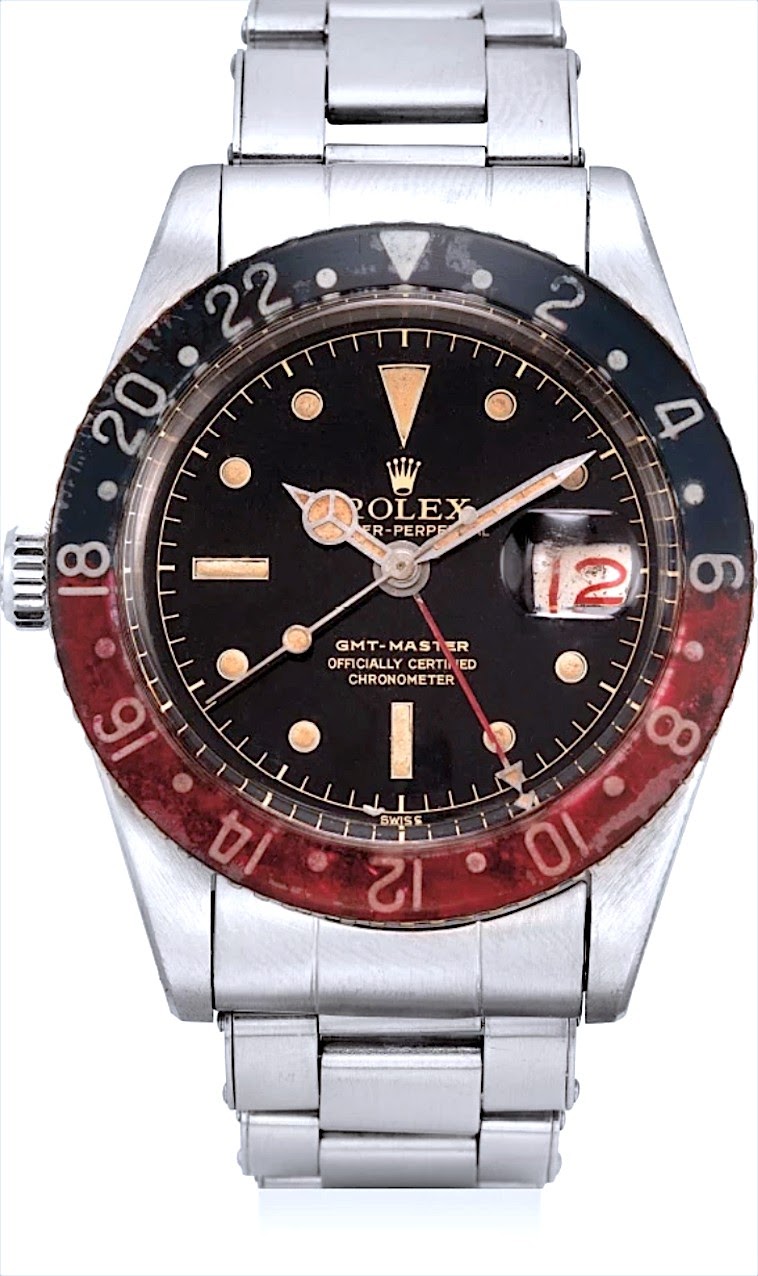
The GMT Master reference 6542 was introduced in 1955 as a specialized tool watch for pilots. It is notable for its dual time zone complication, achieved through a rotating 24-hour bezel and an independently adjustable 24-hour hand. This reference marks the initial iteration of the GMT Master line, establishing the core functionality and aesthetic that would define subsequent models. Its development addressed the need for a watch capable of displaying multiple time zones simultaneously, a requirement that emerged with the advent of intercontinental air travel.
The 6542 features a 38mm stainless steel case, housing the automatic caliber 1036. This movement provides a power reserve of approximately 42 hours. The watch is fitted with an acrylic crystal and offers a water resistance of 50 meters. Early examples of the 6542 are distinguished by a Bakelite bezel insert, which was later replaced by an aluminum insert due to durability concerns. The dial is typically black, often featuring gilt printing on early examples.
This reference holds significance for collectors as the foundational model of the GMT Master series. Its distinct characteristics, particularly the early Bakelite bezels and specific dial configurations, are key points of interest. The 6542 represents the original design intent for a pilot's GMT watch, making it a reference point for understanding the evolution of the model line. Variants exist with different bezel materials and dial details, contributing to its collectibility.
Do Rolex issue archive paper like Patek Philippe do on request?
The most unique watch of the auction. The number one that caught my attention. The other one is the Seamaster proto.
The condition is also too bad to be verified?
The explication with the numbers is not bad, but not enough. Best Walter
Aren't the dial feet typically offset on a Rolex? (Not at 6 & 12 or 9 & 3). If they are offset, perhaps having feet in this unique position would help authenticate. If the feet were moved to make this change, there should be evidence of tampering on the back of the dial. I'm just throwing out some ideas here.
I think the case number could be manipulated, given the overall condition of the Watch. So rotating the dial 180 degrees ...
This thread is active on the Rolex forum with 25 replies. Share your knowledge with fellow collectors.
Join the Discussion →