Baron - Mr Red initiates a crucial discussion on the historical use of radioactive materials in Rolex watch lumes, from radium to tritium, and the controversial debate surrounding strontium. This post delves into the health implications and historical context of these materials, offering a scientific perspective on radiation levels in vintage watches and challenging common misconceptions.
I would like to start a thread about this theme. We all know that once upon a time, radium used to be used on lume. Back in the 1950s, believe it or not, radium water was actively marketed as a health-giving drink. Likewise, radium toothpaste was also widely on sale as giving one's teeth that extra "glow". It was one of the ingredients in certain types of chocolate and many other consumable products. It was of course also used on lumes in watches. The workers who conducted that particular work were, inevitably, women and one of the practises that was commonly adopted in order to get a very good finish on the lume was for the tip of the paint brush that had radium on it to be placed in the mouth so that it was compressed and aligned so that a neat finish could be applied to the watch dial.
Many of these women subsequently died of various forms of cancer as the radium quite often dissolved their bones in their mouths. Direct contact with radium is not a good thing. Is it dangerous on a watch lume? This is a question that has been looked at by a number of people. I know I have taken each of my watches to a physics professor i know and had the radiation levels tested. So often, a simple Geiger-counter test is not enough to determine if something is dangerous or not. Of course, if a reading is off the scale, it would be a worry. The half-life of radium is certainly long enough to keep it active for a very long period, though it would depend on what isotope was being examined. Suffice to say, Rolex were wary enough of it to make a shift to tritium. When i tested my watches, those with radium recorded well above background noise but actually not anywhere near levels that are seen as dangerous. Further, if the readings were taken through the case back, then most if not all the effect was nullified. So, unless you go to sleep with your head on the front of the watch, it is basically just not an issue. Inhaling the lume....well that is not something i would try.
Tritium was the next lume of choice by Rolex. For the record, not one of my watches with tritium is now recording above-noise levels of radiation. The half-life is pretty short.
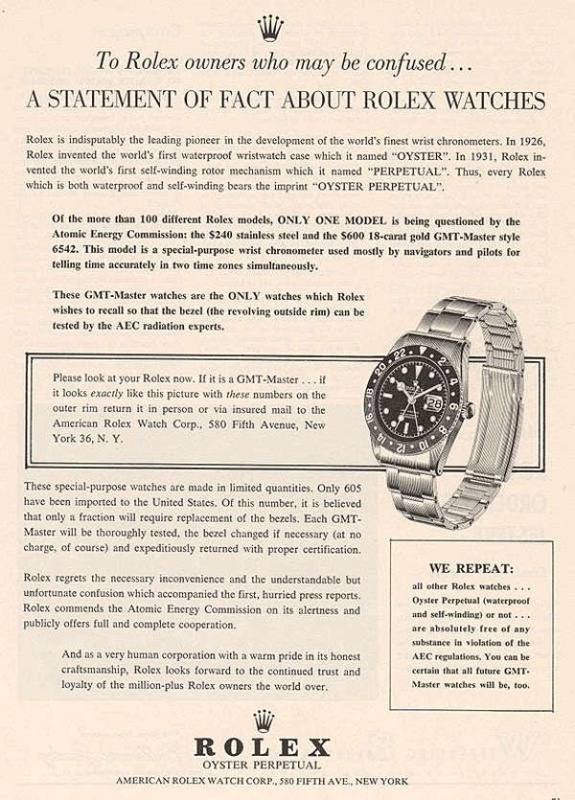
But it is not tritium that i find interesting....(cue Marcello...LoL), it is the debate about strontium, the shift from radium to tritium (and the so-called exclaim point that has appeared on so many Rolexes around the period 1958-1963) and exactly what this all meant. First things first...it would be great to put to bed the idea that Rolex just did not use Strontium on their watches. Strontium is most definitely not a nice radioactive buddy to have. It can cause serious problems and as it breaks down, it turns into something with an even longer half-life. Basically, as far as I can understand, strontium potentially gets more radioactive as the longer it is around (on your watch) and its characteristics are not pleasant. So....did Rolex really jump from Radium to Strontium to Tritium...... what happened. Thanks to Nicolas for the scans, but I thought this was an interesting starter...
So, on the basis of these two pieces of information, what conclusions can i draw? Well, I think drawing a conclusion would be premature. What appears a reasonable assumption, then?
1) Rolex did use strontium on some watches.
2) The strontium used was applied to the bezel and not the dial.
3) The strontium was used on a very small batch of watches restricted to early GMTs
4) No other Rolex reference had the strontium issue.
5) If the strontium issue was related to just the GMT, is it reasonable to assume that the so-called exclam mark that appears across a number of references, notably Submariners, has absolutely nothing to do with strontium.
6) Or could it be that, in order to dispel concern, the exclam mark was applied in order to confirm to the buying public that no dangerous radioactive material was present?
So many questions and such a deep topic to discuss bearing in mind no records truly confirm what happened in that 1958-63 twilight era.
What I will say is that I believe it is entirely plausible for a watch to have an exclam and STILL have radium. The exclam does not, to my mind, indicate a switch from radium to tritium.
Would be great to hear if anyone has any thoughts, ideas, theories or even facts that can be added to this issue.
This message has been edited by Baron on 2013-11-15 04:03:24 This message has been edited by Baron on 2013-11-15 04:08:37
Key Points from the Discussion
Marcello Pisani provides an in-depth article from 'Orologi & Market' discussing the evolution of phosphorescent paints, from radioactive substances like radium and tritium to non-radioactive alternatives developed by the 1970s.
A documented instance of a semi-official recall of Rolex Submariners around 1960 in the Netherlands, where dials were swapped for less radioactive versions, supports the idea of Rolex's awareness and action regarding radiation concerns.
The chronology of material changes suggests that the strontium scare, primarily linked to the bezels of a few GMT 6542s, likely prompted Rolex to reconsider radium use across all references, rather than indicating widespread strontium use on dials.
A radiation expert confirms that radium emits alpha particles, which are easily blocked by a watch's plexi, but ingestion or inhalation is highly harmful; strontium, a calcium homologue, emits beta particles and can cause leukemias.
The international regulation shift from radium to tritium for luminous materials occurred around 1961, although its immediate effect on production varied, leading to the 'T Swiss < 25' marking.
The lack of concrete evidence for widespread strontium use on Rolex dials, beyond a small batch of GMT 6542 bezels, suggests that the strontium issue might be a 'red-herring' for general dial radioactivity concerns.
Advertisement
The Discussion
MA
marcello pisani
Nov 12, 2013
you hate me !!!!!!!!!!!!!!!!!!!!!!!!!!!!!!!!!!!!!!!!!!!!!!!!!!!!!!!!!!!!!!!!!!!!!!!!!!!!!!!!!!!!!!!!!!!!!!!!!!!!!!!!!!!!!!!!!!!!!! LLLOOLLLL
LE
Le Monde Edmond
Nov 12, 2013
Other than to say I think the topic is absolutely fascinating and thank you for starting it! It will allow myself and others to learn about this and it is an important topic in Rolex history. Best Edmond
MA
marcello pisani
Nov 12, 2013
exclamation point on Rolex dials can be seen only in watches from 1962 and 1963 , so with case number roughly in the range from 750.000 up 1.000.000 .
MA
marcello pisani
Nov 12, 2013
in any case I obviously agree with you : for me the excl. point is not related to the switch from radium ( or other luminous material still unknown ) to tritium ... I would even dare to say that is not related at all to the luminous material on dial/hands ... : I'm really a brave guy !! LLOOLL
TE
teofft
Nov 12, 2013
i'm somewhat of a radiation expert, and have always wanted to own a 6542 for my personal testing. Technically, if we knew in general what the activity of the original paint was, i could measure the current activity quite simply and date the watch! it would certainly clear up in my mind any questions of authenticity :) radium emits mostly alpha particles and b/c in general alpha particles are "fat" and "slow" something as thin as a piece of paper and certainly the plexi on watches would prevent h
BA
Baron - Mr Red
Nov 13, 2013
I suspect there may be a few who disagree on that...LoL
Advertisement
Continue the conversation
This thread is active on the Rolex forum with 35 replies. Share your knowledge with fellow collectors.