Vintage
Baron - Mr Red tackles a perennial question in vintage watch collecting: the importance of original box and papers. His post offers a nuanced perspective, distinguishing between newer and older watches and the varying value these accessories add. The discussion synthesizes community opinions, providing a comprehensive guide for collectors navigating the complexities of authenticity and provenance.




Buying a vintage Rolex can be a traumatic experience. Even the most experienced collector will have horror stories to tell of buying a watch only to find it is not quite what was expected. Sometimes, parts will be replaced incorrectly, incorrect hands and even on occasion an incorrect dial. Sometimes, innocently during a service with the manufacturer, an aspect of a watch which is integral to its vintage persona gets inadvertently changed. Indeed, many things can cause problems for the vintage collector. It is with this in mind that many collectors take comfort from the fact that their watch comes with its original paperwork and box. At least, with these passports of authenticity, they can feel assured that their watch is correct. One of the most common questions that I get asked is with respect to a watch having its box and papers. So, just how important are they? Before giving my opinion, I will say that it is only my opinion…..others may well disagree with my view, but it is at least a yardstick for collectors to evaluate the situation.
I will start off with a generalisation. If a watch is relatively new (i.e. 10yrs or less), I find I definitely want it to have box and papers. For such a young watch, I want to “feel” that its previous owner(s) cared enough about it to not lose the box and papers in such a time period. Would I still consider a relatively new watch without box and papers? Yes, of course. So long as I was sure that the watch was genuine, I would have no problem buying it, but I would not expect to pay the same price as one with box and papers. To my mind, the value of the latter is about 10% or so. No more in my view.
Once a watch starts to gain some vintage age, then box and papers become interesting from different angles. For one, it represents a fuller historical record of the watch. The box and papers in themselves represent history. For vintage Rolex, as many have suggested in recent weeks, record prices at auction seem to reflect the fact that many are attracted to the rich history that is attached to vintage Rolex. When such a rich history is enhanced through box and papers, then yes, of course it adds to the attraction of the watch. Take my Ricciardi 1680…..this is a watch from an Argentinian retailer that had a special method of engraving the watch under the lugs. On its own, I would find this an attraction to buying the watch, but when it comes with Rolex papers that are punched and stamped with the Ricciardi stamp as well as a Rolex box that has been customised for Ricciardi, then the whole package takes on a more meaningful historical relevance. The 1680 as a watch is lovely…a single red…..but when it has these bells and whistles attached, then it becomes more spacial. Do I place a premium on the box and papers in this instance? Yes. Probably in the range of 10-20%.


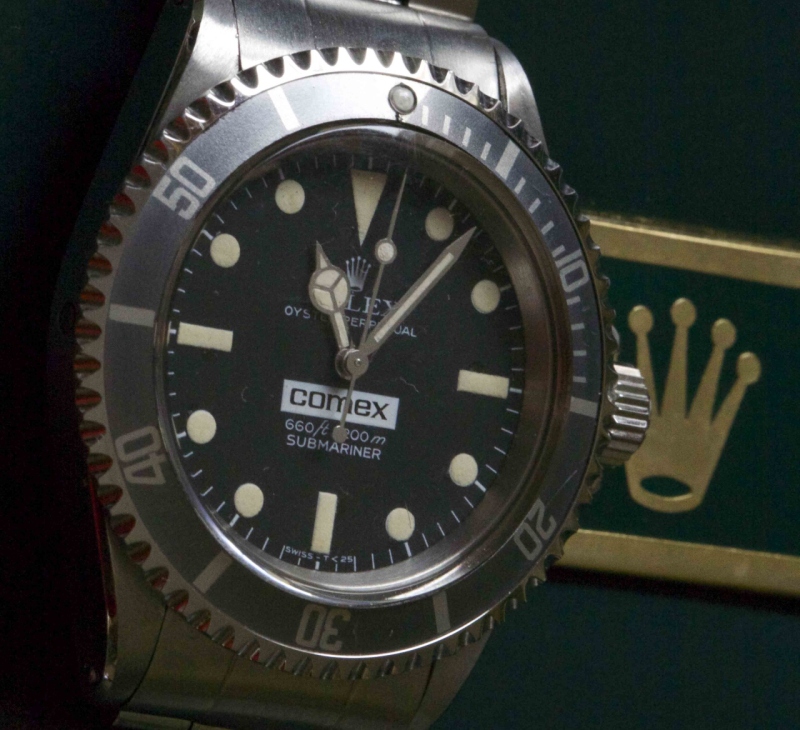
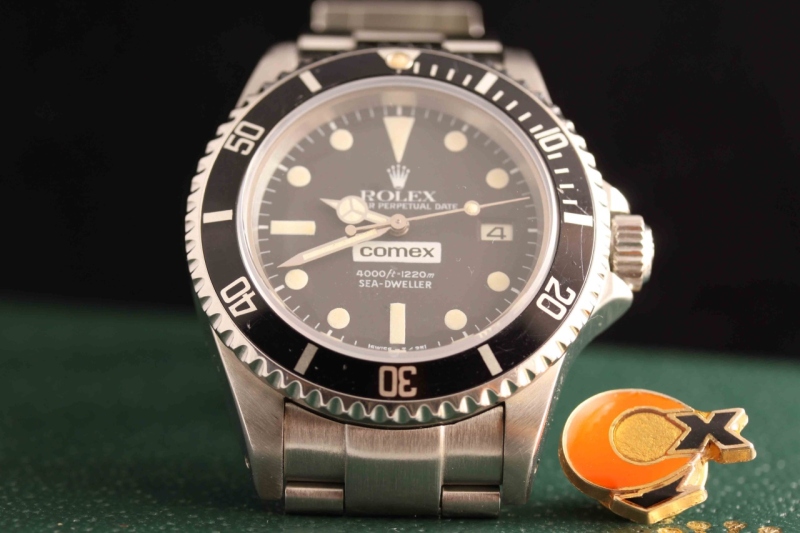
The 1680, however, is not a watch with a special historical interest…unlike for example the Milsub or Comex. These latter two have a very direct historical relevance. For such watches, I believe the importance of provenance and proof of such provenance becomes much more important. When Henry Hudson left Rolex, all sorts of spare parts were found cropping up for sale. Theoretically, these parts could easily have been used to form essentially new watches. Although they would be composed of entirely legitimate parts, they could theoretically be far from original. Now, with many tool watches, it is quite expected that they will have been put through their paces by their original owners. One would expect parts to have been replaced at service as the watch took the occasional beating. However, that is a long way away from artificially creating a new watch that looks like it was an original. I will give some examples……
My problem with many Comex is that, so often, its hard to tell whether a watch is authentic or not. I remember one story of a very plain Submariner that had no distinction on it at all that differentiated it from the mass-produced version. Yet, on its case back there was a small engraving of a very small number, indicating it was one of the very first Comex dive watches. On its own, I would have felt very concerned paying a Comex premium for such a watch, yet when it is being sold by an ex-Comex diver who details his story explaining how he came to be given the watch by Rolex and that he used it to test the watch when giving for Comex, then yes it becomes more credible and the value of that provenance rises considerably. Now, take another example of a similar situation…in this case a Comex logo dial on a 5513. Now, this is not such a rare Comex. However, when the number on the back of the case is engraved with a very low number AND there is a letter from the ex-Comex diver explaining how he was given the watch AND a similar letter from Henry Hudson at Rolex verifying the number of the watch with its serial number, well then in such circumstances the watch's papers become an extremely valuable component. In such a situation, the value of the provenance is in the region of 50% premium in my view. It provides a rich backdrop to the history of the watch not just verifying its authenticity (which of course it does) but also adding to that historical flavour.


One more Comex example….the Comex 16660 Matt dial. This is a watch that has been discussed on this forum before. Maybe 40-50 now exist……according to reliable sources (you know who you are!), out of these 40-50 examples of 16660 Comex, possibly 8-10 have original box and punched papers. Now, if i saw a 16660 Comex without papers, it is not that I would worry that it was a forgery, but rather that the full-kit version provides me with both some assurance of the watch’s veracity but more importantly a richer backdrop to its history. It makes it more "complete" from a collecting standpoint.

An important point to add at this juncture is the issue of believing that punched papers imply a watch is authentic. Such papers certainly add to the evidence in support of that, but faked papers can easily be made…easily. Buying authentic vintage boxes is not that expensive. Can a forger make forged punched papers and buy an original box and make a watch look like it has a full-kit? Of course. And herein lies the need to make sure that the watch in question, whether it is a mass-produced Sub or a virtually unique Comex, ticks the box of authenticity on all other fronts. Even experts can be fooled by a perfectly made forgery, so it is as well to have a watch verified by a number of people. Don’t ever trust that a watch is authentic JUST because it has box and papers.
With this caveat in mind, I will move on to more typical vintage references. Lets take the 1675 GMT. This is certainly in vintage range and with a very large number on the market available. Now, if i saw two versions and one had a stunning patina but no box or papers and the other had a standard dial but with box and papers, which would i take? Assume the watch conditions were otherwise identical…..I would take the one with the patina. Why? Simple, I spend most of my day with the watch on my wrist and not with the box or papers on my wrist. I look at the dial not the papers. My concern with the choice is that both watches are authentic. Once that hurdle is crossed, then my mind is focused on which watch appeals to me most. Having said that, of the 1675s that are for sale, as time passes, fewer and fewer will have original box and papers. As time passes, this historical flavour that is provided by box and papers becomes more attractive to a collector. How do I evaluate it on a watch like the 1675…. no more than a 10-20% premium in my view.
In some circumstances, it is quite clear that the provenance provided by box and (more usually) papers is quite significant to not only the authenticity of a watch but also to the historical colour of that watch. Such circumstances, however, are not normal. Rare Comex, Milsubs and such watches clearly carry enormous amounts of historical significance for Rolex. Provenance that adds to the authenticity of such a watch that at the same time provides a more complete history makes box and paper an important issue. For most vintage watches, however, the importance is significantly less. Forgers can create forged punched papers. Forgers can buy authentic vintage boxes for relative peanuts. For this reason, I believe that for most vintage pieces, a collector should not pay more than 10-20% premium for a watch. Assuming that a watch is correct and authentic, the single most important issue that a collector should consider is how much a watch makes him smile when he looks at it. To repeat the mantra…..its the watch that spends its day on your wrist, not the box and papers.
The Rolex Submariner reference 5513 is a notable example within the Submariner line, distinguished by its two-line dial and lack of a date complication. Produced for an extended period, it represents a core offering for collectors seeking a straightforward and robust tool watch. Its design emphasizes legibility and functionality, aligning with the original purpose of the Submariner series. This reference is recognized for its consistent aesthetic throughout its production run, with subtle variations in dial text and bezel inserts.
The watch features a 40mm stainless steel Oyster case, offering durability and water resistance suitable for its intended use. Powering the reference 5513 is the automatic Caliber 1520 movement, known for its reliability. The crystal is acrylic, contributing to the vintage character of the watch. The unidirectional rotating bezel, typically with an aluminum insert, allows for elapsed time measurement.
For collectors, the reference 5513 is a significant model due to its long production history and the various dial iterations, such as gilt and matte dials, which present distinct collecting opportunities. Its appeal lies in its foundational design and its position as a non-date Submariner, making it a desirable piece for those who appreciate the model's original form. The watch is often paired with an Oyster bracelet, completing its functional aesthetic.
There is very little that I disagree with on your thoughts. With the more rare pieces the paper punched, letters, receipts all help to paint the picture of the history of the watch. An as noted with rare pieces you don't have a s many pieces flying around so you may put a very high premium on papers like you noted as much as 50%. But again that is not the rule in assigning the premium. I also agree that as a general rule 10-20% range is about standard for sets and it can climb a little as you ge
.....I guess one of the things I wanted to get across is that so often new collectors will place a significant importance on box and papers as a form of authenticity passport....whereas in fact, this type of thinking only really applies to a few rare exceptions. Rather, as you put it well, box and papers furnishes the information we already have that allows us to make a more informed decision. In legal terms, its a weight of evidence issue rather than a verdict.
And what an insert you found! Best, my friend. Nicolas.
When a nice watc comes with the box and the papers, ok, I will not cry... But if the same very nice Watch comes without, I will not pass on it. An example? This 6542, which came with its papers. Not the box, but while I am at it, why not trying to hunt the box, and the correct booklet? I can tell you that it would have come without its papers, I would have jumped on it. At the beginning, though, I didn't even know it came with its papers. The seller didn't give me this precision. This is when I
....as some often see B&P as some form of guarantee....which it never is.
It was owned by a British serviceman Royal Navy. The case back is engraved. Bill
This thread is active on the Rolex forum with 25 replies. Share your knowledge with fellow collectors.
Join the Discussion →