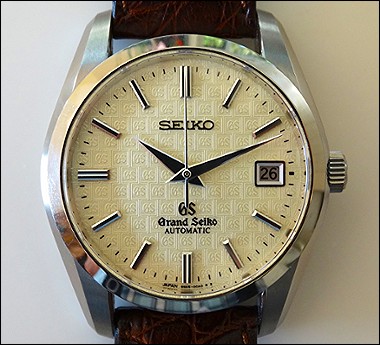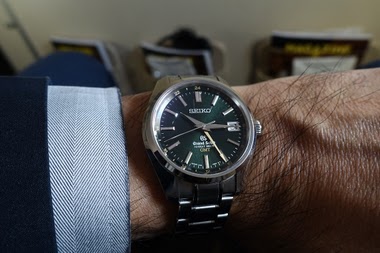
Manufacture
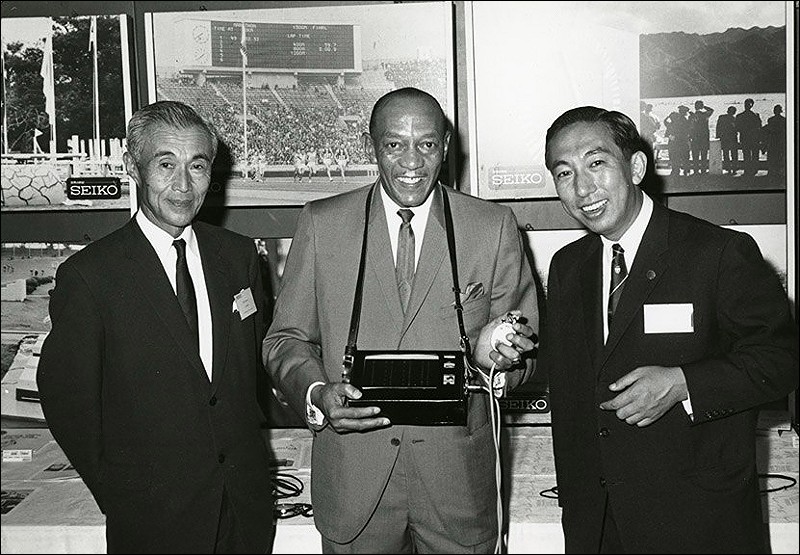
Hieraklion introduces a foundational article exploring Seiko's enduring commitment to accuracy, setting the stage for a detailed review of the Grand Seiko SBGH035. This post provides historical context, referencing key moments like the 1964 Tokyo Olympics, where Seiko's timing innovations challenged established norms. It serves as an essential prelude for understanding the technical prowess embodied in models like the SBGH035.


Even if quest for accuracy was always a part of
Seiko DNA, below is a brief summary of its history within Seiko Corporation.
Readers will find a great number of details and reviews on Internet, in the
document "A Journey in Time. The Remarkable Story of Seiko." (Seiko
Watch Corporation, on 2003), as well as in the book "Rattraper et dépasser la Suisse" (Pierre-Yves Donzé, Alphil
publishing, 2014).
Already victorious in all the accuracy competitions in Japan in the 50s, the awarding in 1959 of the 1964 Summer Olympics organization in Tokyo was an opportunity for K. Hattori and Co., Ltd (*) to confront with Switzerland and in particular with Omega. In 1963, the IOC formalized Hattori as timer of the Games. It was a huge success for the Japanese company: not only no single issue occurred during the event, but also, the 1964 Games were the first Games to rely on quartz-based systems for timing (ref. QC-951).

(*) The company K. Hattori and Co., Ltd. is renamed Hattori Seiko Co., Ltd in 1983 then Seiko Corporation in 1990.
(**) For more detail, Seiko Museum: museum.seiko.co.jp
In the middle of the 1960’s, the Geneva and Neuchâtel Observatories contests competitions of chronometry were another opportunity for K. Hattori and Co., Ltd to confront in an official and independent way with the most famous Helvetian brands.
The first confrontation with a mechanical movement took place in 1964 during the competition of the Neuchâtel Observatory. The results were more than mediocre: Suwa Seikosha factory came 144th and Daini Seikosha factory came 153rd. On top of it, no caliber received the highly expected "Chronometer" label.
This did not affect Seiko’s morals. They kept on pushing, and were awarded 9th place in 1966 (Daini Seikosha factory even came 3rd as manufacturer), then 2nd and 3rd place as manufacturer in 1967 (62 movements labelled "chronometer"), only beaten by an Omega chronometer.
In 1968, the Neuchâtel Observatory stopped their contest.
Seiko thus entered the Geneva Observatory competition, and in 1968 its mechanical watches monopolized 7 positions, just behind quartz watches (*)!
In just a few years, Seiko - Daini Seikosha and Suwa Seikosha factories – managed to be successful both in timing official events and beating the Helvetian brands in their homeland.
(*) The Geneva Observatory contest does not take into account the differences between quartz and mechanical movements.
Despite ending their contests, the Neuchâtel Observatory kept on testing movements. In 1968, certifications were awarded to 73 pieces of cal.4520, and they were sold in 1969 as "Astronomical Observatory Chronometer".

In 1969, Neuchâtel Observatory certifications were awarded to 25 cal. 4580, then 128 cal. 4580 in 1970. They were sold as “45GS-VFA”.
On their side, Suwa Seikosha released the “61GS VFA” automatic models (cal. 6185/6186-8000, 36000 alt./h). A women model “19GS VFA” is released in 1972.


In those days, the VFA were the most accurate watches (see lower chart) and today, they are considered "a must have" for collectors and aficionados, because they are the perfect association between the famous "Grammar of the Design" of Taro Tanaka and an extreme accuracy.
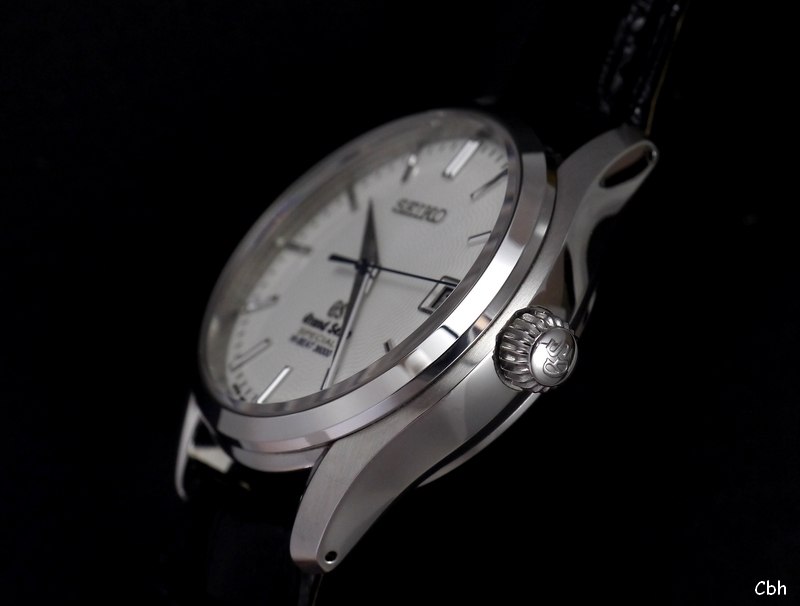
The "SPECIAL" words appeared for the first time in 1970 in the Grand Seiko collection. The term is not recent and proves how much accuracy is used by Seiko as a guarantee of technological sophistication but also perennially in their qualitative initiative.
The 61GS movement (6145/6146 at 36000 alt./h), the battle horse of the brand since 1968, is modified and finely adjusted to deserve the 61GS "SPECIAL" name. It is given for [-3; +3] s/24h accuracy and it is available for following references:
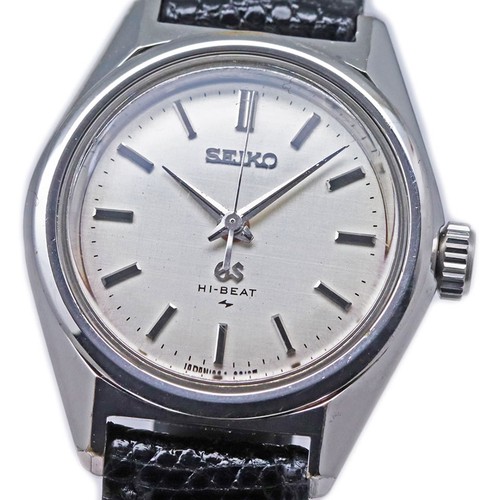
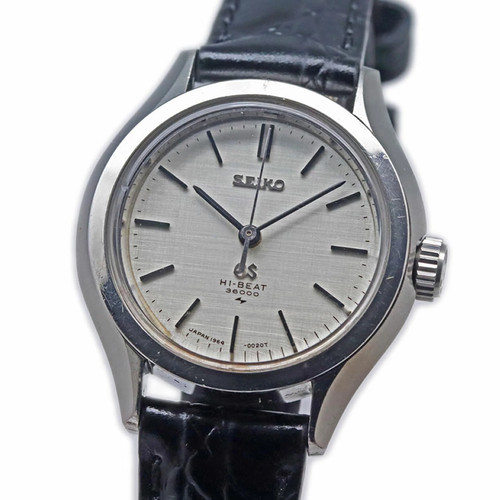
The "SPECIAL" term is displayed on the dial below the “GS” gold logo, followed by “HI-BEAT” and Suwa Seikosha logo. The SEIKO GS gold medallion is in the back of the watch because in those days, sapphire back was not common.


A "SPECIAL" caliber appeared again in a Seiko watch only recently, in 2012. As a matter of fact, quartz had been associated with Grand Seiko since 1988. Later in 1998, Seiko introduced a new mechanical movement in the Grand Seiko collection: the 9S55 with 50 hours of power reserve with a single barrel and in 2010, 9S6x series were introduced with 72 hours of power reserve.
But it is only in 2009 that the new movement 9S85 Hi-Beat 36000 alt./h enabled Seiko to improve accuracy : “Static accuracy” is the same between 36000 and 28800; the difference is in normal wearing conditions: +10/-1 sec. for 28800 VS +8/-1 sec. for 36000.
In 2012, Shizuku-ishi studio (inaugurated in 2004 in Iwate prefecture) used a finely adjusted
9S85 caliber to release a "SPECIAL"
movement fitted in 3 gold models ref. SBGH019 (18K white gold), 020 (18K yellow
gold) and 022 (18K rose gold).


Many excellent reviews of these watches can be found on Internet. The model SBGH035 shares a lot of common features with these 3 models.
Note that in 2014, Seiko also released, mainly for the Japanese market, the SBGJ007, 008 and 010 references fitted with a 9S86 Hi-Beat GMT "SPECIAL" movement. The production is limited to 200 pieces per year in each gold.
The 1966 Ford Mustang represents a significant year for the model, building on the initial success of its introduction. This reference is part of the first generation, which established the Mustang as a distinct category of American automobile. It continued to offer a range of body styles and engine options, allowing for considerable personalization and appealing to a broad market segment. The 1966 model year saw refinements rather than radical changes, solidifying its design language and market position.
The vehicle's construction typically featured a steel unibody chassis. Various engine configurations were available, including inline-six and V8 options, paired with manual or automatic transmissions. Specific dimensions varied slightly depending on the body style, such as coupe, convertible, or fastback. The interior offered a functional layout, with instrumentation focused on driver information.
This reference holds interest for collectors due to its place in the early history of the Mustang and its enduring popularity. The availability of different engine and trim levels means that specific examples can vary widely in their features and performance. It remains a recognizable and sought-after classic, often celebrated at automotive events worldwide.
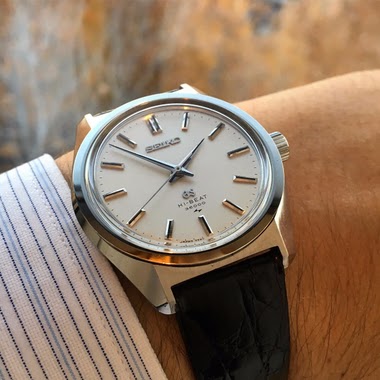
Definitely my grail Grand Seiko!
This thread is active on the Seiko forum with 1 replies. Share your knowledge with fellow collectors.
Join the Discussion →