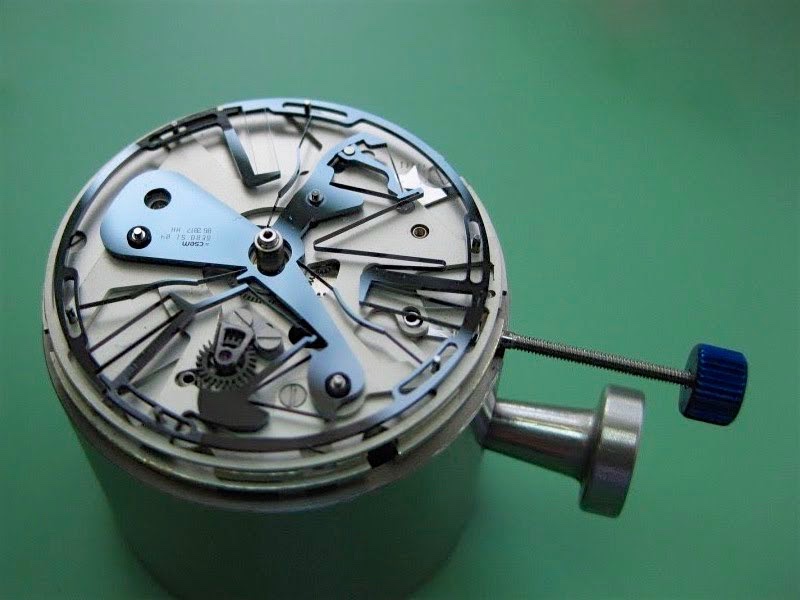
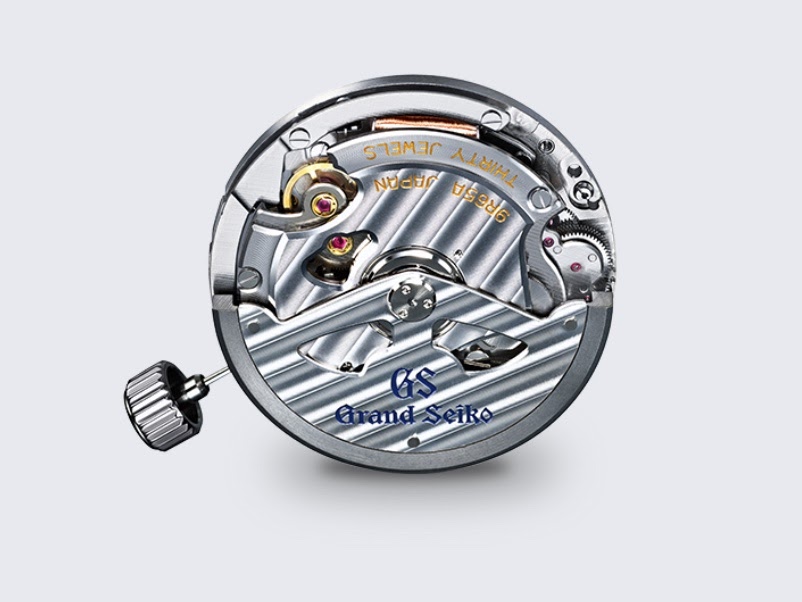
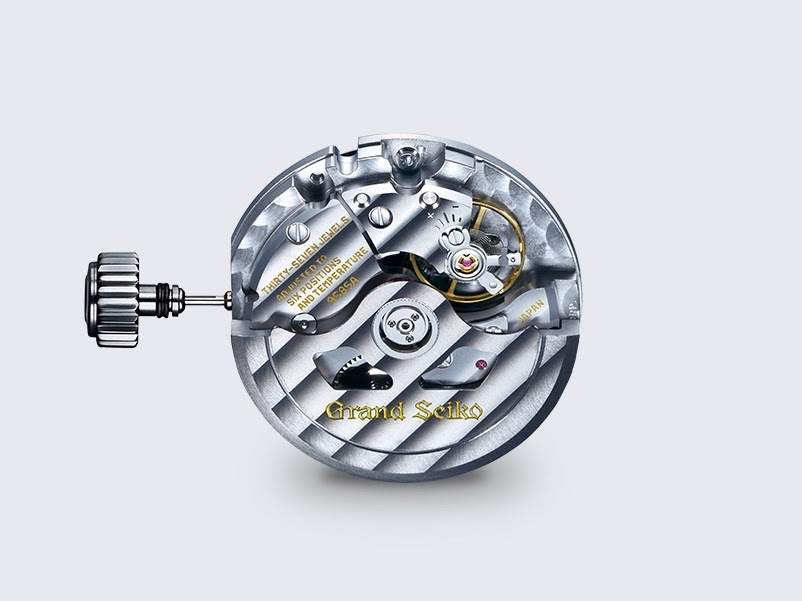
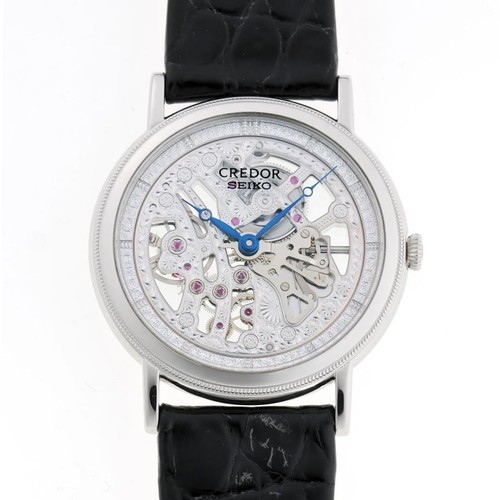
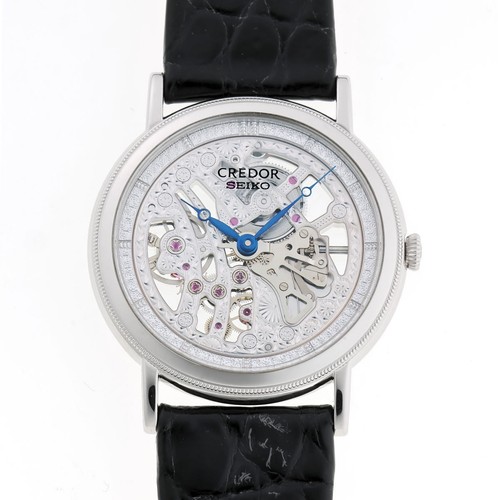
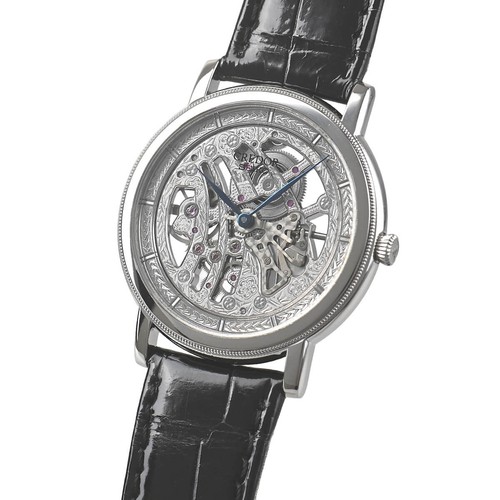
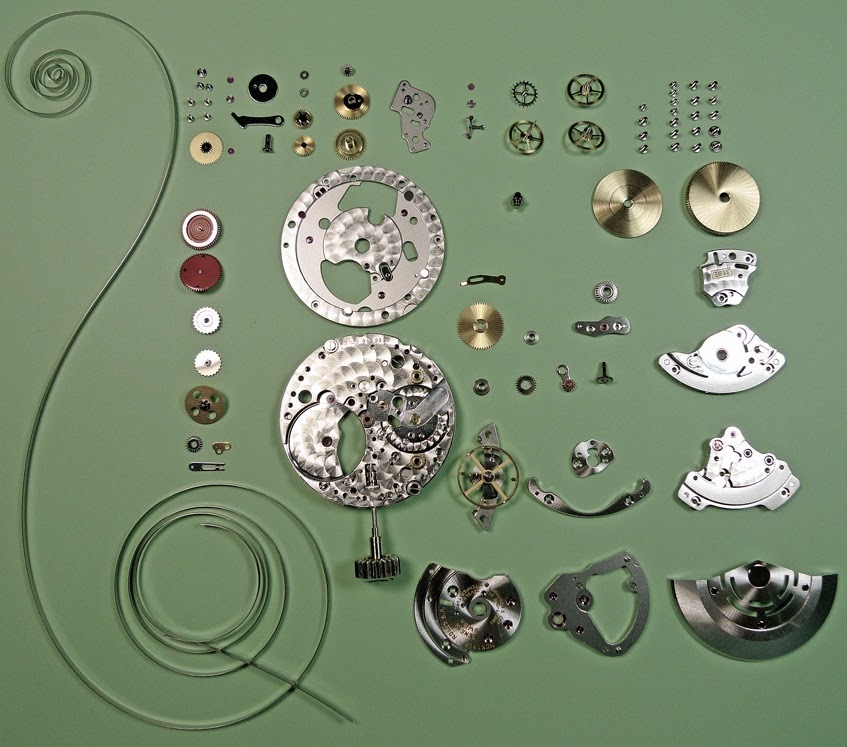
INTRODUCTIONWatch movements are tiny, wonderful, mechanical marvels. In essence, they cause the hands of a watch to reliably revolve at a precise speed, for at least one and a half days per winding, for many years. To achieve this, movements are made up of a small number of precision systems:
- mainspring with winding mechanism (manual and/or automatic) and a "click", to keep it from unwinding; and with "stop works", to avoid breaking the spring from overwinding
- gear train, which transfers power from the mainspring to the hands and accomodates the turning ratio of the second, minute and hour hands
- escapement, which releases power at a precise rate, so the watch "keeps time"
- plates and jewels, between which all the other components are fitted and retained in alignment
- dial and hands which form the "face" of the watch and indicate the time and other information
- case and crystal which protect the movement and allow it to be fastened to a wrist (or stored in a pocket)
- crown and setting works for winding the movement and adjusting the hands; extra crowns or pushers as needed for complicated watches
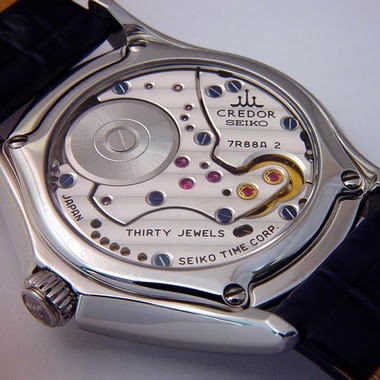
It doesn't matter whether we are talking about Seiko (first image)

or Rolex (second image), the basic componentry performs the same functions in each watch.
Of course there are differences in practice, materials and finishing, and each manufacture has its own patented or preferred solutions for things like automatic winding, or adjusting the escapement.
VARIATIONS
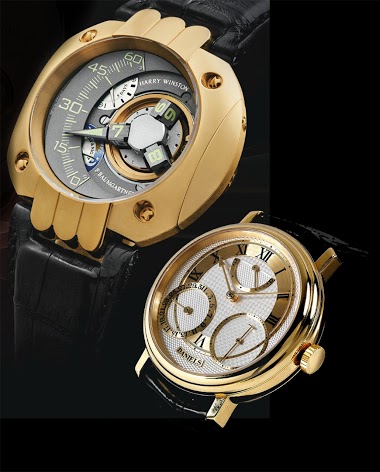
Esoteric movement designs might combine certain functions to save space - such as using the back of the case as one of the plates, or omitting the dial for cosmetic reasons, or putting the movement "into" the hands (UN Freak). For example, the ultra-thin Piaget 900P:
Or the minimalistic watches of Vincent Calabrese which show how little is required to keep accurate time:
As reported here recently, Zenith has shown a watch whose escapement is entirely composed of an oscillating silicon element, dispensing with balance wheel, pallet fork, etc. Again this improves accuracy and extends running time. However, it still contains all of the sub-systems I have described -- which exist in most watches.
CATEGORIES OF MOVEMENTS
Traditionally all watches were powered by one or more mainsprings (not having room for falling weights, pendulums, etc.) We refer to these as mechanical movements.
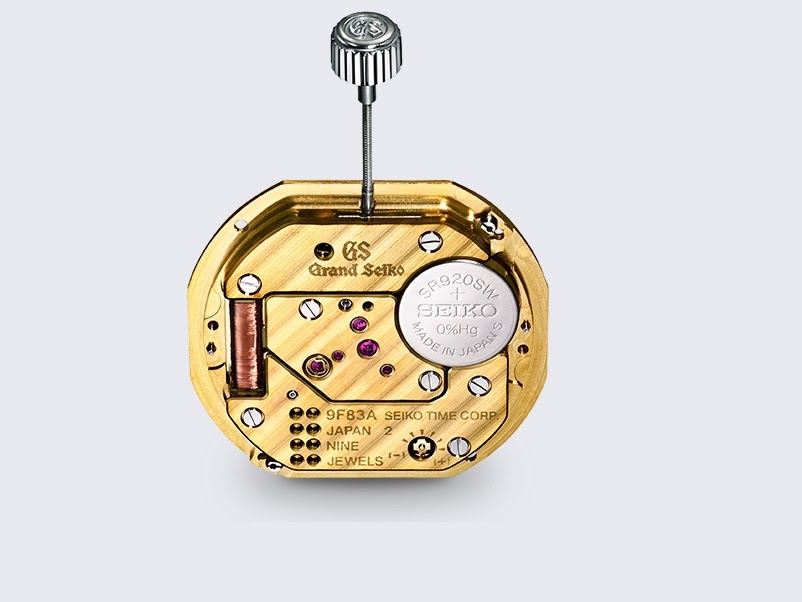
Hundred of millions of watches have been powered by quartz movements, since Seiko introduced the first Astron in 1969. Quartz movements are accurate, convenient, and run for several years before a new infusion of power (battery). And as long as they are analog watches with hands, the general arrangement of parts is the same as in a mechanical watch, with a battery and electric motor replacing the mainspring, and a quartz crystal timing circuit replacing the escapement.
For 15 years Seiko has also offered a hybrid model called Spring Drive, which has all mechanical systems described above, but replaces the entire escapement with a tiny generator and quartz regulating circuitry. This requires a few more components, but provides better accuracy and longer autonomy (running time).
NOTE: in this article, I am ignoring dead-end technologies, such as "tuning fork" movements. Other variants such as kinetic or solar watches simply generate power to drive a quartz movement.
COMPLICATIONS
In complicated watches, movements often serve as a "tractor motor". The name implies a power unit that can push or pull lots of connected accessories. This Bobcat tractor (motor, wheels and seat) can use many varied attachments to lift, scoop, drill, scrape, sweep, etc.
Complications can be designed "into" the base movement, or attached on either side as "modules". The former approach is frequently considered more graceful and "pure" whereas the latter can be more affordable and may offer some convenience in servicing.
There is almost no limited to the chronological, lunar, astronomical, astrological, musical and other variations that can be built into/onto a watch movement. When taken to extremes (I am thinking of JLC and PP here), this complication frenzy can result in a huge inventory of different movements. In looking through my 2017 Patek Philippe Catalog, I see 45 different movement photos.

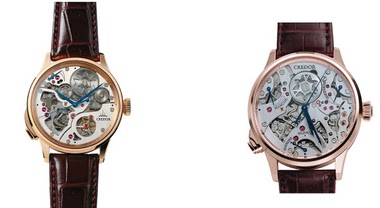
Thankfully for students of the Grand Seiko / Credor / Galante universe, there are not quite that many movements to consider. Why? Because high-end Seiko watches generally avoid complications. The ones they do offer don't take a tractor motor to drive a complication module. The movement is developed in an integral fashion with the complications.
SEIKO FEATURES & COMPLICATIONS
The higher line Seiko watches (Grand Seiko / Credor / Galante) offer a limited number of features or complications versus many Swiss brands. They include:
- Date
- Day of the week
- GMT (second time zone)
- Chronograph
- Moon phase
- Power reserve
- Minute repeater / sonnerie (Credor)
- Tourbillon (Credor)
Some manufactures may tailor movements for an exact application - such as sport watch, diver, see-through caseback, etc. but generally Seiko uses the same movements regardless of whether the case is stainless, titanium, gold or platinum. Depending on the model of watch, your preferred features may be offered with power provided by mechanical, Spring Drive, or quartz movements. I will list the variations that have been offered in the last decade or so. Since all Seiko movements periodically receive improvements to extend autonomy (running time) and to enhance accuracy, those changes will be pointed out as we go.
SEIKO SPRING DRIVE MOVEMENTS
The Spring Drive models provide at least 72-hour autonomy and accuracy to +/- 15 seconds a month. Recent high-accuracy, limited-production models have selected quartz regulators that improve accuracy to +/- 10 seconds a month. They are assembled by a small group of the most senior watchmakers. The new 9R01 movement adds three linked barrels and mainsprings, a single main bridge, and other details to give 8-day (192 hour) autonomy. This movement is produced in very small numbers by the Micro Arts Studio team.
7R11 High accuracy minute repeater
7R14 High accuracy, power reserve on the back
7R88 Hand wind, power reserve
7R89 Hand wind, power reserve, moonphase
9R01 High accuracy, 8-day with power reserve on the back
9R15 High accuracy with date & power reserve
9R16 High accuracy, with GMT, date & power reserve
9R65 Date & power reserve
9R66 GMT, date & power reserve
9R84 Chronograph with date & power reserve
9R86 Chronograph with GMT, date & power reserve
9R96 High accuracy chronograph with GMT, date & power reserve
SEIKO QUARTZ MOVEMENTS
This first list includes early production and/or small quartz movements used in some Grand Seiko watches.
4J51 No date & small (ladies)
4J52 Date & small (ladies)
8J55 No date
9581 No date
9587 Date
Just as Seiko mechanical movements have improved autonomy and greater accuracy through a longer mainspring of SPRON material, enhanced escapements, lower friction, etc. so likewise Seiko quartz models have been given their share of refinements. These include:
- twin-pulse motor for greater torque to drive larger, longer hands
- backlash reduction for no vibration on the hand tips
- instantaneous day/date switching at midnight
- sealed motor with 50-year lubrication
- temperature compensation
- adjustment screw on movement
- quartz crystals aged 90 days, tested & sorted for accuracy
This is the current line-up of quartz models:
9F61 No date
9F62 Date
9F82 High accuracy with date
9F83 High accuracy with day and date
SEIKO MECHANICAL MOVEMENTS
9S51 No date, automatic
9S54 No date, hand wind
9S55 Date, automatic
9S56 No date, GMT, automatic
9S61 72-hr autonomy, no date, automatic
9S64 72-hr autonomy, no date, hand wind
9S65 72-hr autonomy, date, automatic
9S66 72-hr autonomy, GMT & date, automatic
9S67 72-hr autonomy, date & power reserve, automatic
9S85 Hi-beat 36,000, date, automatic
9S86 Hi-beat 36,000, GMT & date, automatic
CREDOR SPECIALTIES
6830 Lo-beat 21,600, thin, decorated, tourbillon, hand wind
6870 Lo-beat 21,600, thin, hand wind
6899 Lo-beat 21,600, thin, skeletonized, hand wind

SUMMARY
I imagine you might have given up by now if you are not a big fan of Seiko. This review has clarified (for me) how the company continues to add incremental features to existing products - giving them a bit more accuracy, and a lot more running time, or more reliability, and better materials. Some of these things can only be done by a large, vertically-integrated company like Seiko, who is not afraid to try new things and insert them into the product line without too much fuss or hoopla.
Please let me know if you have additions or corrections to this article - and if I can clarify more details of the high-end Seiko universe.
Cheers,
Cazalea
PS - approx 35 movements