Cazalea offers an exclusive look into the Shizukuishi Watch Studio, the heart of Seiko's mechanical watch movement production. This third installment of his factory visit series focuses on the intricate assembly and craftsmanship behind Grand Seiko, Credor, Galante, and Ananta movements. His detailed report provides a rare glimpse into the precision and dedication that define Seiko's high-end mechanical watchmaking.
I suppose it is time to get to the heart of things for most PuristS (please don't give up here though).
Mechanical movements are assembled in the Shizukuishi Watch Studio at Morioka Seiko Instruments, Inc.
As you may recall if you've read previous reports, this studio is located hundreds of miles north of Tokyo in a quiet alpine area. We took the bullet train (more on that later).
Quiet forests surround the facility that was built in 2004.

A wooden clock in the lobby testifies to the forests outside. The leaves are just changing, so if you like that autumnal effect, SEIKO says this is a GRAND time to visit the area.

Notice the fabulous wooden watchmaker's benches! These are made to order and reflect the prestige given to this group of crafts persons. A couple dozen out of the 600 or so that work here.
What do the rest of the people do? Well, they create about 8 million movements a month for Seiko's main line of watches. All that in a room 50m x 70m, with production lines running 24 hours a day.
The craft studio has doubled their production of Grand Seiko, Credor, Galante and Ananta watches in the past couple of years, and look to doubling it again soon. Although I would guess that's about 10 minutes of the quartz production ....
If you are not so much into trees but like round shiny things better, you have come to the right place. Shizukuishi is full of beautiful round objects. Here are some base plates being prepared.

This lady is locking (welding?) the rotor bearing into the rotor.
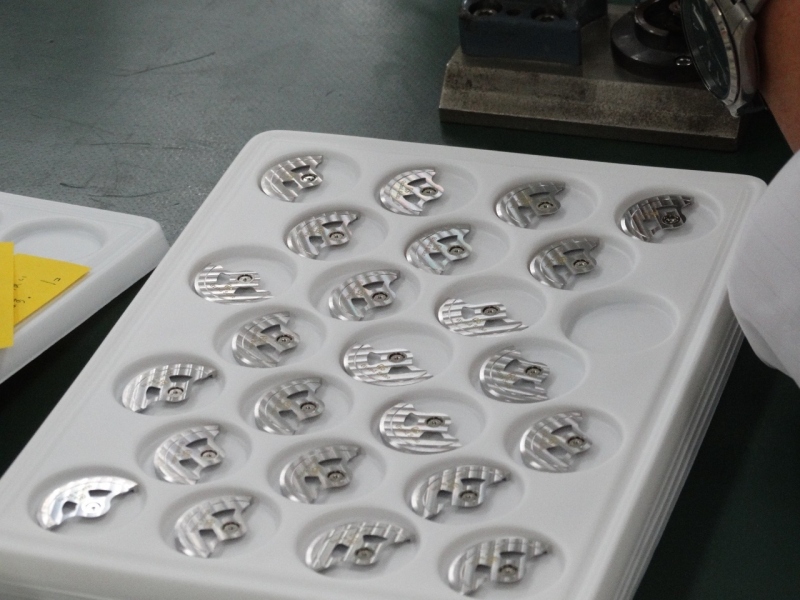
And here some finished Grand Seiko winding rotors, complete with bearings and fully decorated with lettering, gold paint and stripes.

Extra decoration or engraving is available too, on Credor models. This is too flashy for the Grand Seiko customer.
In case I forget to mention it elsewhere, this workshop produces all the cutting tools used here - from CNC cutters to special engravers formed to the palm of the artisan who wields it!
This master tweaks the hairspring by hand. He can do many a day - it only takes him a few minutes per watch. Most people could never do this.

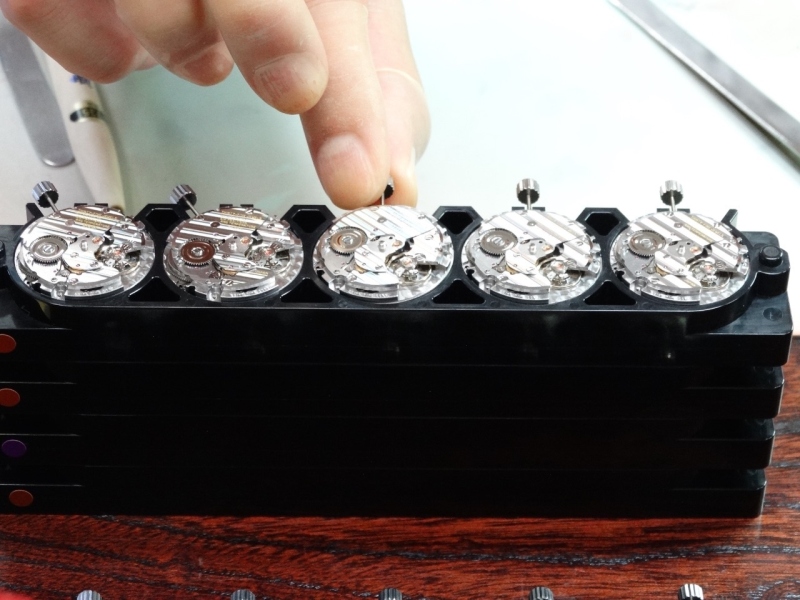
Meanwhile the rest of the movement is being assembled in the same room.

A few finishing touches and the watch comes to life before our eyes.

Finished movements (minus the winding rotors).

Raw movements are fitted with test dials and run for a week or two. This is observed by cameras to detect any issues.

Assuming everything goes as planned, then dials and hands are installed on the movements. (Those are made by Seiko; see Part 2 of my report)

This facility also produces some gold Grand Seiko watches.

Here is the dial setting person, hard at work.

Now that I know how much trouble it is to produce a flawless dial, I think I'd pass on working at the dial setting station.

I'm not sure the tweezers are gold, but they sure are pretty. And part of the job is the bend or curve the hands to match the domed dials. Sheesh! No pressure here, eh?

I was tempted to ask "Witschi Doing?" but couldn't think how that pun would play in Japanese, so I skipped it. These are Swiss timing machines.

She's doing another preliminary test before the watches get cased and tested.
This looks great in person. I hope the photo does it justice.
Finished and cased watches are pressure tested, then water tested in a big tank, then placed on a drying towel over a heated plate.

Everyone likes to see their name in lights, but the real stars today are the folks building Grand Seiko and Credor and Galante movements up in Morioka.
I hope this series is entertaining and enlightening.
Please continue to read as we go to Part 4.
Cazalea
This message has been edited by cazalea on 2014-10-19 20:23:36
This message has been edited by cazalea on 2014-10-21 05:47:25