Cazalea offers a fascinating exploration into the varied power reserve display designs across Seiko's Spring Drive movements. This deep dive illuminates how movement architecture dictates the placement and orientation of this crucial complication, providing valuable insights for collectors and enthusiasts alike. His detailed photo essay highlights the distinctions between manual-wind and automatic Spring Drive calibers, as well as specific models like Credor, Galante, and Grand Seiko.
Greenwatch mentioned the curious power reserve hand on his recently acquired GS Spring Drive "Snowflake". That prompted this post because it's quite an interesting feature that explains a lot about watchmaker movement architecture and designs.
MANUAL WIND
Many Spring Drives have the power reserve arbor (pivot point) at 7 o’clock position, but not all.
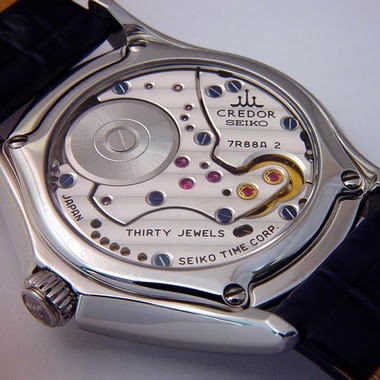
In a few instances, the power reserve is in a different place, such as between 10-11, on the back ... and in a few other display styles. Why? It appears that Seiko chose one location for manual-wind movements, and another automatics.
Here's the first Spring Drive (photo of my watch) from 1999. Pivot at 10:30 and Full is moving towards 12 Counterclockwise

Same display on my Credor Spring Drive from roughly the same period. Both of these movements are manually wound.
 AUTOMATIC WIND
Here's my Credor Spring Drive with power reserve pivot at 7 o'clock and Full is moving towards 6, also CCW. This is an automatic.

Here's a photo of my Galante Spring Drive with pivot at 7 and Full towards 6 CCW. Also an automatic.
And my early production GS Snowflake pivot at 7 and Full moving CCW towards the 8 o'clock position

Here is a Seiko Spring Drive as sold in the US (not GS or Credor or Galante or Ananta). Pivot still at 7 and full moving CCW towards 12 o'clock. Display takes up a huge portion of the dial
DIVER / SPORT WATCH
Here's a non-chrono Landmaster which if we rotate 30 degrees to put crown at 3 (instead of Seiko Diver customary 4 location) -- there's our Power Reserve at 7.

DRESS WATCHES
Top of the Line Credor Sonnerie has power reserve at 10 on the edge of the movement, with CCW movement towards 12 for Full. (The repeater mechanism power reserve is at 2 o'clock)
Credor Eichi I power reserve at 10 on the edge of the movement, with F moving CCW towards 12. Same as the Sonnerie.
Eichi II power reserve moved to the back exactly opposite its position on Eichi I thus rotation towards F is Clockwise.

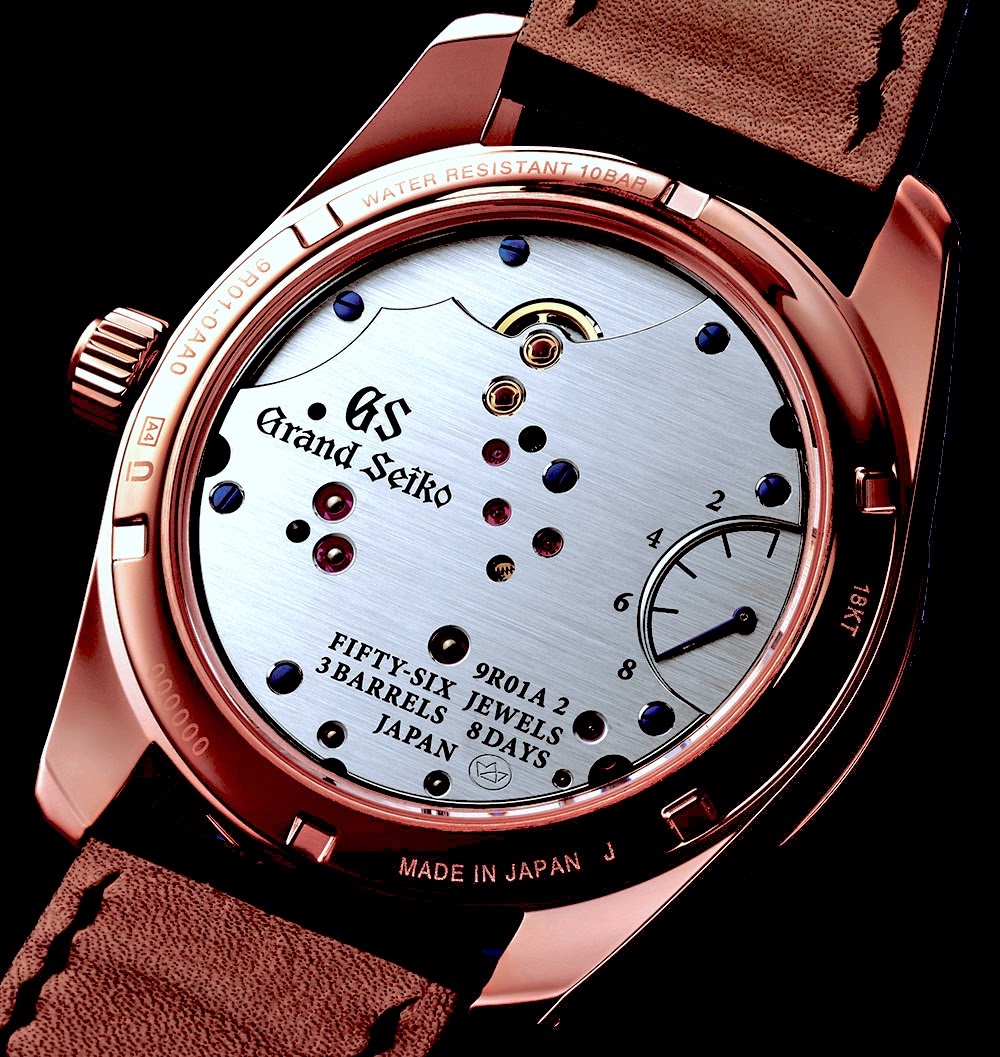
And on the 8-Day Grand Seiko watch, it's at 9 o'clock (if viewed from the front) moving CCW towards full 8 days.
TECHNICAL DETAILS & IMPLEMENTATION
Now technically, how do they do this? There is a module here in a Seiko diagram showing the Power Reserve Indication Unit

It appears to be a complex little item! As shown on this diagram framed in red:

And here as well in a different implementation. In both of these exploded views there is a tiny hand on the dial (in line with 7)

So while Seiko engineers and designers have moved the power reserve around, they haven't changed it much. Why?
Regarding the functional theory of the power reserve, Wikipedia says
"The principle of any power reserve device is that when the mainspring is wound either automatically or manually, a special train of gears connected to the ratchet wheel or the barrel arbor drives the power reserve indication (toward Full) showing the extent of the wind. The barrel’s teeth are also connected to the other side of this differential train so that as the mainspring's power is used, the power reserve indication moves in the opposite direction" (towards Empty).
Notice the similarities here in these two watch dials? (collage made from my photos and movement shots from watchdoctor blog). The scheme for a pocket watch is almost exactly replicated in the classic UN 1846. A series of gears carries the information from the back side of the movement’s mainspring barrel (left top shot; barrel removed) up to the 12 position and pokes through the movement to the 12 position on the dial side for display.

There are other ways to do this, of course, and AHCI members seem to delight in finding ways to use cones, levers and tricky methods to ascertain the power status and display it to you. One of the challenges is you need to take about 40-50 rotations of the crown and transform them into winding the mainspring AND providing an indicator with only 90-300 degrees of rotation. Remember in an automatic watch you can wind indefinitely (by hand or the rotor) because the mainspring slips in the barrel when it's fully wound. Of course some don't use a rotating indication - they find another approach, like this NOMOS and Panerai:
Seiko's approach is a no-nonsense indicator.
CHRONOGRAPH
Let me just confirm that last statement with some Spring Drive Chronograph pictures.
The GS Chrono has Power reserve at 7, CCW rotation towards full.

Another version - same arrangement. The scales are sometimes cryptic (holes, bars, colors, etc).

The Ananta Chrono has PR at 7 and CCW rotation towards full, with a huge, gaudy scale.

Seiko's limited edition mega-expensive Space Walk is different because the pushers and crown are at 12. If rotated so the crown is at 3, then the power reserve is there at 7, as expected. Here it is labeled like the fuel gauge in a car.

The same thing applies to the Landmaster Spring Drive variants (watches we can all afford, unlike Space Walk). Here's a variation which has its crown at 12. Rotate 90 degrees to get PR at 7.

Finally, here's the wacky upside-down IZUL chronograph dial (however the movement inside is the same except for date window location).
I hope Seiko fans find this information interesting. What you can learn is the engineers keep as much as possible unchanged, while designers change as much as they can!
Cheers,
Cazalea