WHL's insightful post delves into the Vacheron Constantin Caliber 4400, examining its aesthetic and technical merits in the context of VC's historical movement development. The author provides a critical yet appreciative analysis, comparing the new caliber to esteemed predecessors and discussing its suitability for contemporary watch sizes. This piece offers a valuable perspective on Vacheron Constantin's in-house movement strategy.
The announcement of a new caliber is always exciting for fans of a brand, and the inaugural watches that
host new calibers make for collectible watches. I remember awaiting VC’s development of its own calibers
after it acquired HDG in 1998 with great anticipation. The tonneau tourbillon caliber 1790 was and is
beautiful and a technical tour de force. The simple caliber 1400 was and is gorgeous with beautifully shaped
bridges and cocks. After the release of those two calibers the wait was on for an automatic caliber, and VC
did not disappoint with the 2475, launched in the Jubile 1755. Then there were the spectacularly
complicated calibers in the St. Gervais and Tour de l’Ile watches from the 250th anniversary set, the latter
being reworked into the regular production Patrimony Traditionnelle-Caliber 2755. Looking into the future,
we can expect an in-house chronograph from Vacheron Constantin. I expect to be blown away by it.

The complaint most heard about the 1400 caliber is that it is too small, at 20 mm, for
the size of watch that is in demand today. Philippe Dufour even mentioned this to
me when I met him in 20005, and that was in reference to the 35 mm Malte Grande Classique:
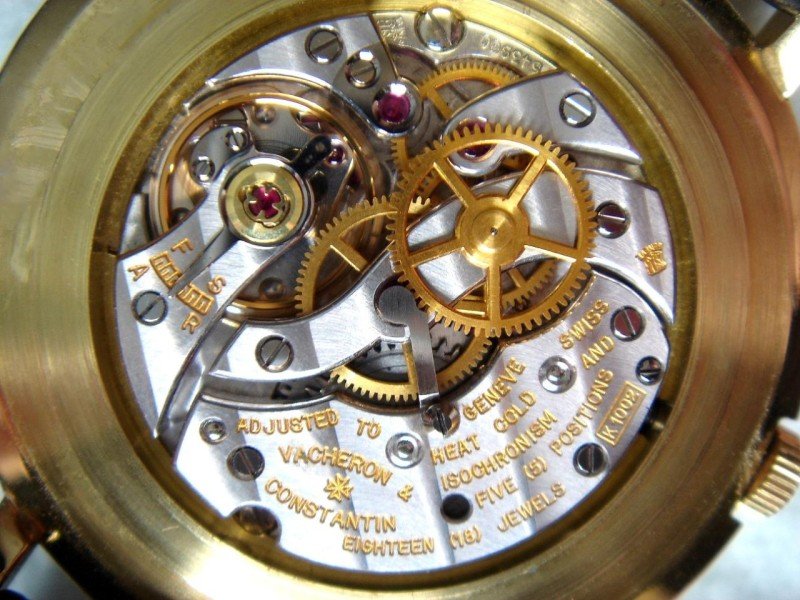
As beautiful as the movement is, and as worthy of showing it off via a sapphire
case back as in the Malte Grande Classique and Patrimony Small Seconds, VC
wisely chose not to do so when it introduced the Patrimony Contemporaine, a thin
two-hand watch 40 mm in diameter. The movement would appear to drown in open
space were it viewable through an sapphire case back.

It had been rumored for at least a year that VC was making a large ebauche more
suitable for placement in larger watches. That movement, which VC has designated
the caliber 4400, arrived just recently in the Les Historiques America 1921
watch.

I think the watch is gorgeous. I have no reason to think that the movement is
less than excellent in terms of its performance, reliability, and serviceability. And yet
I am marginally disappointed. Why? Simply because of my expectations
with respect to the aesthetics of the movements that go into a Vacheron Constantin watch.

Before I begin my criticism, let me say that there are many things that the
caliber 4400 does to satisfy my expectations. In addition to all the fine
functional and decorative finishing one would expect with a watch earning the
Geneva Seal, there are interior angles on the bridges that can only be executed
by hand-a trait often found in VC's finest movements, serving no purpose but beauty.

But it is the structure of the layout that bothers me. Here are some calibers
that VC has used in the past. The caliber 453 was VC’s workhorse in the 1940’s:
Back in the 1950’s VC used the caliber 1001 (subseconds) and 1002 (center
seconds):
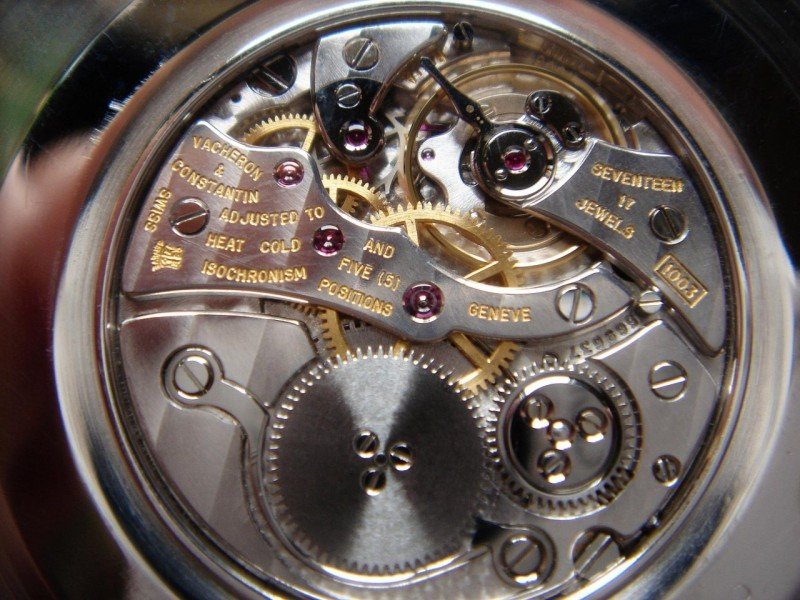
and the ultrathin caliber 1003:
From this historical record I am conditioned to want to see a separate cock for
the escape wheel in a Vacheron Constantin watch. Ideally I want to see separate
bridges for the escape and fourth wheels, as in the caliber 1400 and 1001. This is baggage
that VC carries from its long history and I think it should be carried forward. When Lange
uses the full bridge from the barrel to the escape wheel in its calibers, I don’t have a problem
with them for it-that is part of the Lange aesthetic. But when VC does, I do take issue.

Would this one aesthetic complaint be enough to stop me from buying a watch with
the 4400 ticking away inside it? Probably not, but it is a question that will be
in the back of my mind when I do look at watches with the caliber 4400 in them.

Bill
About the Gevril Tortue GV2 Ladies Polished Stainless Steel White Textured dial - Polished Stainless Steel Ref. 4400
The Fiftysix reference 4400 from Horological Meandering is a notable entry in the brand's contemporary offerings, distinguished by its design which draws inspiration from mid-20th century aesthetics. This particular reference is characterized by its balanced proportions and a focus on everyday wearability, positioning it as an accessible yet refined option within the broader collection. It represents a modern interpretation of classic watchmaking principles, aiming to appeal to a wide range of enthusiasts.
This reference features a stainless steel case, housing a Swiss Quartz movement. The case diameter is 40mm, providing a versatile size suitable for various wrist sizes. The watch is fitted with a sapphire crystal, ensuring durability and scratch resistance. Its construction allows for a water resistance of 30 meters, making it suitable for daily wear and incidental exposure to water.
As a quartz-powered timepiece, the Fiftysix reference 4400 offers reliability and convenience, appealing to collectors who prioritize precision and ease of maintenance. It stands as a testament to Horological Meandering's commitment to offering diverse options, from mechanical to quartz, within its product lines. The polished stainless steel strap further enhances its classic appeal, making it a cohesive and understated piece.
Specifications
- Caliber
- 1326
- Case
- Stainless Steel
- Diameter
- 40mm
- Dial
- Bracelet / Strap:
- Water Resist.
- 30 meters / 100 feet
- Crystal
- Sapphire
About the Vacheron Constantin Historiques Ref. American1921
The Vacheron Constantin Historiques American 1921 is a distinctive reinterpretation of a cushion-shaped watch originally produced by the manufacture for the American market in the 1920s. This reference is characterized by its unique diagonal display, with the crown positioned at the 1 o'clock position and the dial rotated 45 degrees clockwise. This design was historically intended to allow drivers to read the time without removing their hands from the steering wheel, offering both a functional and aesthetically unconventional presentation within the Historiques collection.
This particular iteration of the American 1921 features a case crafted from precious metal, often rose gold, with a polished finish that highlights its cushion shape and stepped bezel. The watch is typically fitted with a manual-winding mechanical movement, visible through a sapphire crystal case back, providing a power reserve suitable for daily wear. The crystal protecting the dial is also sapphire, ensuring clarity and scratch resistance.
The American 1921 appeals to collectors seeking pieces with historical provenance and an unconventional design. Its distinctive orientation and vintage inspiration make it a conversation piece and a unique offering within Vacheron Constantin's contemporary lineup. Various sizes have been produced, catering to different wrist preferences while maintaining the core design principles of the original 1921 model.
Specifications
- Caliber
- Caliber 4400 AS
- Case
- 18k rose gold
- Diameter
- 40mm
- Dial
- Silver
- Water Resist.
- 30m
- Crystal
- Sapphire