Manufacture
WHL presents an insightful interview with Christian Selmoni, Vacheron Constantin's Artistic Director, on the intricate art of designing watch hands. Selmoni's expert commentary sheds light on the precise considerations that go into determining hand lengths and proportions, revealing how these subtle details contribute to the overall harmony and legibility of a timepiece. This discussion offers a rare glimpse into the meticulous design philosophy at Vacheron Constantin.


Back in November Purist participant Tiggermelad had a question about the length of the hour hand in two models from the Traditionnelle family. He noticed that with some Traditinonelle models, like the manual winding reference 82172, the hour hand is shorter in relative terms than on the the self-winding reference 43075.

I asked Chistian Selmoni, Vacheron Constantin’s Artistic Director, about what elements go in to designing the hands for a watch and he gave me a thoughtful reply, which I post below in blue text. The length of the hands is just one element that goes into making a successful watch design, and the creators have to take many factors into account in order to bring off a harmonious combination that is pleasing to the eye.
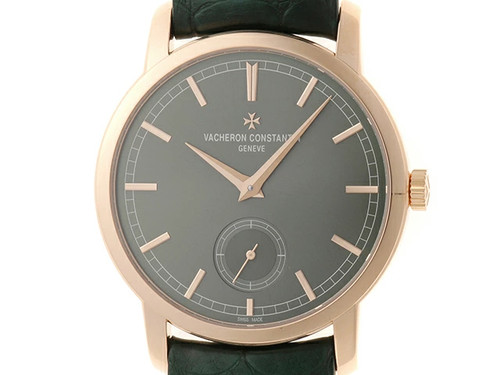
- The 1st hand to be designed is the minute-hand. Its length is determined by the position of the minute-track. Ideally speaking, the minute-hand should arrive in the middle of the minute-track zone.

Close up of the Jubile 1755 dial and hands
- When there is no minute-track, well…. we imagine it and so we determine the optimal length of the minute-hand; it must also aesthetically match, in such situation, with length of the indexes or numerals

Patrimony 81180
- Then, we determine the length of the hour-hand. For us, we don’t have an exact rule to determine its length. Our “in-house rule” is that the length of the hour-hand must be between 2/3 and ¾ of the minute-hand’s length.
- In certain cases, the hour-hand can be shorter, especially when indexes are too thick for the adjustment of the hour-hand - meaning it wouldn’t be possible for this hand to be above the indexes. In such case, the length of the hour-hand will be adjusted to arrive just “in front” of the lowest part of the index.
Like with so many aspects of watch design, determining the length of the hands is about striking the right balance between all the elements that are incorporated into the design. I find that Vacheron Constantin consistently gets these details right in their watches, especially the simplest of them, where any flaw in concept or execution of the watch will stand out in a negative way.

Historiques 1955, with no minute track
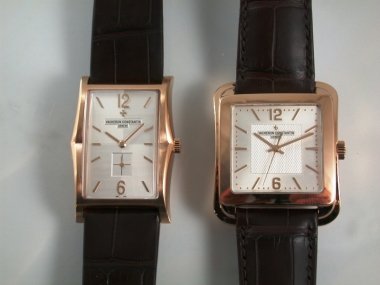
This topic did get me to thinking about why I have never actually gone through with purchasing form cased watches like the Historiques Aronde 1954 or Toledo 1951 where the dials are not round, as much as I like the watches and all that they do well:

It might be because I have an subliminal problem with the variation in the length of the hands relative to the hour markers and minute tracks, and becomes unbalanced to me eyes. Perhaps I should just get one and get over it.  I would love to hear the thoughts of owners who have both round and form Vacheron Constantin watches on whether such things ever cross their minds.
Bill
The Patrimony Contemporaine Bi-Retrograde reference 82172 represents Vacheron Constantin's interpretation of retrograde complications within the Patrimony Contemporaine series. This reference distinguishes itself through its bi-retrograde function, offering dual retrograde displays on the dial face.
The watch features a 42.5mm case crafted in 18k rose gold with a fixed bezel configuration. A silver dial sits beneath sapphire crystal, while an automatic movement powers the complications. The case offers 30 meters of water resistance, positioning it for dress watch applications rather than sports usage.
Reference 82172 appeals to collectors seeking complicated dress watches with traditional precious metal construction. The 42.5mm case size accommodates contemporary sizing preferences while the rose gold case material and silver dial combination provides classical color coordination. The bi-retrograde complication adds mechanical interest beyond standard time display functions, targeting collectors who appreciate visible complications in formal timepieces.
But it has not stopped me from getting a host of form watches! The anal side of me means I have to set the time on the 15/45's or close to it. Then, I am certain to hit the exact alignment. Mr. Selmoni's rules apply perfectly at those times! I must be one of those nuts who consider it a great game each day when I change watches to get the time as exact as possible. This means you set the minute hand exactly right so at the zero second mark, the minute hand is on the exact appropriate marker. Of
Thank you for relaying M. Selmoni's comments on the art of the hands. This only one of the details of a watch that VC more often than gets just right, IMHO. Seeing the 82172 and the 43075 side by side illustrates several things very well. The difference in the hour hands' lengths relative to the dials and minutes hands, as per the point of your post is clear, but for me both dials work very well. The size of the dial, the inclusion or exclusion of a seconds subdial both make a difference. It is
Peter took such a fab photo. I like to keep it very handy Joe
That is a great photo of one of my favorite pairs in all of Watchdom. For some reason, I tend to think of VCs in pairs even within my own collection. I should do a post on that theme one of these days. One of my little dreams is to own both the 1955 and the 1968 -- double the perfection! ;-) Interestingly, I think that Peter Chong took this photo of the 1955 and 1968 when they were just announced, if I am not mistaken. The crown on the 1955 in the photo in particular looks different than it appe
Robert, that 1972 dial pattern is absolutely mesmerizing. Lovely watches in this thread, a real treat to view. So here is a comparison of a couple of vintage form watches, ref. 4108 and 4166 from the 50s. Seems the length of the hour hands were designed/constrained to clear the sub-seconds hand. LOL, they are not hacking so absolute precision is not possible, however, back then who cared?!?!
Thanks for sharing Mr Selmoni's words. Very interesting. You also sparked the forum to to post some lovely photos. One of the things I love is looking at the overall proportions and designs of numerous pieces - especially over time. It is remarkable that a brand like VC can express its identity so clearly with seemingly so few elements at its disposal. I suppose the same is true of some other brands, but it feels like this is one thing that VC just nails. Thanks again.
This thread is active on the Vacheron Constantin forum with 7 replies. Share your knowledge with fellow collectors.
Join the Discussion →