Ornatus-Mundi presents a retrospective on the Zenith Chronomaster Open Power Reserve, highlighting its significance as a 'modern vintage' piece. The article focuses on two pioneering features: the openworked escapement and the early adoption of silicon components, positioning Zenith as an innovator during a transformative period for the brand.
Believe it or not, time flies by quickly and we have to slowly bid our goodbyes to a couple of references which signed the times for a 'modern' or rejuvenated Zenith, such as this
Chronomaster Open Power Reserve in stainless steel. The watch in particular offers two remarkable details, the
openworked escapement with its
silicon components:

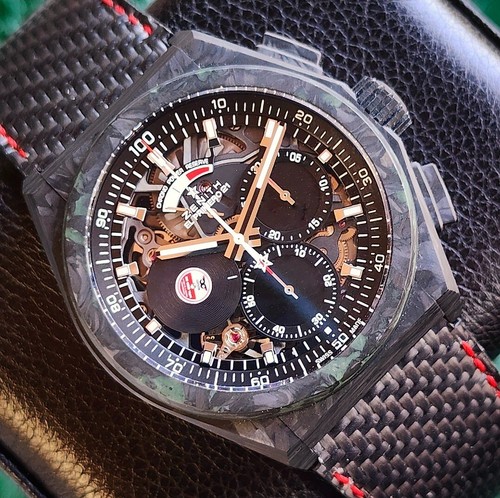
Presented in a case which is still very much the staple of Zenith's creation these days, the watch features a combination of elements which are either getting increasingly rare in Le Locle or are even no longer used: the hole in the dial to exhibit the escapement and the large central power reserve indication.
Both were elements brought into the Zenith line while the brand was under the guidance of Thierry Nataf.

The dial with its cut-out was very unusual at its time, but served as a billboard to advertise the El Primero's uniquely fast escapement, and a bit later, also the broad implementation of silicon escapement parts, for which Zenith certainly acted as one of the early adopters and pioneers:

The general dial design is still in use today at Zenith, if you refer to the 2017 iteration of the Chronomaster, for example (you might want to check
this report). The particular use of microcontrast and fonts (tachymetery scale) however indicate its vintage.


The power reserve hand is quite unusual as it is hinged at the center arbor of the watch, which affords a large and precisely readable indication.

The hand is heat-blued, which adds lustre and drama to the dial.

A brave decision for its time, Zenith did not shy away from using novel (and then still untested in large scale production) materials. The hot topic a decade and more ago was the replacement of traditional metals and rubies in the escapement by a crystalline material called
silicon, a tetravalent metalloid and semiconductor, primarily known from the electronics industry.

Since about the year 2000, silicon has found a new use in mechanical watch movements, where the material has
many advantages, such as its antimagnetic properties, further, it is thermally stable, shock resistant, and requires little to no lubrication. It can be produced in precisely defined shapes, with pieces identical almost like clones. And then there is this blue-grey metallic lustre:

The exchange of traditional escapments for silicon parts is relatively straightforward and does not require a re-design of the mechanics, which certainly encouraged Zenith pushing in favour of it (if the material would not deliver as intended, there would be little effort to replace the parts with standard ones later).
Below you see a silicon (left) and a conventional (right) escapement wheel: in terms of geometry and surface shapes the parts are identical and can be easily exchanged for each other in a given movement (which made it so easy for us to opt for a silicon escapement in the
Cronometro TP 2 PPRo-15 watch...).

Silicon is a hard but brittle crystalline solid, and therin lay the main reservations against this material. Everybody who ever held a solid block of silicon in his or her hands immediately will notice that debris continually break off the block. However, silicon has proven reliable and delivering the advantages that the material promises, so today, silicon parts are a mainstay in the watch industry.
And this also thanks to pioneers such as Zenith!
The remainder is a very common Zenith El Primero base movement, here designated Cal. 4021, indicating the power reserve function.

So, this is almost a sight from a bygone era:


With this short article I'd like to highlight Zenith's tradition as an innovator, a notion that these days gets pushed even further, with the Defy 21 and particularly the Defy Lab, both true novelties offering tangible practical benefits to the user (and the latter even rightfully a revolution!).
Zenith continues with its core competency, i.e. pushing the envelope of watchmaking technology. It is really a competence deeply embedded into the fabric of the manufacture which it has cultivated since decades now, even if it was mostly hidden and/or overshadowed with other elements (sch as the controversial open dial).
Thanks for reading,
Magnus