Vintage
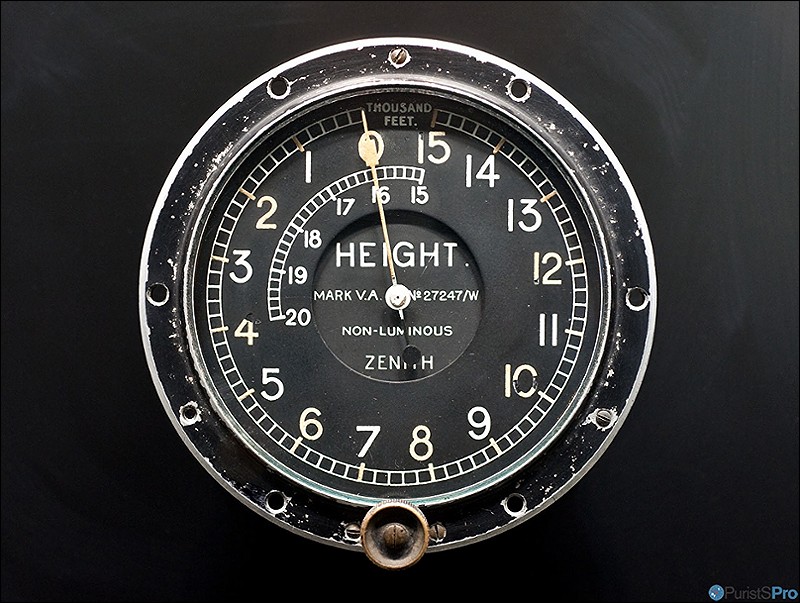
Ornatus-Mundi's post uncovers a fascinating historical detail behind the rectangular chronograph hand on the original 1969 Zenith El Primero. By tracing its origins to early Zenith aviation altimeters, he reveals how a functional design element from precision instruments transitioned into an iconic watch feature. This exploration highlights Zenith's deep heritage and the thoughtful integration of utility into its celebrated chronograph.


The Zenith El Primero Original 1969 is a re-edition that pays homage to the initial El Primero chronograph from 1969, known for its high-frequency movement. This model is characterized by its 38mm case size and distinctive tri-color sub-dials, which are faithful to the historical design. It occupies a significant place in Zenith's collection as a direct link to its heritage, offering a vintage aesthetic with modern manufacturing.
This watch houses the automatic El Primero Caliber 400, an integrated column-wheel chronograph movement beating at 36,000 vibrations per hour (5 Hz), providing a power reserve of approximately 50 hours. The case is typically stainless steel, and the dial features three sub-dials for 30-minute, 12-hour chronograph functions, and small seconds, often in contrasting colors. The crystal is sapphire, and the caseback is usually transparent, showcasing the movement.
For collectors, the El Primero Original 1969 is highly sought after due to its historical accuracy, compact 38mm size which appeals to a broad range of wrist sizes, and the technical prowess of the El Primero movement. Its design, particularly the tri-color sub-dials, is a recognizable signature of the original 1969 model, making it a desirable piece for those appreciating chronograph history and classic proportions.
is an interesting feature and I can't recall much discussion about it. Here's a similar black counterweight that is designed to be invisible - indeed I didn't even know that it was on this clock until I double-checked. My El Primero didn't have this rectangular item on its chrono hand - is there a category of watches that do and those that don't? whereas this rainbow has a pointy arrowhead with lume and of course some have the star counterweight and this one has an arrowhead and a star on the ha
Really cool to see the link between the history and more recent history! :) 1969 is my birth year, I really should find one.... Best Blomman
That is the kind of detail I love. We should try to gather them in one post. Thanks, Magnus. Le 8 juil. 2015 à 19:10, zenith watchprosite < [Email address suppressed for privacy] >
You and Michael Schumacher born; Richard Nixon was President; I was 18 then. No wonder I feel old today!
Magnus, Thanks. No many people knew about the altimeter hands' style. It makes sense for luminescent 'rectangle' on the hand as the dial was marked "NON Luminous". It is interesting to note that in 1910, they had not agreed a Universal convention for indicator direction (clockwise or anti-clockwise) for aircraft altimeters. This example indicates increasing altitude by the needle moving anti-clockwise. Regards, MTF
These early altimeters look to be based on lightly modified weather barometers. If you have one on your wall, you'll see that moving from higher to lower pressure (or say, Fair to Stormy) involves anti-clockwise hand rotation, as per going from low to high altitude. (As an aside, 1910 seems a little early for a 20000ft altimeter (if this is from a aeroplane))
This thread is active on the Zenith forum with 14 replies. Share your knowledge with fellow collectors.
Join the Discussion →


