A 21st Century Myth: the Opus V
foversta

Since 2001, the Opus collection from Harry Winston has given to talented watchmakers the opportunity to express their skills, to present their ideas, to develop their concepts with the certainty that their achievements would get a strong media exposure. It is indeed one of the great successes of the Opus collection: year after year, we wonder what will resemble the next Opus watch which will be unveiled at the Basel fair. The success of the collection also brings to Harry Winston a blow of projector. It is a very important consequence as the brand has had clearly the will to develop an ambitious watch collection.
Opus V is perhaps the watch which best symbolizes the first 10 years of this common history between Harry Winston and the watchmakers and designers who were involved in it. Indeed, it comprises all the characteristics of the ideal Opus watch:
• it presents a surprising design, not to say daring
• it proposes an original time display system specifically developed for it
• it has worked without any trouble from the beginning and has kept its reliability the years after
• it had a strong impact at the time of its presentation
• its incarnates the creativity and the talent of the independent watchmakers
The watchmaker who imagined this Opus V could only be one of most gifted of his generation: Felix Baumgartner, one of the founders of a brand which is familiar for us nowadays: Urwerk.
It is however necessary to come back to the year 2005. If the idea to found Urwerk came to Frei and Baumgartner's mind in 1995, if the brand has existed since 1997, until the presentation of the Opus V, the watches created by the duet Felix Baumgartner and Martin Frei consisted of an aesthetic and technical successful evolution of the old principle of the wandering hour. The Opus V made possible the evolution of the concept and to precede what the Urwerk 201 would be two years later.
A 1997 Urwerk:

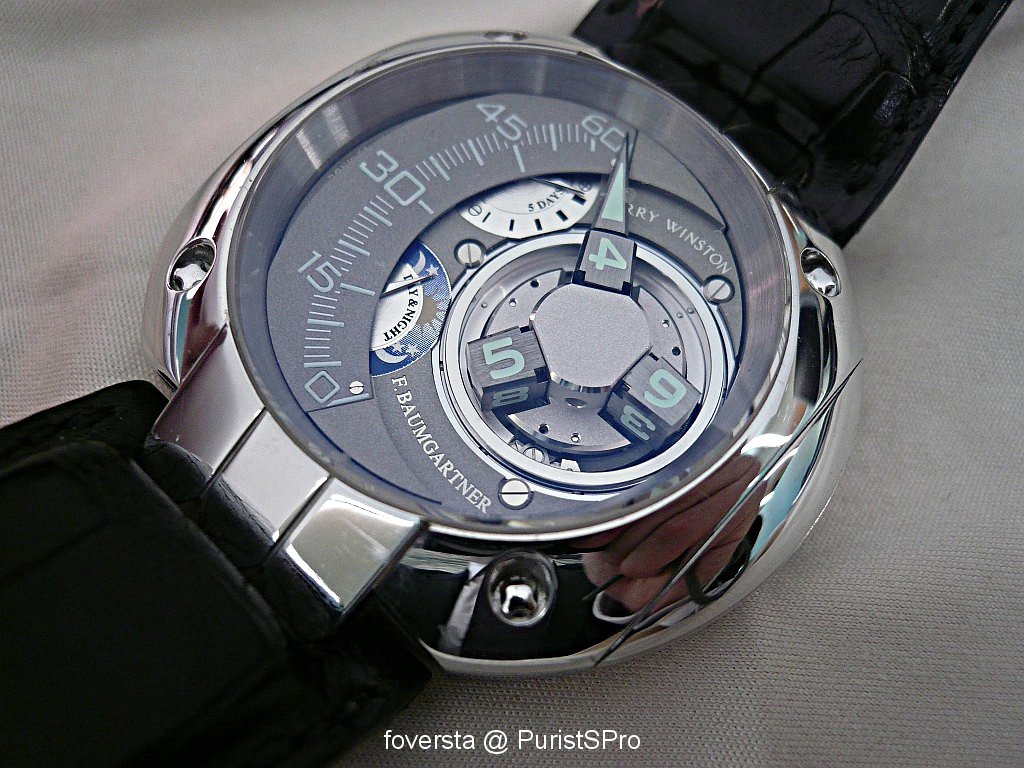
The Opus V indeed proposes a time display system which remains unique today: the hours are indicated by 3 small cubes which turn like dices (4 faces out of 6 are used to display the hours figures). The hour of reference corresponds to the figure being at the base of the large hand (or needle if you prefer here) which runs in front of the minutes track. But contrary to the Urwerk 201 in where each cube has its own needle and in where the three cubes&needles units turn regularly, here the single needle is separated from the cubes. The main feature of the Opus V is the behavior of this needle: it works in fact like a retrograde hand which at the sixtieth minute comes back instantaneously at the beginning of the track and in front of the adequate cube. The mechanical principle is thus different from the one of the 201. You will note that the minutes track is not exhaustive: the first and last minutes are not graduated but it doesn't a big trouble for the readability, the choice of drawing the 0 and the 60 having been privileged.

The result is visually spectacular: the slow ballet of the cubes is a true pleasure because beyond the fact that they carry out a rotation, they also turn on themselves in order that the good figure of the hours appears correctly. The watch does not comprise a second hand but two extremely useful complications can be found on the dial: a relevant night&day indicator (because the cubes are graduated only from 1 to 12) and the power reserve indicator. This indicator, graduated over 5 days, is a proof of the use of the Lajoux-Perret handwind caliber, with a 120 hours power reserve, as the base of the movement and which goal is to feed in energy all the time display module developed by Felix Baumgartner. This caliber would be also used two years later with the 201.

The newest 202 White Shark from Urwerk which is basically an automatic version of the 201. The base of the movement is an Girar-Perregaux automatic caliber. You will notice that three needles are used:

In spite of the differences which may exist with Urwerk 201, the work carried out on Opus V was extremely useful for the creation of this upcoming watch:
• it made it possible to develop the system of cubes animation
• it made it possible to know the performance of the Lajoux-Perret caliber (the previous Urwerk watches used a Peseux 7001 base)
• it allowed the development of a rare complication in the watchmaking landscape: the oil change indicator. It cumulates the years of operation of the watch and at the end of 5 years, the indicator announces that a revision is necessary. The indicator is displayed on the caseback of the Opus V.

The Opus V is not only one technical prowess, it is also a daring watch from the aesthetic point of view. That is due to its original time display but also to its case. This last takes again some “Harry Winston” codes like the parts at 6 and 12 o'clock which are arch-shaped and inspired by the entrance of the New York boutique. It is bulky (50mm diameter), very thick but also has some subtleties as for example the way in which the crown is hidden.
The Opus V is a very rare timepiece and was produced in a limited edition of 100: 45 with patinum case, 45 with pink gold case and 10 with platinum case set with diamonds. Due to the respective weight of the movement and of the case, the Opus V is very heavy and is not adapted to the small wrists. On the other hand, for the people who are able to wear it, the pleasure is real: you feel it on the wrist and the magic of its timedisplay operates.

The Opus V is a watch without any compromise, any concession what makes it very attractive. More than 5 years after its presentation, the Opus V is still one of the best symbols of what the contemporary watch industry must produce i.e. a watch resolutely thought and created in the present time, which is freed from some past references in order to bring new ideas, new concepts.

I wish to warmly thank the owner of this watch who gave me the ability to photograph it and to handle it. Taking into account its rarety and the difficulty of seeing it, it was one privileged moment for me.
Fr.Xavier
This message has been edited by foversta on 2010-10-26 14:26:44 This message has been edited by foversta on 2010-11-03 13:53:42
Opus V is perhaps the watch which best symbolizes the first 10 years of this common history between Harry Winston and the watchmakers and designers who were involved in it. Indeed, it comprises all the characteristics of the ideal Opus watch:
• it presents a surprising design, not to say daring
• it proposes an original time display system specifically developed for it
• it has worked without any trouble from the beginning and has kept its reliability the years after
• it had a strong impact at the time of its presentation
• its incarnates the creativity and the talent of the independent watchmakers
The watchmaker who imagined this Opus V could only be one of most gifted of his generation: Felix Baumgartner, one of the founders of a brand which is familiar for us nowadays: Urwerk.
It is however necessary to come back to the year 2005. If the idea to found Urwerk came to Frei and Baumgartner's mind in 1995, if the brand has existed since 1997, until the presentation of the Opus V, the watches created by the duet Felix Baumgartner and Martin Frei consisted of an aesthetic and technical successful evolution of the old principle of the wandering hour. The Opus V made possible the evolution of the concept and to precede what the Urwerk 201 would be two years later.
A 1997 Urwerk:
The Opus V indeed proposes a time display system which remains unique today: the hours are indicated by 3 small cubes which turn like dices (4 faces out of 6 are used to display the hours figures). The hour of reference corresponds to the figure being at the base of the large hand (or needle if you prefer here) which runs in front of the minutes track. But contrary to the Urwerk 201 in where each cube has its own needle and in where the three cubes&needles units turn regularly, here the single needle is separated from the cubes. The main feature of the Opus V is the behavior of this needle: it works in fact like a retrograde hand which at the sixtieth minute comes back instantaneously at the beginning of the track and in front of the adequate cube. The mechanical principle is thus different from the one of the 201. You will note that the minutes track is not exhaustive: the first and last minutes are not graduated but it doesn't a big trouble for the readability, the choice of drawing the 0 and the 60 having been privileged.
The result is visually spectacular: the slow ballet of the cubes is a true pleasure because beyond the fact that they carry out a rotation, they also turn on themselves in order that the good figure of the hours appears correctly. The watch does not comprise a second hand but two extremely useful complications can be found on the dial: a relevant night&day indicator (because the cubes are graduated only from 1 to 12) and the power reserve indicator. This indicator, graduated over 5 days, is a proof of the use of the Lajoux-Perret handwind caliber, with a 120 hours power reserve, as the base of the movement and which goal is to feed in energy all the time display module developed by Felix Baumgartner. This caliber would be also used two years later with the 201.
The newest 202 White Shark from Urwerk which is basically an automatic version of the 201. The base of the movement is an Girar-Perregaux automatic caliber. You will notice that three needles are used:
In spite of the differences which may exist with Urwerk 201, the work carried out on Opus V was extremely useful for the creation of this upcoming watch:
• it made it possible to develop the system of cubes animation
• it made it possible to know the performance of the Lajoux-Perret caliber (the previous Urwerk watches used a Peseux 7001 base)
• it allowed the development of a rare complication in the watchmaking landscape: the oil change indicator. It cumulates the years of operation of the watch and at the end of 5 years, the indicator announces that a revision is necessary. The indicator is displayed on the caseback of the Opus V.
The Opus V is not only one technical prowess, it is also a daring watch from the aesthetic point of view. That is due to its original time display but also to its case. This last takes again some “Harry Winston” codes like the parts at 6 and 12 o'clock which are arch-shaped and inspired by the entrance of the New York boutique. It is bulky (50mm diameter), very thick but also has some subtleties as for example the way in which the crown is hidden.
The Opus V is a very rare timepiece and was produced in a limited edition of 100: 45 with patinum case, 45 with pink gold case and 10 with platinum case set with diamonds. Due to the respective weight of the movement and of the case, the Opus V is very heavy and is not adapted to the small wrists. On the other hand, for the people who are able to wear it, the pleasure is real: you feel it on the wrist and the magic of its timedisplay operates.
The Opus V is a watch without any compromise, any concession what makes it very attractive. More than 5 years after its presentation, the Opus V is still one of the best symbols of what the contemporary watch industry must produce i.e. a watch resolutely thought and created in the present time, which is freed from some past references in order to bring new ideas, new concepts.
I wish to warmly thank the owner of this watch who gave me the ability to photograph it and to handle it. Taking into account its rarety and the difficulty of seeing it, it was one privileged moment for me.
Fr.Xavier
This message has been edited by foversta on 2010-10-26 14:26:44 This message has been edited by foversta on 2010-11-03 13:53:42
Comments:

DRMW October 26th, 2010-14:36
re: OPUS V " The Opus V is a watch without any compromise, any concession what makes it very attractive. More than 5 years after its presentation, the Opus V is still one of the best symbols of what the contemporary watch industry must produce i.e. a watch resolutel...


i_am_Sam October 26th, 2010-17:13
This is a true modern horological art! No message body

jek October 27th, 2010-05:56
Maybe the best Opus, but it's a hard fight! Congratulations to Felix that made a real unforgettable art work.
foversta October 27th, 2010-14:27
Yes, it is without any doubt one of my fav Opus... maybe THE fav one ? Fr.Xavier

SJX October 28th, 2010-09:09
One of the best Opus. A whopper of a watch and pretty darn uncomfortable on the wrist due to its weight but amazing nevertheless. It was special in its time. - SJX
0-10-8
Load More Comments
Next Article

foversta
Harry Winston Opus 10th anniversary: a celebration of a milestone
foversta
Last Thursday, Harry Winston organized an event in its Manufacture to celebate the 10th year of the Opus Collection. This event gave to Harry Winston the ability to remind us the influence of this collection on the whole industry and on the other collections of the brand (for example: the Opus 1 influenced the Excenter collection). There is a before and an after Opus. How can we describe an Opus watch ? It is a creative and innovative watch which is the result of a partnership between a major brand and a young watchmaker.
© 2017 - WatchProZine