
Independents
Pplater offers an intimate glimpse into the world of Spanish independent watchmaker Aniceto Jiménez Pita, an AHCI member. This post goes beyond technical specifications to explore Pita's fascinating personal journey and the humble origins of his craft, making his work discoverable to new enthusiasts.


There isn’t much that hasn’t already been written about the fascinating personal development of Spain’s pre-eminent watchmaker (and AHCI member) Senor Ancieto Jiminez Pita: for example, there is the thoroughly readable chapter in the book “Masters of Contemporary Watchmaking” by Michael Clerizo and, more locally, the excellent post with fantastic pictures brought to us on this forum by Fr. Xavier last year. Even so, it is fascinating to hear those stories from the mouth of the man himself – well, from the mouth of his interpreter anyway!
Senor Pita operates from a tiny storefront in an anonymous inner suburb 20 min from the centre of Barcelona. There is a fruit and vegetable store on one side of the shop and a series of apartments on the other side. The shop is only a few metres wide, and yet manages to serve several purposes: the front of the shop has counters and display cases full of new and vintage jewellery, watches and clocks; the midsection of the shop seems to be given over to a small, seemingly personal collection of various watches and clocks near an area used for watch repair whilst the master’s atelier – more like a Hobbit’s home, really – is at the back of the shop.

Senor Pita has been here for as long as he has been self-employed as a watchmaker–nearly 46 years now–but that may change in the near future as there is talk of moving to a new shop nearby, one where the master may focus on the practical realisation of his ingenuity whilst the master’s familiar (his son Daniel) continues to deal with the business aspects of the operation.
As the story is told, Senor Pita came from a very small town in the South West of Spain, Oliva de Merida, the population of which was less than 500 people. His father was the local cabinetmaker and Senor Pita was one of nine sons. They had to make their own fun, and make their own way. Senor Pita was fascinated by his father’s tools and by anything that was manual or mechanical. Given that there was no clockmaker in town, the local townspeople would invariably throw away their watches or clocks whenever they stopped working. The young Senor Pita gathered these up, first to play with and then to tinker with. In tinkering with them, he found that he was able to make them work again and began to understand the basic principles of clock making. Often, he would return these discarded clocks to their original owners in working order.
Word soon spread around the village; instead of throwing away their broken clocks and watches the villagers would bring them to Senor Pita who would often be able to repair them and would do so simply as a favour. Sometimes, the favour was rewarded with a small amount of money; sometimes, the favour was rewarded with gifts of food or invitations to the family dinner table.
Senor Pita remembers making his first watch at about the age of 12. In his early teens people brought to him increasingly complicated watches, some of which presented a challenge but none of which presented an insurmountable challenge. Indeed, he freely confesses that he sometimes fixed watches sooner than was apparent, but continued to tinker with them afterwards in order to gain repeat invitations to the dinner table!
At about the age of 17, Senor Pita took up a mechanical engineering traineeship (with Siemens??) but continued to tinker with watches in his free time and at night. He was able to get contract work as a restorer in the workshops of the larger retailers in Barcelona and after five or six years was able to leave his engineering role and support himself with watch, clock and jewellery restoration and sales.
Senor Pita’s first commercially produced watch (now called the 5.2) is a watch that he initially designed for himself in 1995 that found appeal amongst a number of his friends and clients. His driving ethos, he says, is to concentrate not on what can be added to a watch, but what can be taken away. He aims for simplicity: for simplicity in design, and simplicity in function.
So it is that the second Pita branded watch was named the ‘Minimal’, a 38 mm watch generally produced in a single hand format. It is ‘minimal’ because it has only one hand; it is ‘minimal’ because it has no function other than time; it is ‘minimal’ because its design is uncluttered and it is ‘minimal’ because it has no crown.

The absence of a crown is a feature common to nearly all Pita watches. Indeed, one of his two patents (expect many more to come…) has been taken out over his ‘TSM’ (time setting mechanism). The TSM permits the time to be adjusted using an element of the case rather than a crown as the adjustment mechanism–turning the case back in one direction moves the hour hand, and in the other direction moves the minute hand.
Most importantly, the absence of a crown permits the movement to be oriented anywhere within the watch case. Countless permutations arise from the possibility of deploying a relatively small mechanism in a relatively large case where no ‘anchoring’ of the movement is necessary.
Senor Pita took this concept to another level for the purposes of his AHCI candidature in 2005. He presented two watches in that year: the Carousel and the Sol y Luna.
The Carousel features a (you guessed it….) carousel, which rotates once every 12 hours. By fixing an hour hand to the carousel and setting the carousel in the centre of the case on bearings it is possible to have the entire movement rotate as part of the display of time. Additionally, Senor Pita generally fixes the winding rotor to the front of the movement in order to give the watch an additional sense of purpose and to give the owner and additional dash of theatre.

The Sol y Luna is an entirely different concept which (speaking personally) seems innovative in the way that solar-powered nose hair clippers are innovative: they fulfill their intended function, they fulfill it in a new and complicated way, but who reaches for the solar-powered nose hair clippers ahead of the scissors?
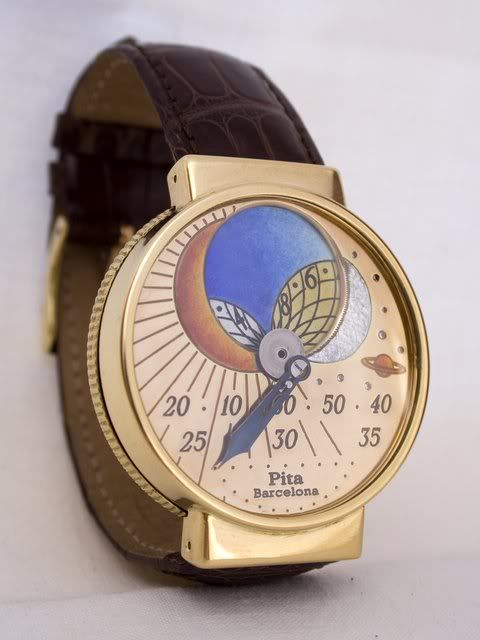
Even so, the large aperture on the face of the Sol y Luna is a feature of which Senor Pita is (justifiably) proud. It has enabled him to provide a large and graphic representation of the sun and the moon on the face of his watch in a way which leaves no doubt as to their meaning and which does not require a magnifying glass for plain viewing. Senor Pita gently notes how many other manufacturers seemed to think, shortly after 2005, that it would be a good idea to introduce a large aperture into the faces of their own watches. Stop and think about it – he’s right, isn’t he?
But we are getting ahead of ourselves…
It was a balmy but humid summer’s day in Barcelona when we arrived at the pre-appointed time for a meeting with Senor Pita and his son Daniel at their atelier. The shop was abuzz with the lisping lilt and passionate gesticulation of customers or friends (probably both). No one, however, seems to be in very much of a hurry to get anything done, and it was not even siesta time!
We were very warmly greeted by Senor Pita himself who immediately apologised for the fact that his English was rudimentary at best, as if somehow we should be entitled to expect otherwise. Senor Pita then introduced us to his son Daniel whose English is completely fluent (due in part to several years spent at university in England) and who has obviously translated for his father on a regular basis given the almost psychic way in which they communicated.

Daniel explained that his father is fluent in Spanish, Catalan and German. With no disrespect to our German friends, the obvious question was “why German?”. Daniel explained that his father is entirely self-taught, and consumes whatever books he is able to find on the subject of watchmaking. Very many of these are in German or French: he began with German, and so it rests.
Catalan, of course, is the native language of the Spanish region of Catalonia which to this day is fiercely parochial. Many Catalans continue to press for a return to independence. Whilst there are many similarities between Catalan and Spanish, there are also, equally, many similarities between Catalan and French, which is not surprising given that France is but very few kilometres north of Barcelona.
As an interesting aside, Daniel is also fluent in Catalan and he observes that the learning of Catalan is on the rise, most especially amongst the younger generation. As previously mentioned, Daniel is effectively fluent in English; he is fluent in Spanish (of course) and is presently learning Japanese – something which is likely to come in very useful given the emergence of the Pita brand in the Asian market.
We had thought that our visit (arranged a relatively short notice) was likely to be an unwelcome interruption of the day’s activities in the atelier. As it turned out, nothing could have been further from the truth: we were very warmly welcomed, and Daniel has a knack for knowing precisely what is likely to interest any watch enthusiast when visiting the atelier of a master. He barely drew breath translating for his father as the two of them reached here and there for cases in precious metal, prototypes, straps, sketches, moulds and all manner of other interesting things.
As Daniel explains, there is relatively little by way of available resources in Spain. Over the years, his father has had to develop a self-sufficiency in making the various parts which go into his watches or, alternatively, finding ingenious ways to circumvent the unavailability of parts. He says, more sadly then bitterly, that (in the early days at least) there was very little collegiate support or assistance coming from Switzerland. A Spanish watchmaker in a Spanish market – self trained, at that – was not taken particularly seriously.
Conversely, the fact that Senor Pita was not Swiss assisted his reputation somewhat in the home market and in other less traditional markets such as Japan. For example, the Pita family has now developed a very close relationship with another family-owned business in Japan doing sensational work with sapphires and crystals. For the moment, nothing more may be said of that relationship – in the fullness of time that will be the prerogative of Senor Pita.
The resourcefulness and self-sufficiency of the autodidact is not to be underestimated. Whilst he may not have hundreds of patents to his name (yet), it is clear from a perusal of a host of dated sketches and notebooks that Senor Pita was the first to imagine (or reimagine) certain features in watches which we presently associate with other, sometimes major, brands. This is a man whose imagination outruns his capacity for production or even documentation: Daniel’s application of sound business principles (amongst his other talents, Daniel has an MBA) will doubtless restore the balance.
We were given the tour of the ‘Tardis’ of a workshop: Daniel showed us the sketches that his father had been making even that day for a watch to go into production. We saw the moulds from which prototype cases will be cast using the ‘lost wax’ method, and then had the opportunity to handle some of the unfinished prototype cases and other parts on which Senor Pita had been working that day.

The purpose of each piece of machinery was explained to us and we were introduced to the to other artisans then working at the atelier (each, at the time, involved in manufacturing a piece of jewellery). Spain is said to be a bastion of anarchy and this atelier seemed to be a leading example of the movement, but as Daniel feverishly translated for his father, order rose from chaos.

Whilst in the workshop we were shown the Oceana, a model of which Senor Pita is very proud. In the context of all that he had done, and all that he could be doing, it seemed anomalous that Senor Pita should have applied his talents to an ‘extreme’ dive watch. Daniel explained that his father thought that it would be possible for him to add something to the pantheon of watch design by making a dive watch with no weaknesses–something fit for purpose.
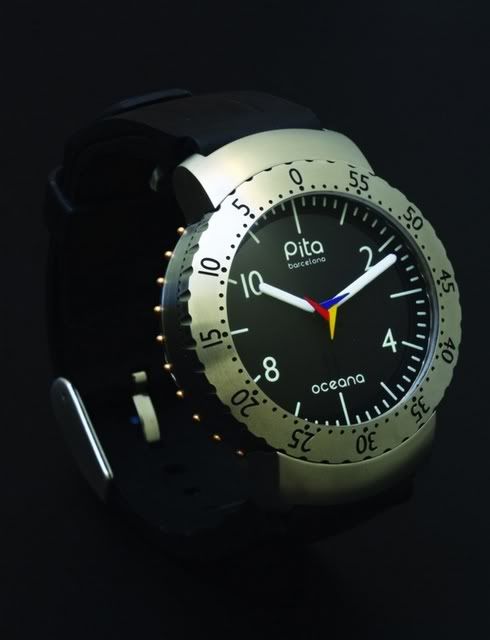
As you know, the Oceana now is available in two iterations–the 2000m and the 5000m WR. The true novelty in these watches is that Senor Pita has eliminated all of the traditional points of weakness–crowns, gaskets, seals and the like. The watches require no helium escape valve; no oil–immersed movement.
For this to be possible, the watch movement is sealed entirely within the case. In fact, the crystal (which is more than 8 mm thick) nestles the movement and is, for all practical purposes, the case. The case back (with walls up to 3 mm thick) forms a kind of exterior case. The two fit together with friction; the wedge-like design of the crystal is such that, as water pressure increases, the profile of the crystal alters ever so slightly, increasing the tension between the crystal and the case, further enhancing the water resistance.
So, how do you adjust a watch with no apertures, no crown, no crown stem? Answer: magnets. Yes; magnets – a solution which runs contrary to the common wisdom of watchmaking. Senor Pita is unperturbed about the mild controversy which his solution invoked amongst fellow watchmakers. However, when one of Switzerland’s most esteemed watchmakers in the form of Monsieur Dufour observed ‘why not?’, Senor Pita was vindicated. By reason of the placement and strength of these magnets, he asserts, they have no detrimental effect on the mechanism of the watch. Asked whether there is a risk that the magnets will become ineffectual – de-magnetise – with age, he replies that they have a ‘half-life’ likely greater than the life of the watch owner.
Make no mistake; a great deal of thought has gone into this watch. For example, one might have thought that the rotating case back of the watch would be prone to accidental rotation, affecting the setting of the hands. However, the case back is stippled with a row of small rivets protruding from its circumference. The rubber strap, meanwhile, is designed with a projection just beneath the point at which the strap meets the case on either side. As the watch is strapped on the projections are compressed against the rivets on the case back and - voila! – the case back is rendered immovable. Even the strap has been the subject of countless designs and experiments. It now features a chamfer which dovetails with the increased angle of the buckle to prevent that ‘bump’ that occurs on so many straps behind the tang – it sits dead flat, and very comfortably.
Apparently a dive watch worthy of the name must have a second hand, so that there can be no question that it continues to work whilst underwater. The Oceana has a seconds indicator in the form of a tricolour ‘windmill’ on the seconds pinion. Here’s another touch of brilliance: the seconds indicator also serves as a depth gauge. Its three vanes are painted red, yellow and blue. Each of those colours disappears, one by one, as a diver reaches certain depths. The colours in the visible light spectrum are neutralised as they pass through water in the order of their wavelength (i.e. the order of the colours in the rainbow). Red is neutralised at about 3 metres, yellow at about 15 metres; if you see blue disappear, then you’re in trouble!
It was terrific to see Senor Pita so passionate about his dive watch. Do you remember those kids at school who could solve Rubik’s Cube in about five seconds with hands twisting so quickly that you couldn’t follow, no matter how hard you tried? Or your grandmother knitting, almost subconsciously creating a complicated cable pattern whilst listening to her ‘wireless’, rocking in her chair and gently chiding your grandfather for dropping ash from his pipe on the best rug? That was Senor Pita with his Oceana. Even as we talked, animatedly, in his tiny atelier, he slipped off his own watch (a DLC cased 2000m on NATO strap) and in a matter of seconds – without even looking – broke it down to demonstrate its construction.
This is an imposing watch – the case of the 2000m stands 18mm high, and the 5000m at 21mm is more half as high as it is wide.

Still, as impressive as it was, we weren’t here to see the Oceana. Knowing this to be so, Senor Pita generously invited us to join him in his apartment office nearby, where he produced several boxes laden with prototypes, ‘archival pieces’ and his collection to date.
This man should have been a burlesque performer: he kept the rows of watches discreetly covered as he revealed them, one by one, like some excruciatingly tantalising striptease, working from the simple, to the complicated, to the extraordinary. All the while he spoke rapidly and gesticulated passionately with Daniel translating seamlessly both ways; he moved excitedly from box to box, from notebook to computer, from sketchpad to catalogue, like the Spanish equivalent of a squirrel on speed. On more than one occasion he halted halfway through a story or demonstration, grabbed another watch and started off on the next fascinating anecdote. It was exhausting just watching him!


The first watches to come out were the ‘Minimal’ series. Most, of course, were single handed twelve hour pieces, but there was also a two hand piece and a one hand twenty four hour piece. Even the pieces from the boxes were a wide assortment – ‘Breguet’ hands, sword hands, cathedral hands, enamel dials, bare metal dials, pastel dials, Roman numerals, Arabic numerals, no numerals. Then out came the sample book: sleeve after sleeve after sleeve of dials of all colours and materials – take your pick!


Prior to this visit, the Minimal watch which had most appealed from a personal perspective was the most simple; white dial, no numerals, plain hand: that is, after all, what it is supposed to be all about. Conversely, the least appealing had been the bare metal dial with blue enamel rectangles apparently cluttering its circumference.

It all came together in an instant, however, when Senor Pita explained that those rectangles were anything but a convenient design. Sure, the outer squares represent the hours, the medium size rectangles represent the half hours and the slender rectangles represent the fifteen minute divisions. Much more importantly, though, this design echoes the very fabric of Barcelona: the enamel highlights used by architects such as Gaudi, Domenech and Puig; the deep azure blues used by Miro and Picasso; the fractured mosaic embedded in the buildings, monuments and pavements of Barcelona. Only upon meeting the watch in its native habitat does this become blindingly obvious: it is Senor Pita’s simple paean to the city that has adopted him, and which he is now doing his bit to represent.


From the Minimal we moved to the Carousel, with Senor Pita demonstrating how the movement rests without anchor in the case. He has experimented with ball bearings of various materials, including synthetic sapphires and rubies, and exposes enough of the bearings around the carousel for them to become a feature in themselves.

White dial, black dial, skeleton, rotor fore, rotor aft: again, the permutations are limited only by your imagination.

We spent some time on the Sol y Luna, and it is clear that Senor Pita is very proud of this particular piece. For someone fond of different and unusual means of displaying time it should have been thrilling to see it in the metal, but as already mentioned it is a convoluted and puzzling display and, were Senor Pita not such a gentle and humble man, one would be tempted to describe it as ‘contrived’.
There is no doubting, however, the agility of a mind that is able to conceptualise such a mechanism. As he described its workings, Senor Pita casually passed over an old sketchbook and flicked to the pages on which he had drawn the first imaginings of the Sol y Luna. Those pages by themselves were interesting enough but it was as if he had handed a bottle of fine wine to a hopeless alcoholic, because on the pages that followed, and in the pages of the other books left lying on the desk, were hundreds if not thousands of sketches for watches of all kinds: the fanciful and the practical, the already built and the unbuildable. We may yet see some of these watches realised and out of respect you will read nothing more about them here, but what a treasure trove!! That alone, as the saying goes, was worth the price of admission.

We were on the back straight now, and headed towards the watch which Daniel had been careful to save to the very last. First, though, we were favoured with a viewing of the technical drawings for the watch, both on paper and then as 3D CAD representations on Daniel’s computer. The CAD drawings, though, were for the next generation of this piece which is barely out of prototype as it is! Those innovations see a further refinement of an already fine piece in ways which will surprise and please those who will be thinking about ordering.
The watch in question is the Molinos. It was impossible to suppress a stupid grin as Senor Pita finally – finally! – handed across one of the simplest but craftiest designs in all of watchdom. It is the very essence of mechanical timekeeping: ‘iconic’ in the true sense of that word.
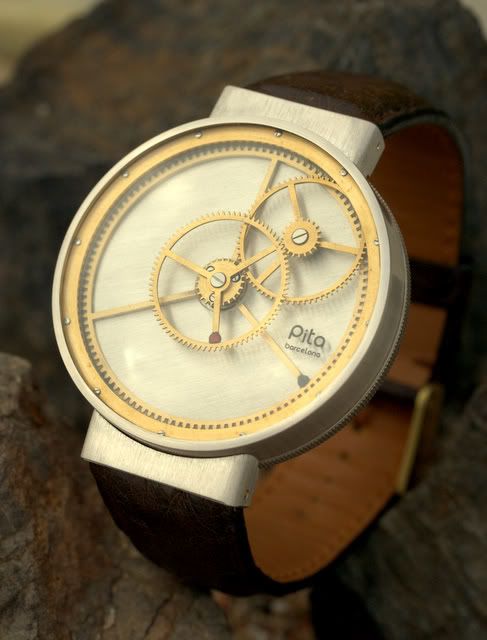
The word ‘grail’ is vastly over-used in our community, but it allows a colourful comparison to be made here. You are either very old, very young or a hermit if you do not know or remember Harrison Ford’s portrayal of Indiana Jones in the ‘Last Crusade’. Faced with the task of selecting the one true grail from amongst a bewildering array of cups and chalices -

- Indie, with an understanding and wisdom beyond that of most mere mortals, did not select the largest, the most bejewelled the most elaborate or the most precious of the would-be grails; he chose the simplest – the cup of the carpenter; the iconic representation of its kind.
So it is with the Molinos. It is not the largest mechanical watch, the most bejewelled, the most elaborate or the most precious, but it is an iconic representation of its kind.
Oh, did we then have fun! Like some mischievous imp Senor Pita pulled out his ‘party trick’ watch. Held at the side or in most any other position, the two hands swing wildly around the dial like the whiplash ride at an amusement park. Brought to the horizontal ‘viewing position’, though, the hands suddenly lock to position to display the correct time! Through Daniel he asked which three watches were most appealing. Four, not three, found their way onto the tray: the decision was that tough. Then, in a question reminiscent of William Styron’s “Sophie’s Choice”, he asked “If it was your birthday and you could have just one, which one would it be?” Well, we will each have our own answer to that question, won’t we?


The afternoon had disappeared without our noticing. Daniel casually asked “Have you had lunch?” – it was five o’clock! “We know a little tapas bar you might enjoy”, said Daniel, and we squeezed into a taxi to get to a hip and buzzing restaurant named (for those of you who know it or may wish to know it) “Tapas, 24”.

Do not be fooled by their svelte Catalan frames: ‘tapas’ is not so much a style of eating as a Spanish martial art, and Pita Senior and Junior are black-belts! Dish after dish appeared at the table, seemingly without having been ordered: squid in its ink, roasted peppers, sweet Spanish tomatoes on oiled bread, stuffed olives, anchovies, sardines large and small, ham, beans and wondrous things, all washed down with several glasses of the local cava (or, in Senor Pita’s case, Diet Coke – so that he doesn’t impair the steadiness of his hands).

By the time we got to chocolate mousse drizzled with EVOO and scattered with sea salt flakes the master had pulled apart his menu and was doodling upon it as he talked, explaining his plan for a %@#** watch with a #$$%!, a rotating %@!!^ and a most unusual #!!$*#. His restless fingers flew across the page, and it was not difficult to believe Daniel when he said that his father will often work through the night or, when he does sleep, will wake up suddenly, reach for his sketch book and draw yet another watch design.
In March of this year, Daniel explained between mouthfuls, the New York Times published a brief article on Senor Pita. (http://www.nytimes.com/2011/03/24/fashion/24iht-acaw-pita-24.html?pagewanted=all).
Since the article was published, says Daniel, enquiries have skyrocketed. At the same time, a major retailer in Madrid has asked to be provided with some stock of all models, and demand is now fast outstripping the atelier’s present capacity of about sixty or seventy watches a year.
As we left the restaurant some hours later Daniel insisted that the proprietor give us a business card; not the ‘usual’ one, but the ‘special’ one. Cute, isn’t it? The guy on the metal detector at the airport didn’t think so!

We returned to our hotel numbed from the saturation in genius, and floored by the remarkable generosity exhibited by the pair of Pitas. Kudos to those who have recognised the sheer talent of Senor Pita and bought one of his watches before now, or who have a piece on order. There seems little doubt that the demand for his work is about to increase dramatically and with that, perhaps, the prices also. As matters stand, these must be amongst the best value watches to be offered by an AHCI member.
Oh, were you wondering what became of that menu? Well, when no-one was looking, you would have done the same, wouldn’t you? Who are you kidding? Of course you would! –

(Obviously, the sketches have been photoshopped to obscure the design, but let’s just say that seeing this watch conceived over casual conversation, cava, Coke and calamari in a cool Catalan café was a real privilege).

Cheers,
pplater.
[Thanks to Pita Watches for the catalogue shots of the Oceana, Sol y Luna and Molinos. Other photo credits are embedded in photo URLs – right click to view.]
Thank you for a great read and photos! The one you choose would have been my choice as well… So “simple”, so genius! Huge congrats to the 3000! A big thank you, so far - l ooking forward to the next 3K… Best Blomman
Your remarkable collection to one side for a moment, your constant support of the forum and its contributors – always a kind and encouraging word - is one of the high points of this site. Cheers, pplater.
I was considering the Pita Single Hand minimal for a while but ended up with a PSM Shimoda which I am wearing as I type this. Pita looks to be a very interesting Indie. I may be re-visiting Barcelona earlier next year and if so, I do hope to drop by Pita. Great report.
Go both – I have a sneaking suspicion you won’t be the only one here to do so if you do! ;-) If you get to Barcelona again you simply must not miss out on a pilgrimage to the Pita atelier; you would struggle to find two nicer, more enthusiastic guys in the Independent watch world. Cheers, pplater.
Pita seems to have a rather natural and raw look to me especially the Caroussel which is actually very different from the more elegant feel of my Blue Moon Shimoda. Not better or worse, just different. But yes, if I do return to Barca next march, I will drop by.
Must admit , I was not aware of this brand till recently. Your post brilliantly portrays his watches in the context of his city and country, the art and the architects. Your post gave us much insight about this independent watchmaker. Did you get a gentleman's agreement with him to receive a percentage of sales from the surge in demand LOL ? Cheers, dreamer
This thread is active on the Independents forum with 69 replies. Share your knowledge with fellow collectors.
Join the Discussion →