Collection
iim7v7im7's detailed account of choosing a Breguet Classique 5177 offers an invaluable guide for collectors navigating the complex world of high horology. His systematic approach, weighing aesthetic, movement design, finishing, and diversification, provides a transparent framework for making a significant acquisition, making this a timeless resource for anyone considering a luxury timepiece.


Hi,
Well after a few months poking around and a number of posts here at PP, my new watch arrived today.
HOW DID I FINALLY DECIDE?
I
began my journey a few months back looking for my first gold watch. I was at
both a point in my life and collecting knowledge, where I wanted to add a
classically sized, rose gold watch with a timeless design aesthetic and a
horologically innovative calibre finished at the highest level. I also wanted
the piece to bring something new aside from its case material to my collection.
I wanted a watch that was dressy, but also was appropriate for wear in normal
day-to-day life amongst my rotation of watches.
As usual, my search
turned out to be highly educational journey that took me through about 90
watches made by multiple makers (AP, ALS, Blancpain, Breguet, Chopard,
Chronoswiss, Dornblueth, FP Journe, GP, GO, IWC, JLC, JD, Moser, Omega,
Parmigiani, Patek, UN, VC and Zenth) . I am fortunate to live near NYC where I
was lucky to be able to see, feel and try on a piece which is invaluable when
making a decision on a watch. I cannot tell how many pieces that I liked based
on images on the Internet that I did not like in person and visa versa. It came
down to 6 beautiful choices, all of which would have been a pleasure to own.
• A. Lange & Sohne, Saxonia Automatic
• Breguet Classique 5177
• Girard-Perregaux 1966 Small Second
• Glashutte Original Sixties
•
Patek Philippe Calatrava 5127
• Vacheron Constantin Patrimony Traditionelle
Manual Wind
I had to step away from emotional drivers (easier said then
done) and look at them objectively and decide what was most important to me.
This involved thinking about aesthetic preference, movement design & finish,
diversification, brand and price:
AESTHETIC PREFERENCE:
All of
these watches were to my aesthetic liking (that's why they were finalists) and
all had some minor but livable "flaw" to them. The livable flaws were that the
ALS and VC were classic in their dial designs, but a bit sterile; the PP was
classic but was somewhat anonymous and ubiquitous in its look; the Breguet had a
date window that was located quite close to the chapter ring; the GP was a bit
large and has a disproportionally small calibre and the GO was not by design
"timeless" in its aesthetic. This after some consideration eliminated the GO
from the mix. I was not looking for a period piece, despite my liking of its
design.
MOVEMENT DESIGN & FINISH:
From a movement design
perspective, the Breguet and the PP with their free-sprung balances, to me;
stood out to me above the rest. The Breguet also had some novel high-tech
materials and surface finishes (silicon, DLC etc.). Some people view new
technologies as unproven liabilities particularly with respect to long-term
reliability and serviceability; but I felt that the silicon technology between
Breguet, Omega, PP and UN had been field tested at this point and the
risk-benefit weighed out on the positive. The balance and escapements on these
seemed superior to the other four movement choices. Both the ALS and VC were
very traditionally designed; each in their respective regional Saxon and Geneva
schools. From a finish perspective, the ALS, Breguet, PP and VC were all
beautifully crafted, each based on somewhat different traditions. The GP, while
a very nicely crafted and robust calibre (a very efficient winder) was a "notch"
less finished than these four when looked at in detail under a loop.
DIVERSIFICATION:
Other than the GO, the other five choices all
were new brands to my collection. My collection by country of origin had a
German single watch, two- Swiss-German, and five Swiss watches so there was no
real differentiator there. Four out of the eight watches had date functions and
four did not. Six out of the eight watches in my collection had small seconds
and only two had central sweep seconds (BP and IWC). So both the Breguet and the
PP had central seconds, but the Breguet (and the GP) brought an enamel dial to
the table (the GP did as well). So I felt that center vs. small seconds' was the
most significant differentiator stylistically.
BRAND:
Well PP
and VC were both considered premier watch ateliers both historic innovation and
from a quality perspective, with PP having the current aura of "Numero Uno"
amongst the collector world. ALS, a perennial favorite among watch enthusiasts
was well regarded for its outstanding craftsmanship and movement innovation over
the last 15 years. Breguet, while acknowledged as making very high quality
watches were considered somewhat of an artificial corporate creation of the
Hayek's. GP was well respected, historic "sleeper" brand, not spoken about as
much as their watches merited. So a collector might say get the "PP" or the "VC"
and a watch enthusiast might like the ALS for its craft. All of these companies
were stable and will be around for the foreseeable future so there was no
difference there. The Breguet and GP would always be viewed by a collector at
the next lower subjective tier of horological hierarchy, because of a lack of
continuous history or authenticity in the case of Breguet or a slightly lower
level of finish on this (key word) GP. After some reflection, I decided that
this sort of hierarchal provenance was both fugitive and subjective and should
NOT factor into a decision as to which watch to choose.
PRICE:
These six watches ranged in price by a factor of 2x relative to each
other in this order from high to low PP>GP>ALS>Breguet>VC>GO.
Really, the middle four were all quite close in price. For a purchase like this,
I decided to take this off the table as well; because I had the money to afford
any one of these choices and to not regret the decision years from now that
might have appeared penny-wise and pound foolish. Again, I decided focused on
the attributes of the watches themselves.
SUM OF THE PARTS:
Aesthetically, I could make a case for any one of them except the GO,
which in the end, while beautiful; is a period piece by design (hence the name
60's). The GP also a period piece by name had more of a timeless aesthetic to
it. From a movement design perspective, the Breguet and the PP won the day with
their free-sprung balances. The ALS, Breguet, PP and the VC were all impeccably
finished so to me there was no differentiator there between them. Both the
Breguet and PP were both new brands with central sweep seconds, but the Breguet
had the novelty of an enamel dial. So in the end movement design and collection
diversification were in the end the differentiators between these choices.
The answer for me was the Breguet.
A SHORT TOUR OF THE WATCH:

CASE:
The case is made from polished, 5N rose gold. 5N rose gold has a
higher percentage of copper than 3N and 4N rose gold (12%, 16% and 20.5% copper
respectively) which is used by some makers today . All are marketed as "pink" or
"rose" or "red" gold, because yellow gold has only 6% copper typically. After
looking around in the shops, I found that I preferred the redder hue of the 5N
alloy. The case is classically sized at 38.0 x 8.8 mm, which while large by
historic standards, is small relative to plethora of 40 mm watches that seem to
be the standard of today, by many makers. It has a simple and narrow, polished
bezel and the watch are visually dominated by the enamel dial and wears larger
than the numbers might suggest. The case band fluting (fine grooves enhanced
with double beading) adds visual interest to contrast the plain dial. The fluted
pattern is cold-rolled into the case band then finished by hand on a mechanical
work piece-holder. The case back is engraved and has a sapphire display back to
see the calibre within. The lugs are thin and are finished with screw pins and
the fluted crown is decorated with a raised company logo


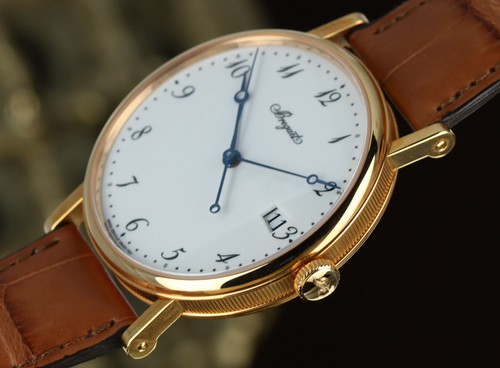
DIAL:
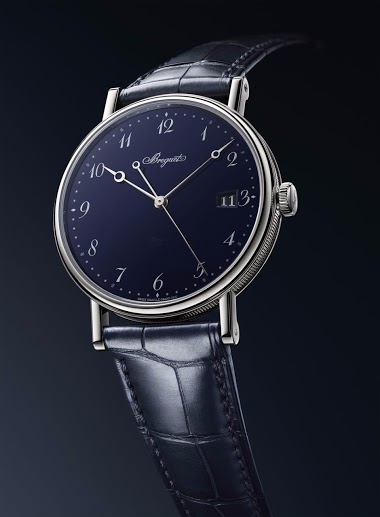
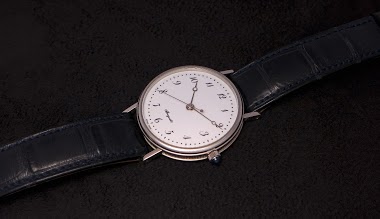
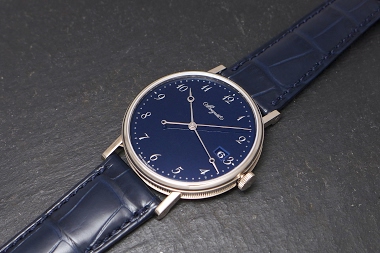
The dial is made from grand feu enamel or high-fire enamel in
English. It is simple, white dial with hand painted Arabic numerals and subtle
and diverse chapter ring symbols. The hour, minute and second hands are done in
Breguet's signature blued eccentric moon tip. The hands are sized to reach the
corresponding symbols on the chapter ring perfectly for easy reading A
trapezoidal date window is located adjacent to the 3 o'clock.


MOVEMENT:
Post-Swatch Group Montres Breguet has developed a reputation
among watch collectors for being a bit surreptitious regarding declaring the
origin of the movements housed within their watches. While all are very nice
movements; many are either historic Nouvelle Lemania (pre-Breguet) or Frederic
Piguet (Blancpain) movements that are used by other watch brands. These are very
fine movements but in a collector's World driven by exclusivity and its use of
vague product literature have created a "bad taste" among collectors. The
Calibre 777Q housed in this watch was commissioned by Mr. Hayek Sr. to Montres
Breguet (Lemania) in 2001 shortly after the purchase of both companies (Breguet
and Nouvelle Lemania). So it is a 100% in-house automatic base calibre used
exclusively by Breguet. The movement was introduced by Breguet five years later
at Baselworld 2006.
It is a 12 ligne, 26 jewels, single barreled,
automatic calibre that winds with counterclockwise rotation. The watch operates
at 28,800 bph and has a 55-hour power reserve. The barrel is coated with DLC to
reduce friction and provide a more consistent power curve. An 18 carat, 5N rose
gold rotor decorated with guilloche and rotates on ceramic bearings to provide
winding power. The balance is free-sprung, with four adjustment weights and
incorporates a new Nivaroc-FAR shock protection system (also used by Omega I
believe) called Nivashoc® that is supposed to allow for better centering of the
balance pivot than Incabloc. The movement's balance is coupled to a Anachron®
Breguet over-coil hairspring for superior isochronism. Both the escapement wheel
and Swiss straight lever are fabricated from silicon to reduce friction, mass
and magnetic sensitivity. The movement is finish is understated, with both Cotes
de Genève striping and perlage decorating surfaces. The bridges are hand
finished with anglage, and are rhodium plated with gold engraved gilding. The
screws are chamfered and black polished as is expected in a finely finished
movement.


STRAP & CLASP:
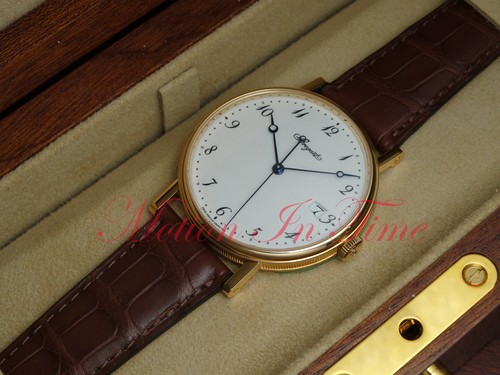
A well crated 20 mm x 18 mm, dark brown alligator
strap to contrast the rose gold to complement the hue of the case with an 18
carat 5N rose gold clasp.


Sorry about the
long post; I didn't have time to write a short one. 
Bob
The 1966 Ford Mustang represents a significant year for the model, building on the initial success of its introduction. This reference is part of the first generation, which established the Mustang as a distinct category of American automobile. It continued to offer a range of body styles and engine options, allowing for considerable personalization and appealing to a broad market segment. The 1966 model year saw refinements rather than radical changes, solidifying its design language and market position.
The vehicle's construction typically featured a steel unibody chassis. Various engine configurations were available, including inline-six and V8 options, paired with manual or automatic transmissions. Specific dimensions varied slightly depending on the body style, such as coupe, convertible, or fastback. The interior offered a functional layout, with instrumentation focused on driver information.
This reference holds interest for collectors due to its place in the early history of the Mustang and its enduring popularity. The availability of different engine and trim levels means that specific examples can vary widely in their features and performance. It remains a recognizable and sought-after classic, often celebrated at automotive events worldwide.
And thanks a lot for the in-depth explanations about the reasons of your choice and the selected watch. It is without any doubt a very fine watch and I'm sure you will enjoy it a lot. To be honest with you, the presence of silicium in a Breguet watch disturbs me a bit. But it is a question of feeling I presume. By the way, I moved your thread into Breguet forum. Fx
Fx, First-off, thanks for moving my post. I originally put in HM because that is where most of my questions were asked during my search, but I understand that Breguet belongs in the Breguet forum. I also understand your "disturbance". We all have different thresholds about using non-traditional materials or methods of manufacture in a luxury mechanical watch. It is actaully what partially attracted me ( . As an engineer, I embrace the new, once it has been proven to where the risk appears manage
Hi Francois: Have to respectfully disagree with your comment about silicium. Breguet's use of it is actually brilliant. There are so many respects in which it surpasses Nivarox. Others have commented on many of its physical properties which make it ideal for use as a hairspring, but one has been left out. It is non-magnetic. The component of a wristwatch which is vulnerable to residual magnetism with resulting adverse rate keeping effects, is the hairspring. By using silicium the same degree of
And I expressed it to the Patek team. I don't have any doubt about the performances of silicium. But for me the future of silicium will be with entry level watches. Let me explain. With time, silicium parts making will become easier and easier thanks to improved machines. Silicium will allow to produce at a cheap price high quantities of these strategical parts. I discussed about this topic with watchmakers and they expressed this feeling. So I do believe that, except some very specific watches,
Interesting perspective Fx. Thanks for sharing it. That is actually something that I had not considered. I am personally not sure where they are from a process scale, simplicity (capital & number of steps) nor efficiency (yield) perspective. Companies like Breguet and Patek are only making a few thousand components per annum I suspect. The big signal that it can be done robustly at scale will be the wide use in Rolex who is a partner investor among the consortium. Additionally, because there
Hi Francois I am completely in favor of sound technical advances that are not incompatible with mechanical tradition. Thus, I actually seek out watches with a silicium spiral now. But what about these other new materials that offer technical advantages: 1. ceramic bearings (great idea, longer wear, less need for lubrication); 2. new oils (gotta love those, they last longer); 3. special anti-friction coatings (these show up in all kinds of places--they are plated onto manufactured parts); 4. sapp
613 Breguet listings are live on the eBay market and 169 collector listings on the WatchProSite marketplace.
This thread is active on the Breguet forum with 37 replies. Share your knowledge with fellow collectors.
Join the Discussion →