New Release
Pingtsai introduces Bulgari's Il Giardino Tropicale, a significant release from Baselworld 2013, marking the brand's first grand complication for ladies. This article highlights Bulgari's fusion of high jewelry and miniature painting, showcasing a tourbillon movement within a vibrant, nature-inspired dial, presented as a limited edition of 50 pieces.


Il Giardino Tropicale di Bulgari
The First Grand Complication Ladies’ Watch

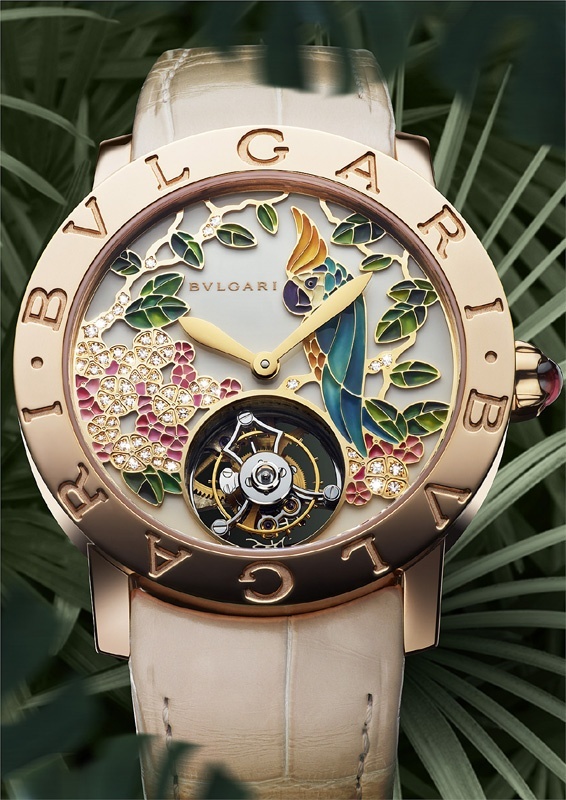
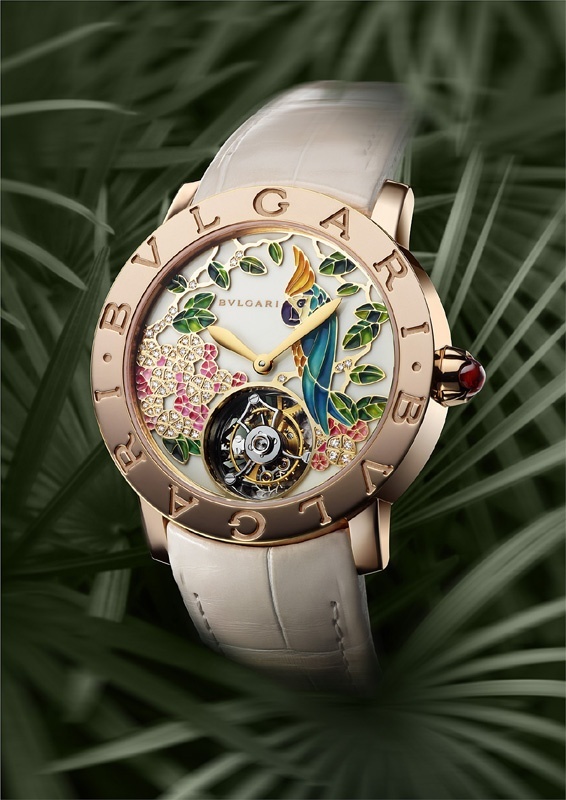
Bulgari is proud to introduce its first grand complication watch for women, a luxurious masterpiece of color and unparalleled craftsmanship. Inspired by the luxuriance of nature, the Il Giardino Tropicale di Bulgari timepiece combines two of Bulgari’s mastered art forms: jewelry and miniature painting. Indeed, the inexhaustibly rich natural and animal worlds have opened endless creative paths for Bulgari. Over the years, flowers and plants, snowflakes, and marine creatures have been reinterpreted by exceptionally creative metaphors. The new Il Giardino Tropicale di Bulgari, is a further example of this thematic tradition.
The complicated tourbillon movement of this exquisite timepiece is visible in the window of the parrot’s “perch,” while the dial and precious gemstones burst with luxuriant life. This timepiece is available as a rare and exclusive creation, issued as a limited 50-piece edition.
The Dial
Il Giardino Tropicale di Bulgari dial is a true masterpiece that falls squarely within the tradition of an art born in the 16th century: miniature painting. This technique for creating extremely small pictorial renditions using a meticulous approach was employed to reproduce a wide variety of scenes. Over the centuries, the themes changed with religious allegories giving way to scenes from daily life, romantic scenes, landscapes, and portraits. The art of miniature painting declined with the birth of portrait photography in the mid-19th century.

Bulgari’s sophisticated timepiece pays tribute to this tradition, brilliantly reviving it through a handcrafted piece that brings together jewellery and miniature- painting techniques. This dial obviously has a very high added value: patience and meticulousness are the rule here. It takes the master craftsman two weeks of work to finish one dial, one week if everything goes smoothly. The process is slow because it requires a mastery of the techniques involved in applying the color and mixing the paint; liquid varnishes are very difficult to work with. A varnish of the desired shade is made by skillfully combining base colors with a binder to give the desired consistency. The apparent simplicity of the preparation conceals great difficulties such as obtaining color gradations, and mixing and balancing the colors.
The Dial Creation Process

This process, which uses transparent varnishes, makes it possible to play with glaze effects and to add depth and luminosity to the design on the dial. However, a number of factors must be taken into account, starting with the drying of the varnish. The varnish dries rapidly and demands quick work with the paintbrush. It is a tricky proposition, considering that each of the cells making up the motif requires anywhere from three coats of paint (flowers) to five (leaves) or even eight (parrot). Between each coat, the artist must clean the surface of the dial and remove any varnish that has overflowed its cell.

A corollary to applying successive layers is that the original color selected is darkened, an added difficulty that makes it necessary to prepare a ground layer of opaque white to ensure that the colors will remain vivid. Between these various steps, the piece is sent to the kiln once each layer of varnish has been applied. Firing time and temperature must be exact: one hour at 80°c, no more, no less. After nearly a week, having been fired in the kiln about twenty-five times, the dial now displays its brilliant, delicate designs. But it is not yet ready for its final home. It still must go to the jeweler who will set it with the 61 brilliant-cut diamonds that will add the final sparkle.


An Organic Mechanism
The serenity of this sophisticated landscape, evoking delicacy and sweetness, conceals another aspect of Bulgari’s talents: a self-winding tourbillon movement with its tourbillon carriage supported by a sapphire glass bridge. This living, organic mechanism is visible through the circular opening over which the parrot is perched. The opening serves as a light source and a window into the perpetual rotation of the regulator which keeps the self-winding movement running steadily. The movement is housed in an 18k pink gold case that is 37mm in diameter. The oscillating weight ensuring automatic winding is made of 22ct gold. Like the dial, it is fully decorated in accordance with fine watchmaking codes.

the rain forest theme goes really well with the Bx2 dialed case, nice one! cheers, Ed~
What is there not to like? This is a wonderful watch combining the best decorative arts wiht the iconic BVLGARI case and a nice tourbillon complication. My point-of-order is the use of the term Grand Complication. Although the tourbillon used to be a rare complication, 'Grand Complication' has a very strict meaning in our world of horology, requiring at least one item from each of the three classic complication families: timing intervals, astronomical and striking. The 'fog of war' introduced by
Nice watch by Bulgari with a very nice dial. I agree that a Grand Complication must have a: 1. Chronograh (I wouldn't even say it'd have to be a flyback) 2. Perpetual Calendar 3. Some sort of repeater.
I and likely everyone else here would agree with you. I think the marketing people over at Bulgari neglected to observe the distinction. What they probably meant to say was Bulgari's first complication ladies watch that's grand. We'll have to let them know :)
i swear i see 4 doors on that car:) cheers, Ed~
While I agree that the term Grand Complication should not be used for a watch with just a tourbillon regulator....... Perhaps Breguet should be held to task as well? Ref: 5377BR Classique Grandes Complications Ultra Thin. :)
This thread is active on the Bulgari forum with 11 replies. Share your knowledge with fellow collectors.
Join the Discussion →


