Review
SJX provides an in-depth, hands-on review of the Cartier Calibre de Cartier Chronograph, highlighting its significance as Cartier's entry-level in-house chronograph. He offers a critical assessment of its design elements and technical features, including the 1904CH MC movement. This article is crucial for understanding Cartier's strategic shift towards in-house movements in its men's watch offerings.


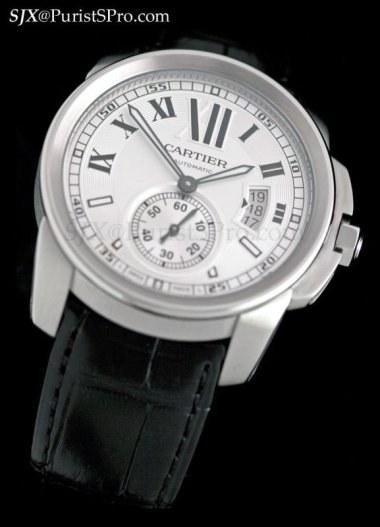
Cartier recently announced the Calibre de Cartier Chronograph, which will be the entry level, in-house chronograph watch targeted at men. Up to now, all the other entry level chronographs, like the Santos 100 for instance, used ETA calibres.

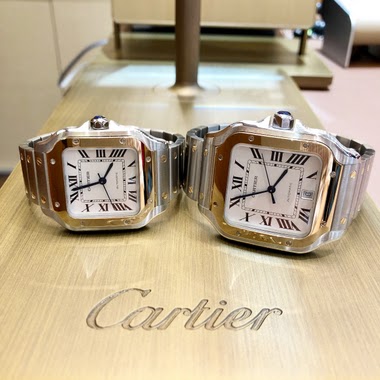
Seeing this watch in the metal changed my mind about it. When I first saw the stock photos I was lukewarm, but in person it is much more attractive. Oddly enough I find the steel and gold version appealing, though I don't usually like that metal combination.

One detail I especially like is the gold rimmed subdials, but notice that the gold tone is a few shades lighter than the rose gold on the bezel. This would look great on a strap I think, I dislike the bracelet design; I find it too similar to the Rolex Oyster and the disparity in size between the steel and gold links is disconcerting.


Equipped with two counters, for minutes and hours - a constant seconds was omitted for aesthetic reasons - the Calibre de Cartier chronograph uses the column wheel controlled 1904CH MC movement, which is based on the 1904 MC movement of the Calibre de Cartier automatic. It has all the features necessary for strong chronometry (and also common to other Richemont-Valfleurier designed movements), including double barrels and a vertical clutch.

The vertical clutch specifically ensures that the torque delivered to the escapement is constant, regardless of whether the chronograph is activated; that means there is no "chronograph drag" assocated with lateral coupling chronographs which causes amplitude to drop.


Carole Forestier explaining the movement
Another interesting notable feature, that is now commonly found in mid to high-end chronographs, is the linear reset hammer. This gives a precise reset for all the chronograph subdials, since there is a single reset hammer for all the chronograph hands. In addition, the linear hammer is flexible - note the springs that are part of the hammer - which reduces wear.
In terms of aesthetics, one key element is the minute scale engraved on the inner rim of the bezel. This gives the watch as a whole a much cleaner look, as compared to have it on the dial.

Two aspects of the design I am unsure of are the three date aperture and the combination of Roman numbers and baton indices.

As with the original Calibre de Cartier Automatic and Cartier watches in general, the case finishing is excellent and amongst the best relative to its peers. The lugs for instance have a wide and precisely polished bevel.

In a segment dominated by brands like IWC and Jaeger-LeCoultre, this is a very strong contender, especially given its brand name and pricing. The retail price (before taxes) will be aboue EUR7400 for the steel on strap, EUR11,000 for the steel and gold on bracelet, all the way up to EUR34,000 for pink gold with matching bracelet.
- SJX


The Cartier Santos 100 was introduced in 2004 to commemorate the 100th anniversary of the original Santos-Dumont watch. It represents a contemporary interpretation of the historic pilot's watch, featuring a larger and more robust case design compared to its predecessors. This model positioned itself as a sportier, more modern offering within the Santos collection, appealing to collectors seeking a bolder presence on the wrist while retaining the iconic square aesthetic.
The Santos 100 typically features a stainless steel or precious metal case, often with a brushed finish and polished bezel screws. Case dimensions vary, but common sizes include a large model around 51mm x 41mm. It is powered by an automatic mechanical movement, often a modified ETA caliber, providing reliable timekeeping. The crystal is usually sapphire, and water resistance is generally rated for daily wear.
For collectors, the Santos 100 is notable for its blend of heritage design with modern proportions and construction. It marked a significant update to the Santos line, moving towards a more substantial and contemporary aesthetic. Its robust build and versatile design made it a popular choice, bridging the gap between Cartier's dressier offerings and more overtly sporty watches.
Cartier for the movement. I am also a very big fan of the engraved seconds, that is a really great feature and gives the face an even greater Roman accent. My main issue from the pictures and this could be quite different in the metal, relates to the balance of the Romans on the northern hemisphere and the bars on the Southern hemisphere. The face looks top heavy to my eye. If they would have included a four and an eight in Romans, I think it would have worked better for me. I also like the choi
The combination of Roman and baton indices bugs me. That being said, the watch looks attractive on the wrist, it's just that the mix of markers doesn't sit well with me. - SJX
Thanks for point out the fact that the dial does seem a little top heavy. I was thinking that, but I couldn't phrase it in my mind. Agree with all of your points as well. My main question is, will this watch age well. Will it still look good 20, 30, 40, 50, 80 years from now? Will its style and design stand the test of time? Look at this old car... It really is quite old. But it still looks beautiful. And a cool "hipster" kid (not to be confused with hippy) would totally drive that. Is this Cart
2,645 Cartier listings are live on the eBay market and 184 collector listings on the WatchProSite marketplace.
This thread is active on the Cartier forum with 3 replies. Share your knowledge with fellow collectors.
Join the Discussion →