
Manufacture
MTF's post delves into Cartier's rich heritage of clockmaking, tracing its origins back to the early 20th century and the influence of illusionist Jean Eugene Robert-Houdin. This historical context sets the stage for introducing two new Cartier clocks, demonstrating how contemporary designs draw inspiration from a century of intricate craftsmanship. The discussion highlights Cartier's enduring commitment to horological artistry beyond wristwatches.


Cartier has been purveyor of 8-day going clocks and Mystery clocks for 100 years.
The earliest Mystery Clock appeared in 1912 as a result of a collaboration between Maurice Couet and Louis Cartier.
It is said that Maurice Couet was inspired by clocks used as magical props by the illusionist Jean Eugene Robert-Houdin.
Robert-Houdin was a legendary stage magician but probably less well known is that he was a watchmaker, whose father was also a watchmaker. His mechanical prowess contributed to the creation of many of his illusions. His exploits inspired Erik Weisz to call himself Harry Houdini as a stage name in America,


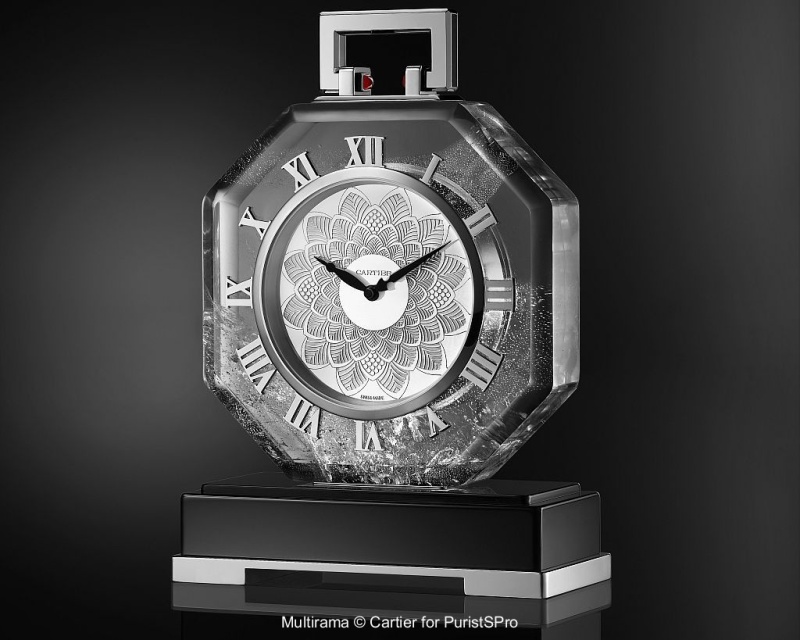
Cartier has preserved all the purity and graphic simplicity of Art Deco in a work of art that is permeated with light.
A clock, in a limited edition of 100 pieces, with stylised hands that mysteriously rotate in front of a transparent rosette engraved with a lotus flower.
Made from exceptional materials and the 6002MC mechanical movement by the master watchmakers of the Cartier Manufacture in La Chaux-de-Fonds, this modern design allies a symbolic geometric shape with the Chinese influence of the central motif and the striking contrast of black and white, all in a fine example of traditional watchmaking.
Rock crystal, solid silver, palladium finish
Red garnet cabochons
Base in onyx and solid silver
Mechanical movement 6002MC
8-day power reserve
Dimensions: 95 mm x 44 mm x 134 mm
This one I like a lot. What is the size? Thanks! Oliver
nt
I prefer a more modern designed clock such as the JLC Marc Newson Atmos. - AT
Anthony, There is where we differ in taste. Newson design is cute but of its era. It will stick out as different from the madding crowd. Centuries later, Cartier designs will stand the test of time, fad and fashion......
Thanks Melvyn for the presentation of these clocks. Fx
This thread is active on the Cartier forum with 5 replies. Share your knowledge with fellow collectors.
Join the Discussion →