Manufacture
SJX provides an exclusive and comprehensive tour of Manufacture Cartier in La Chaux-de-Fonds, offering an unprecedented look into the vertical integration of Cartier's watchmaking operations. This detailed report highlights the extensive in-house capabilities, from component manufacturing to high-complication assembly and vintage restoration, underscoring Cartier's commitment to horological excellence.


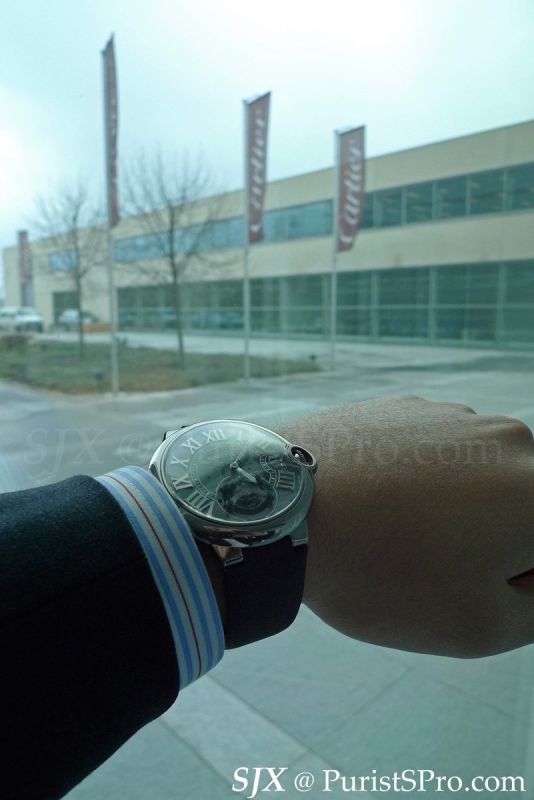

Cartier has five facilities in Switzerland, but the Cartier manufacture is in La Chaux-de-Fonds; everything from the Cartier Fine Watchmaking tourbillon to the Santos 100 is made there in one way or other. This provides an overview of the Cartier manufacture in La Chaux-de-Fonds and the processes in creating a watch; each department will be explored in more detail in later posts. This report also provides exclusive peeks into certain areas of the manufacture never seen before anywhere else.
Manufacture Cartier possesses a high degree of vertical integration and in it one can see almost every single process in creating a watch. At many firms the various steps are done in various places, but at Cartier it is all under one roof at La Chaux-de-Fonds. The benefits of vertical integration are primarily speedier time to market, greater flexibility in production and a higher level of quality control. On average, a third of any one component used in production, be it hands, dial or even screws, is made in-house by Cartier and mostly at La Chaux-de-Fonds.

Manufacture Cartier
A notable benefit to the consumer of this manufacturing capability is the nearly unlimited availability of parts. If the spare part is out of stock, even if it is a case, crown or bracelet, which is more difficult to replace than movement components, it can be manufactured. Parts for vintage timepieces are also made here, including hard-to-find bits like the balance wheel and accompanying timing screws.

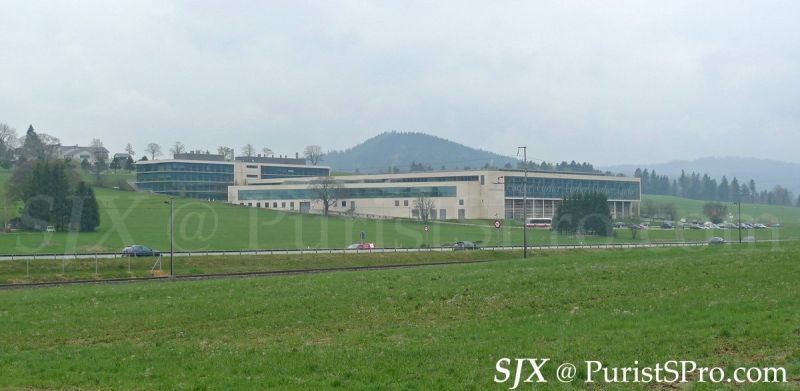
Completed in 2000, the La Chaux-de-Fonds manufacture consolidates what was previously a disparate number of production sites into one 33,000 m2 manufacture. It currently houses more than 1000 employees, engaged in every aspect of watch production. It is a very large building – in all it took over more than eight hours over two days to cover practically every area of the manufacture. I was fortunate enough to be shown around by Pierre Piffeteau, Customer Service Manager, and Sebastien Mathey, head of the restoration workshop.

Cartier's immediate neighbour to the right happens to be the revered Geneva house of Patek Philippe


The view of the staff canteen on the ground level from the rear of the building
Of course, size in itself means nothing and could even be a weakness as the spirit of craftsmanship could be lost. But Cartier has managed to preserve artisan skills – the manufacture has its own enamelling workshop with three full time enamellers as well as a high jewellery workshop where spectacular, sculptural jewellery watches are made by hand. Movement component finishing also has its own atelier, where anglage and other top-end decorative finishing is hand-applied.
These skills are evident in the high-end Cartier watches, ranging from the high watchmaking complications to the enamelled watches. These are of course separate from the entry to mid-range watches, which are excellent products at their price point, but accessibly priced, honest products, not high horology. It is Cartier’s wide range of products, from the affordable to the Astrotourbillon, that make this vastly impressive manufacture possible, where economies of scale exists alongside skilful, artisanal work.
Each of the areas of the manufacture will be explored in the follow-up posts below.
click here for Part I.

This message has been edited by SJX on 2010-08-21 23:31:13
The Cartier Santos 100 was introduced in 2004 to commemorate the 100th anniversary of the original Santos-Dumont watch. It represents a contemporary interpretation of the historic pilot's watch, featuring a larger and more robust case design compared to its predecessors. This model positioned itself as a sportier, more modern offering within the Santos collection, appealing to collectors seeking a bolder presence on the wrist while retaining the iconic square aesthetic.
The Santos 100 typically features a stainless steel or precious metal case, often with a brushed finish and polished bezel screws. Case dimensions vary, but common sizes include a large model around 51mm x 41mm. It is powered by an automatic mechanical movement, often a modified ETA caliber, providing reliable timekeeping. The crystal is usually sapphire, and water resistance is generally rated for daily wear.
For collectors, the Santos 100 is notable for its blend of heritage design with modern proportions and construction. It marked a significant update to the Santos line, moving towards a more substantial and contemporary aesthetic. Its robust build and versatile design made it a popular choice, bridging the gap between Cartier's dressier offerings and more overtly sporty watches.
The entire development department, comprising technical development, R&D and the others mentioned below, are collectively known as the Think Tank (yes, it’s a pun on the that Cartier watch), and is situated in one wing of the manufacture across four floors. The workflow begins at the top-most floor. Once a week, Cartier’s brain trust, known internally as the Studio, gathers here to brainstorm and discuss ideas. Everyone is represented at such meetings; staff from marketing, design an
After development and R&D is construction. Put simply, technical development creates the movement and construction puts it in a case; the folks here design the case, dial and hands around the movement. One of the most challenging creations was the Astrotourbillon, primarily due to the multi-layered dial and orbital tourbillon. On the lower floors are the areas for creation of prototypes. These include the resin models created by a 3D used in early stages of product development to fully working p
Cartier’s production is most impressive, both for its scale and range. For instance there are 18 turning machines (specifically bar-fed, turning machines) in La Chaux-de-Fonds making only bracelet and clasp parts. Some of these Bumotec S-1000 machines were even specifically designed for Cartier, hence the C-suffix. But even though the bracelet and clasp components are machined on a vast scale by enormous machines, they are deburred and cleaned by hand, one by one. Case components are creat
Movement components are of course manufactured in La Chaux-de-Fonds, ranging from the basic 1904 MC automatic to the Astrotourbillon. These are made on a variety of milling and drilling machines. Raw components from the milling machines are beadblasted to clean them before the tolerances are checked on microscopes.
Cartier even manufactures hands in-house. The department producing hands is fully integrated, from stamping, polishing, bluing or plating and application of Luminova. In fact, it even has a machine that cuts and punches the small paper cards that hold the loose hands. Given the skill of this department, I personally believe that Cartier actually makes hands for other Richemont brands, including highly technical brands that have their own integrated manufactures. One of the more interesting manuf
Movement assembly is split into three areas: mechanical and quartz. Assembly for mechanical and quartz movements are done assembly line style, with one watchmaker assembling one portion of the movement. Movements are slid from one watchmaker to another via a seesaw. In the mechanical section for example, one watchmaker installs the wheels of the gear train while another puts in the escapement and so on, finally reaching the watchmaker during regulation. The mechanical movements put together here
2,764 Cartier listings are live on the eBay market and 183 collector listings on the WatchProSite marketplace.
This thread is active on the Cartier forum with 43 replies. Share your knowledge with fellow collectors.
Join the Discussion →