Review
MTF offers a comprehensive review of Cartier's iconic Mystery Clocks and Watches, tracing their origins from early 20th-century 'Model A' clocks to contemporary wristwatches. This article provides a deep dive into the ingenious mechanics and historical context behind these horological marvels, highlighting the contributions of figures like Maurice Couet and Jean-Eugène Robert-Houdin. Readers gain insight into the enduring allure of Cartier's illusionary timepieces.



For more than a century, Cartier has been confounding its clients with magic and mystery.

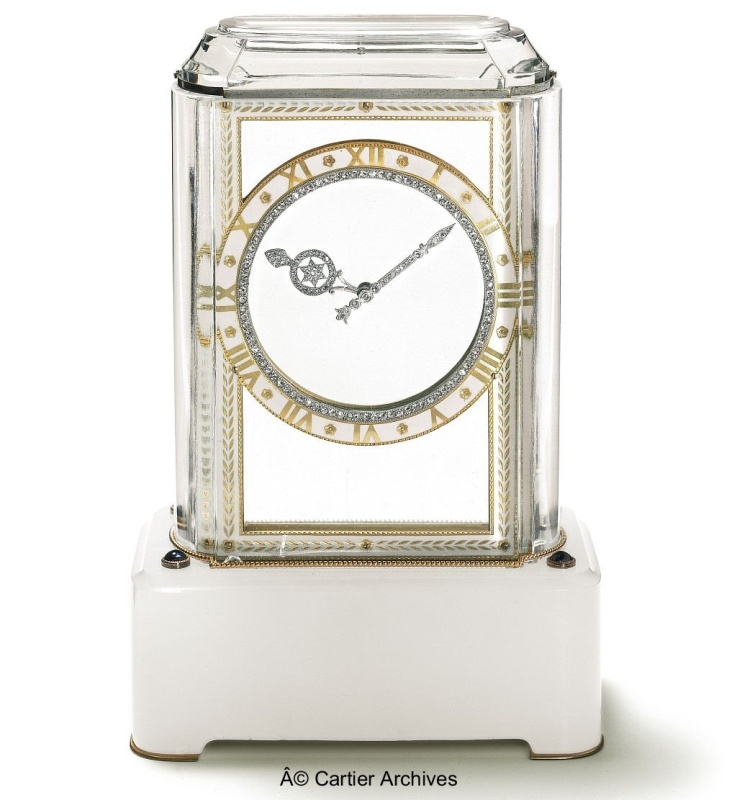
"Model A" Mystery Clock, Cartier Paris, 1914: Sold to Count Greffulhe.
Nick Welsh, Cartier Collection © Cartier
Base in moulded and polished white agate containing the movement. Four bezel-set sapphire cabochons at the corners. Case in moulded and polished rock crystal; a beaded gold line at the bottom.
Transparent centre, frame with laurel leaf motif in gold and white enamel. Hour circle in gold and white enamel, Roman numerals and half-hour buds in réservé gold. An inside line of platinum and rose-cut diamonds.
Hands in platinum and rose-cut diamonds.
Rectangular, 8-day movement, gold-plated, Swiss lever escapement, bimetallic balance, Breguet balance spring. Hand-setting and winding mechanism underneath the base.

Carole Forestier-Kasapi explained some of the Mystery Clock history

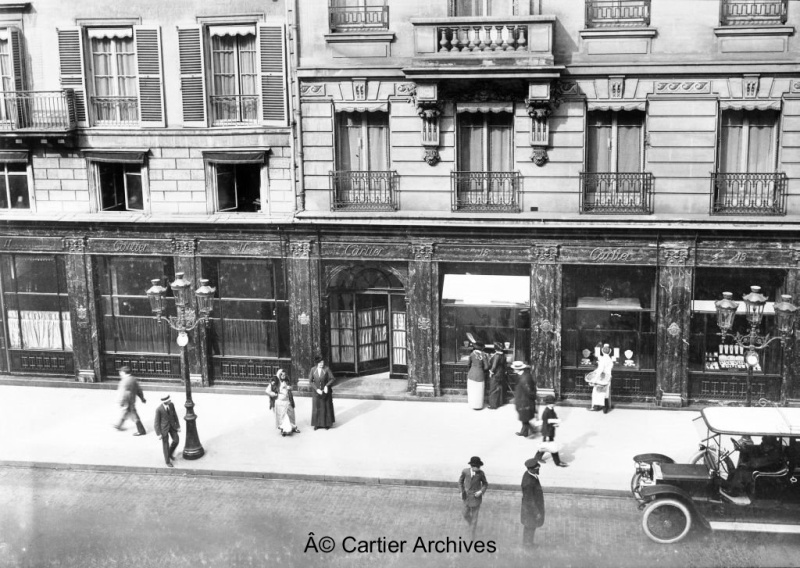
Historic Cartier boutique at 13 Rue de la Paix (1915)
Cartier Archives © Cartier
The first “Model A” mystery clock was sold by Cartier in 1912. They are mysterious because their platinum and diamond hands appear unconnected to any mechanical movement. Actually, each hand of the clock is set on a circular disc of crystal with a cloaked, toothed edge; the toothed disks are driven by two vertical racks (wormed rods) hidden in the sides of the clock; these racks are driven by the movement hidden in the base.
The contemporary journals called them “clockmaking miracles” (La Gazette du Bon Ton, 1925). The miracles were actually conjured by a genius clockmaker, Maurice Couet (1885-1963). He was only 25 years old when he first collaborated with Louis Cartier. Descended from a clockmaking family (both father and grandfather had worked for Breguet), Maurice Couet had worked for Cartier's finest supplier before setting up his own workshop. In 1911, he became Cartier’s exclusive clock supplier.
Maurice Couet took inspiration from the clocks of the French illusionist and inventor of modern magic, Jean-Eugène Robert-Houdin (1805-1871) who exhibited his first at a French Exhibition in 1839. Robert-Houdin's clock had only one hand to tell the time but it's raison d'etre was illusion and not time-keeping.
The principle that Couet adapted and developed was based on a brilliant trick: the hands were not directly linked to the movement but were attached to two glass discs, each fitted into a metal ring edged with gear-teeth. The movement was hidden in the clock base and turned the two discs – one at a revolution per hour (minutes disc) and the other at one revoultion per 12 hours (hour disc). To complete the illusion, the metal ring borders of the discs were hidden in the hour circle.
Several versions of the Model A were produced with variations of the base material (onyx, agate, nephrite or gold), the decoration of the dial and frame (often white enamel and mother-of-pearl) or the shape of the hands.

Cartier’s clock workshop at 53 rue Lafayette, headed by Maurice Coüet (1927)
On display, the “Egyptian” temple clock. The crystal Chimaera clock is in the process of being made.
Cartier Archives © Cartier
In 1920, another form of mystery clock unlike the Model A was introduced – the “central axis”. The new mechanism involved a single central shaft turning both discs instead of the shafts on either side of the base previously. This innovation allowed wider design and aesthetic freedom.

Cartier workshop at 53 rue Lafayette, directed by Maurice Couet. Circa 1927.
Cartier Archives © Cartier
In 1923, the next evolution was when the movement was placed in the top of the famous Portique mystery clocks. These were supremely exquisite and rare offerings, at times taking over a year of work and several different specialist workshops.
Only royalty seemed to be able to afford them such as the Queen of Spain, Queen Mary (consort of King George V of England), the Maharaja of Patiala, and America's royalty-by-wealth like John Pierpont Morgan Jr. Some of them had more than one of those precious clocks, thus qualifying as 'collectors'.
The Cartier Collection now contains a unique group of 17 priceless mystery clocks, including the first of the six Portique clocks and two Model A clocks similar to the original creation of 1912.

Designer’s drawing of a Model A mystery clock in rock crystal, mother-of-pearl, onyx and diamonds, 1929.
Cartier Archives © Cartier
The production of Cartier Mystery Clocks has never ceased and here is a modern example.

Mystery Clock 2013
White gold, rock crystal, white quartz - a soft milky gem studded with diamond chips, mother-of-pearl marquetry radiates around the face, onyx, brilliant-cut diamonds.
Mechanical movement with manual winding 6002 MC, 8-day power reserve
Unique piece
Cartier succeeded in the miniaturisation of mysterious illusion in the early 20th century with the Mystery Pocket Watches.

Mystery pocket watch Cartier Paris, 1931
Cartier Collection © Cartier
Square case of satin-finish platinum with cut corners, edged with fillets. Flat, notched, recessed winding crown on back at 12 o'clock.
Round off-center dial of transparent crystal. Chapter ring of Roman numerals in black enamel.
Pear hands of blued steel. A monogram "P.L.H." engraved at the back of the case.

Carole Forestier-Kasapi (Head of Watchmaking) and Thierry Lamaroux (International Marketing Director - Watches) explained as best they could when we last met.........without revealing all the mystery.
Cartier presented two new watchmaking complications that astounded even the competition by stretching the boundaries of mysterious horology yet further, thus continuing the House tradition. Rather than shroud the secret mechanism with heavy bezels and dials, Cartier embraced the concept of transparency and ephemeral simplicity.
The challenge was to eschew hidden complexity but emphasise incredible lightness in offering two different but equally mysterious wristwatches.
The first timepiece mysteriously displays the hour and minutes with two hands that for all intents and purposes, float magically in space.
The second timepiece doubles the conundrum with a mysterious double tourbillon whose floating cage eerily rotates around its balance spring whilst the whole escapement dances around in space.
MYSTERIOUS DOUBLE TOURBILLON
It takes a while to rationalise what the eye sees of a watch equipped with a tourbillon that seems to be suspended in space. That was what Cartier achieved with its new movement, the 9454 MC Mysterious Double Tourbillon certified with the Geneva Seal.
Magnified inspection reveals the mystery of the mechanism. The flying tourbillon rotates once on its own axis every 60 seconds and appears to float completely free in space, with no visible connection to any gears. The illusion is compounded by the same tourbillon cage making a second type of rotation at a rate of one turn every five minutes.
Even while watching this mysterious dance, the observer occasionally loses hinself in the magic and forgets about the mechanics to simply enjoy the creative daring and watchmaking know-how.

OF MAGIC AND ENGINEERING
At one extreme, one could simply accept the elegance of the illusion without explanation but at the other end, the inquisitive observer may attempt to unmask the complexity of the Rotonde de Cartier Mysterious Double Tourbillon. This is not easy to reveal because Cartier has utilised the modus operandus of the magician – Misdirection. The actual "Magic Trick" is still the focus of the performance but even a very simple trick can be greatly enhanced by a good performance from the magician. The design team studied the “tricks” of Jean-Eugène Robert-Houdin, the father of modern magic, to create the illusion of levitation.
PuristS are familiar with the rationale workings of a tourbillon: in a vertical position, the rotation of the cage over a given time may mitigate the effects of gravity on the balance (regulating organ) by averaging out those regularity errors (causing the gravity effect to occupy every point on a circle in a given time). Playing on this required rotational movement, the Rotonde Mysterious Double Tourbillon, seems to defy the law of gravity, appearing to float unsupported in the void, and that its cage has completely liberated itself from gravity by rotating one turn in a minute and performing a complete rotation in its space in 5 minutes.

Rotonde de Cartier Mysterious Double Tourbillon, calibre 9454 MC
Laziz Hamani © Cartier
Case platinum
Diameter 45 mm
Crown beaded, platinum, set with a sapphire cabochon
Crystal sapphire
Case back sapphire
Water-resistance 30 m / 100 feet / 3 bar
Dial slate-coloured, galvanised, guilloché, silvered open-work grill with sunray eect, black transferred Roman numerals
Hands sword-shaped in blued steel
Strap in black alligator skin, double adjustable folding buckle in 18-carat white gold
MISDIRECTION: ROTATION AND REVOLUTION
Cartier watchmakers misdirects the observer by using a large disc of sapphire crystal with an anti-reflective finish containing a small aperture the size of the tourbillon to give the best possible illusion. They set the disc to support the cage in rotation. The minute wheel, that also drives the oscillator, is positioned on an axis designed to limit the "resistance torque" created in the mechanism that supports the tourbillon.
By limiting the resistance torque, the force is transmitted to the tourbillon such that the entire device revolves in its space once every 5 minutes. The result is a tourbillon that revolves one full turn in the open, transparent space in 5 minutes, while the cage performs 5 complete rotations in that same period. The solution is to place a rack around the edge of the sapphire crystal disc, transforming it into a large gear wheel that performs one revolution every 5 minutes.
DEFYING GRAVITY AND BALANCE
The 9454 MC Mysterious Double Tourbillon movement is the culmination of long research & development. They made numerous calculations and simulations of the rotational speeds for different moving parts. The magic figure of 5 minutes for the tourbillon cage to make one complete revolution in its dedicated space was not arbitarily chosen but the mathematical derivation to optimise power consumption. If it had turned once per minute, the power consumption would be 25 times as much. To improve the mechanical efficiency of this movement, the weight of its components had to be minimised to limit the inertia of the rotating assembly (the disc and the titanium tourbillon cage).
Although the weight of the “flying” cage was reduced to the absolute minimum (0.28 g), its combined weight with the regulating organ had to be compensated by a circle segment designed to relieve the teeth being placed opposite the tourbillon to restore the equilibrium between the masses; thus achieving dynamic balance.

Movement Manufacture mechanical with manual winding, calibre 9454 MC, certifed Geneva Seal, double mystery tourbillon
Vincent Wulveryck © Cartier
Casing-up diameter 35 mm
Total diameter 35.5 mm
Thickness 5 mm
Number of jewels 25
Number of parts 242
Balance 21,600 vibrations / hour
Power reserve 52 hours


Ostensibly simpler, the Rotonde de Cartier Mysterious Hours watch is a better example of misdirection by its creators. The performance stage is larger as the aperture in which the ethereal hands float in space is larger.
All debate about Form vs. Function is moot as the eye is drawn by the purity of its design and the brain is mesmerised into forgetting the watchmaking complexity of its mysterious display. They say true wonder is when you stop wondering how its done.


The Cartier watchmakers were forced to rethink their traditional mystery mechanism. The objective was to overcome the problems involved with turning large sapphire crystals discs. There were problems of supplying adequate motive force to overcome frictional resistance and with sufficient power reserve between windings. With such a large mystery 'space' on show, there does not seem to be sufficient space for a movement to drive the watch! Surely, there must be a movement....

Rotonde de Cartier Mysterious Hours, calibre 9981 MC
Laziz Hamani © Cartier 2013
Case 18-carat pink or white gold
Diameter 42 mm
Crown beaded, 18-carat pink or white gold, set with a sapphire cabochon
Crystal sapphire
Case back sapphire
Water-resistance 30 m / 100 feet / 3 bar
Dial white, galvanised, guilloché, silvered open-work grill with sunray effect, black transferred Roman numerals
Hands sword-shaped in rhodium-coated steel
Strap brown or black alligator skin, double adjustable folding buckle in 18-carat pink or white gold

The display by hands whose connection to the movement is completely invisible required more engineering calculations.
The traditional method of rotating sapphire crystal discs in Mystery clocks is in guide grooves but the power constraints of a wrist watch required a more efficient way.
To limit friction between the sapphire crystal discs, they turn on fine pivots like a wheel in a gear train. This new solution avoids friction and limits the power consumption of the movement.

The next engineering solution was to reduce friction to a minimum; achieved by first reducing the inertia of large sapphire crystal discs, weighing just 0.56 g and made using DRIE technology (Deep Reactive Ion Etching).
With this cutting-edge method, metal components can be made by 3-D building up material, thus obtaining a gear wheel of extremely high concentric precision in one piece with the sapphire crystal disc. The geometry of the assembly is exact to the nearest micron.

DESIGN OPTIMISATION
To assemble the different components under optimum conditions, Cartier chose a modular structure. The movement has two elements: the movement proper, which occupies a crescent-shaped zone on the baseplate, and a separate display module occupying the circular space left empty for the purpose. This sub-assembly of four anti-reflective sapphire crystal discs with an anti-reflective coating, is assembled separately in a laminar flow hood to eliminate dust.
Cartier has stretched the watchmaking envelope by allocating 58% of the diameter of the movement to the sapphire crystal discs, allowing a huge display for best legibility.

Movement Manufacture mechanical with manual winding, calibre 9981 MC, mystery display of hour and minute
Vincent Wulveryck © Cartier
Casing-up diameter 31.3 mm
Total diameter 31.9 mm
Thickness 4.61 mm
Number of jewels 27
Number of parts 158
Balance 28,800 vibrations / hour
Power reserve 48 hours

KEEPING THE MYSTERY WORKING
Mystery clocks and watches have always been considered delicate because of their sapphire crystal discs. As part of the certification tests, calibre 9981 MC had to withstand 500 consecutive impacts, as well as being dropped on to a hard ?oor from a height of one metre. It is certainly not a "safe queen".
The Rotonde de Cartier Mysterious Hours watch, with floating hands and transparent caseback appears to reveal all. But in truth, although the movement and dial are open to view, it only shows what Cartier is willing to let you see; another case of misdirection.
Louis Cartier refused to explain how his Mystery clocks worked, even to Cartier salesmen, let alone to customers. This preserved the mystical allure. Today, the mechanism that connects the movement to the hands of the Rotonde de Cartier Mysterious Hours is so designed as to "disappear" into the structure of the calibre and remain invisible, keeping the allure alive......
Dr M. Teillol-Foo, 2014
I must say that since the 1980's I have been enamored by the Cartier Mystery Clocks. It has since been one of my lifetime goals to have just one. Maybe when I publish my first book !? In the meantime, this might just be the year that I pull the trigger on one of these! Dean
Spellbound, Good luck with the book and quest for a mystery clock. A vintage clock will be a gazillion dollars even if available. A new one to order will be twice that amount! ;) The Rotonde de Cartier Mysterious Hours is a more likely target because they are in production and cost only a fraction of gazillions. Its still amazing looking at your photo how big the "hole" looks on the dial. Where do they stuff the movement that makes the magic happen? There must be a movement...right? Regards, MTF
Always thinking that the mystery clock is magical, I am even more mystified that such a mechanism is fitted into a small watch case. And especially a Tourbillon in a 45mm case! So much information here, it needs to be read more than once. And I shall do so. Thank you so much - once again - for your time and effort in preparing this wonderful, historical write-up. Cheers, Carl
Are heavy reading and my eyes glaze over until they refocus on the mystery watches again. Then, the explanations become a mild drone in the background and the magic hapens. There is no need to know how it happens. Only to know that it happens. I prefer the "simpler" Mysterious Hours version because there is nothing else whirling to distract from the floating hands. Which do you like more? Regards, MTF
Perhaps there is no movement at all. It is indeed a large "hole". Not to detract from Cartier for creating these almost affordable "mystery watches" but the hole in the Konstantin Chaykin Levitas watches, which were developed around the same time, are even larger ! Cartier and Chaykin are different beasts and although I love the Levitas, and love the Independent status, my preference would be for the Cartier given the history you laid out so beautifully. Warmest, Dean
I always loved Cartier's mystery clocks, and of course any of the wonderful mystery wristwatches - even if I fear that the sight of a hairy wrist under the seemingly bodyless indications somewhat compromises the effect. Your marvelous article series on Cartier's traditions and competences continues to fascinate me, and I wish it would be collected and presented with easy access as a whole opus somewhen! Marcus P.S. Also nice to see Mme Forestier to have such a formative impact on Cartier's watch
This thread is active on the Cartier forum with 12 replies. Share your knowledge with fellow collectors.
Join the Discussion →