Manufacture
SJX's article, "Creativity by Committee," offers a rare glimpse into Cartier's rigorous product development process, challenging the notion that committees stifle innovation. This piece highlights how Cartier's collaborative approach, involving dozens of experts from marketing to technical development, ensures that every new watch aligns with the brand's identity and strategic vision. It reveals the meticulous trial-and-error involved in refining designs, underscoring the depth of thought behind each timepiece.


Product development at Cartier is a rigorous and complicated undertaking involving dozens of people from marketing and technical development. Watches are not created in isolation but with careful regard to the overall brand strategy and identity. In fact, new watches are so important that Cartier CEO Bernard Fornas himself approves every new launch. For those who say that too many cooks spoil the broth, or that committees are the death of creativity, Cartier is here to prove you wrong.
The development area in La Chaux-de-Fonds


The Studio
The creation of a new Cartier watch generally starts with the Studio at the manufacture in La Chaux-de-Fonds. Every week, about 14 members of the product development team, with about half from marketing who fly in from Paris headquarters and the rest from the manufacture (including head of technical development Carole Forestier), gather in the Studio for a full day meeting to discuss any of the 150 to 200 projects that are simultaneously underway at any one time.


The Studio encompasses Marketing, Creation and R&D...

And it works on new products, concepts and special orders

The five steps for production: concept, prototype, pre-series, production and evaluation
Each these marathon sessions, dozens of projects are discussed, and they can be at any stage of the development process, starting with new concepts all the way to finalising the strap for an upcoming product. It typically takes 12 to 18 months for a project to get from concept to final product. The level of attention to detail is amazing, absolutely no aspect of a watch is left to chance. Even the style and colour of stitching for the straps are important, so important that there is an entire display case of strap materials and samples in the Studio.
Below: Sketches for the Roadster; this is what it looked like before it was finalised


Below: Strap options in terms of construction and lining


A plethora of colour swatches are available, mostly in alligator hide
From a marketing perspective, watch development comprises five essential stages – creation, pricing, marketing, production quantity and launch. The product development meetings in the Studio deal with the first step of creation, from concept to final product, while the latter processes are generally the domain of the headquarters in Paris.
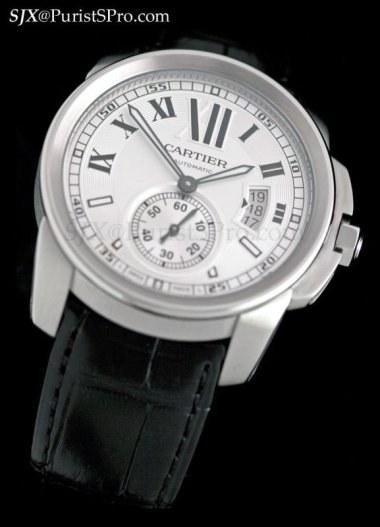
The genesis of a new product can come from any part of Cartier but it is always thoroughly worked through during the Studio meetings. For instance, according to Hélène Poulit-Duquesne, the Director of Watch Marketing at Cartier, the Calibre de Cartier was developed because Cartier needed a masculine and technical watch to increase its appeal to male clientele. On the other hand, some other ideas have originated from Carole Forestier’s prolific notebook sketches.

Sketch for the Santos Triple 100


Santos Skeleton

Astrotourbillon
But this process is dynamic; ideas go back and forth between departments and people. As an example, the Astrotourbillon was conceived as a result of a Studio meeting and Carole Forestier was told to create a tourbillon that was different from all the others.
Below: The Technical development department


The brains in Cartier keep track of the industry through the print media, with a rack of the latest magazines, and of course through the internet
Afterward the concept is approved, prototypes and models are created. As a result, the proceedings of these meetings are not only conceptual, but also tangible. There is a lot of metal, plastic and leather in the form of models and mock-ups being passed around. Very often, multiple iterations of products are presented, in different case shape and sizes, or with more minor variances like hands and crown.
Below: Various stages of the Santos 100 Skeleton


And it is not only new products that are evaluated, but also line extensions and custom orders, like a new dial for the bestselling Ballon Bleu or a custom made Santos Mystere. Sometimes, product ideas are turned down, for various reasons. For instance, a recent order for an unusual bespoke Crash watch was declined, because it was too far from what Cartier wants the Crash to be.
In fact, there is a department dedicated to create prototypes for evaluation. Fully equipped with the necessary milling and drilling machines, the prototyping section can create practically an entire watch from scratch, even the strap.
Resin models...

are printed in 3D by this machine.

Subsequently, actual protoypes - cases, movements, the works - are made here.


Like other firms in the industry, Cartier works with a three year strategic plan for its products. Because Cartier is a large, multi-product brand, the development of watches is part of a broader strategy. For example, one can discern the recent push towards male-oriented products with the Fine Watchmaking collection as well as the new lines of leather goods and even the male-accessories sections in new boutiques.
Right now the minds at Cartier are working on the product pipeline extending several years down the road. The collection to be presented at SIHH 2011 is already largely fixed and I have heard it will be mighty impressive. In fact, there is a rumour that a notable collector has already ordered a customised version of one of the upcoming novelties before even seeing it. Fortunately, it is only 3 months to SIHH.
- SJX
This message has been edited by SJX on 2010-10-12 05:47:00 This message has been edited by SJX on 2010-10-12 18:16:47 This message has been edited by SJX on 2010-10-17 18:51:53The Cartier Santos 100 was introduced in 2004 to commemorate the 100th anniversary of the original Santos-Dumont watch. It represents a contemporary interpretation of the historic pilot's watch, featuring a larger and more robust case design compared to its predecessors. This model positioned itself as a sportier, more modern offering within the Santos collection, appealing to collectors seeking a bolder presence on the wrist while retaining the iconic square aesthetic.
The Santos 100 typically features a stainless steel or precious metal case, often with a brushed finish and polished bezel screws. Case dimensions vary, but common sizes include a large model around 51mm x 41mm. It is powered by an automatic mechanical movement, often a modified ETA caliber, providing reliable timekeeping. The crystal is usually sapphire, and water resistance is generally rated for daily wear.
For collectors, the Santos 100 is notable for its blend of heritage design with modern proportions and construction. It marked a significant update to the Santos line, moving towards a more substantial and contemporary aesthetic. Its robust build and versatile design made it a popular choice, bridging the gap between Cartier's dressier offerings and more overtly sporty watches.
very informative of the on goings behind the scenes. Is the practice of custom orders something quire new in terms of horology and something that has come about due to the change in the market? It took me almost a year to convince Cartier to consider a custom piece (before the economic downturn) and yet your article mentions custom orders as being a regular part of the business.Is this correct? Thanks Roni
in watches and of course jewellery, and also other items. For watches Cartier can do almost anything, but there are several informal rules. One is that the custom order cannot be a lower price version of an existing model, i.e. no steel version of precious metal watch. Another is that it has to be coherent and in keeping with the model and brand identity. Though I can't reveal specifics, I have seen some interesting custom order timepieces by Cartier, including a Mystery wristwatch and a grande
Woud love to see the mystery wristwatch! Roni
but unfortunately client confidentiality has to be preserved. What is notable is that the Mystery wristwatch was custom made some years before the release of the commercially available Santos 100 Mystere. The custom order was of course different from the Santos. Do you mind sharing what you ordered from Cartier? - SJX
watches is forgotten and we concentrate on the final product. By doing so, it is all to easy to criticize without realizing the degree of thought behind the watch and that there may be areas that we have overlooked or ignored. Your photos and words are a worthy reminder of the degree of thought behind the watches that simply 'appear' at SIHH or atelier shelves... Great photos btw. Andrew H
when I was discussing the Calibre de Cartier with one of the senior executives at headquarters in Paris, I mentioned that I thought the hands were too slim. The response was "I know", followed by an explanation that more than half a dozen hand sizes (not design, but varying widths) had been tried and the concensus amongst the entire team was that the version you see now worked best. This process of trial and error for design is more or less done for an entire watch; it is a really lengthy proces
2,764 Cartier listings are live on the eBay market and 183 collector listings on the WatchProSite marketplace.
This thread is active on the Cartier forum with 12 replies. Share your knowledge with fellow collectors.
Join the Discussion →