
Review
MTF's retrospective review of the Rotonde de Cartier Perpetual Calendar Chronograph offers a detailed look at a significant 2013 novelty. This article provides valuable insights into Cartier's horological advancements, particularly its integration of complex complications within a refined design. Readers gain a deeper understanding of the brand's commitment to both technical innovation and aesthetic appeal.


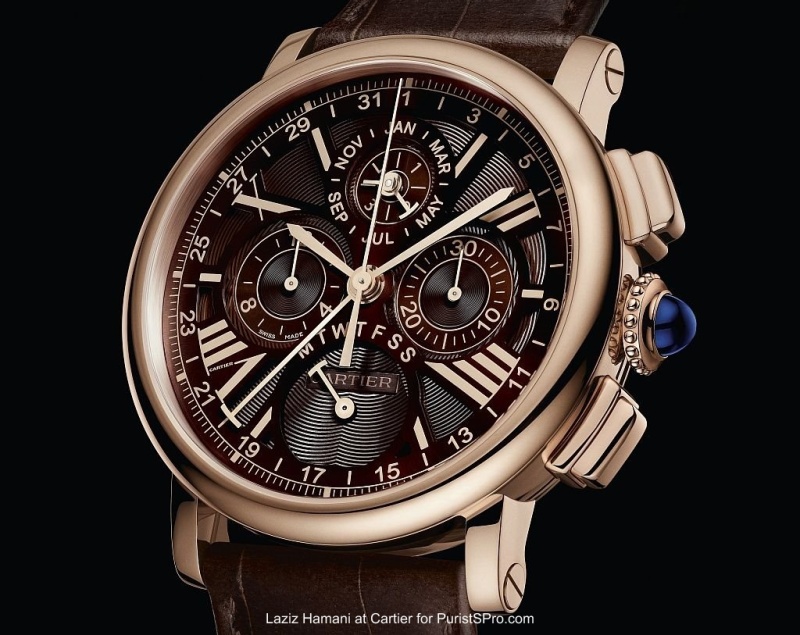
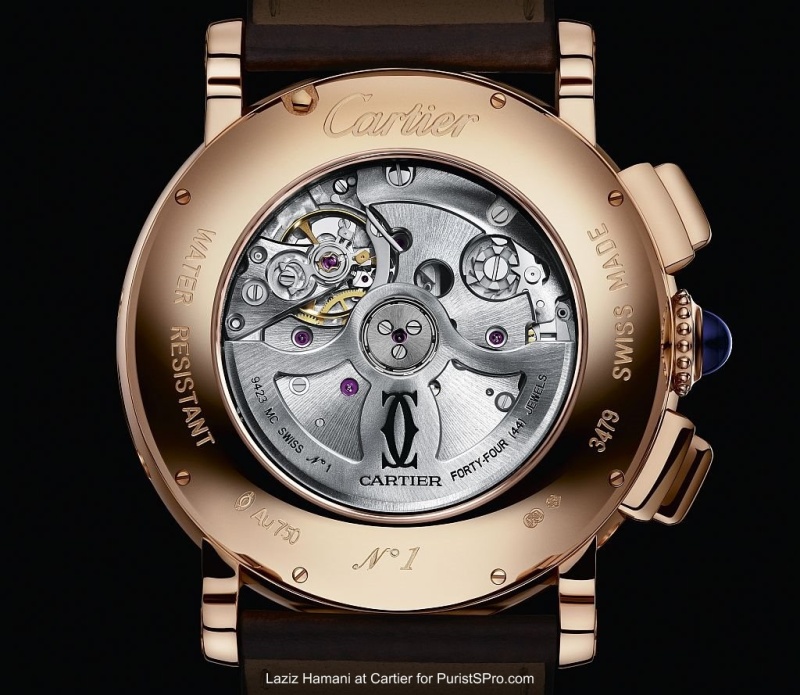


As we approach the reveal of new Cartier watches for 2014, I would like to describe a last look at a 2013 novelty: Rotonde de Cartier perpetual calendar chronograph watch.
The real colour is remarkably similar to the official photos.

In a paroxysm of rare luxury, it allows the measurement and display of short periods of time (chronograph) with a mechanism that can track and compensate for the long period irregularities of the Gregorian calendar.
There are two precious versions: in white or pink gold. The overall diameter of 42 mm and alligator-skin strap are in keeping with the expectations of modern Cartier clients who want an instrument fitted with two useful Cartier complications.

The first is the perpetual calendar that continuously indicates long periods of time; the second is a new column-wheel chronograph movement that, on demand, measures much shorter periods with precision. Originally, chronographs were invented for the 'sporting gentleman' to use to time horse races but today's gentleman is more likely to time his car parking time expiration.
The second development is designed to compensate for the irregularity of the Gregorian calendar, with a delicate, complex mechanism of cams and snails. This module also incorporates a retrograde hand, indicating days of the week at 6 o’clock, as well as a specific mechanism for displaying the date, which is indicated by a hand on the edge of the dial. The three calendar displays are controlled by rapid correctors incorporated into the case middle. These enable the wearer to easily reset the information on the dial.

A manufacture chronograph calibre
The delicate mechanical calendar assembly already existed in the Cartier collection and is called ”the Module” by the watchmakers. It has been added to the completely new Manufacture calibre 1904-CH MC. The self-winding mechanical chronograph movement incorporates a number of technical innovations to increase its precision and power.

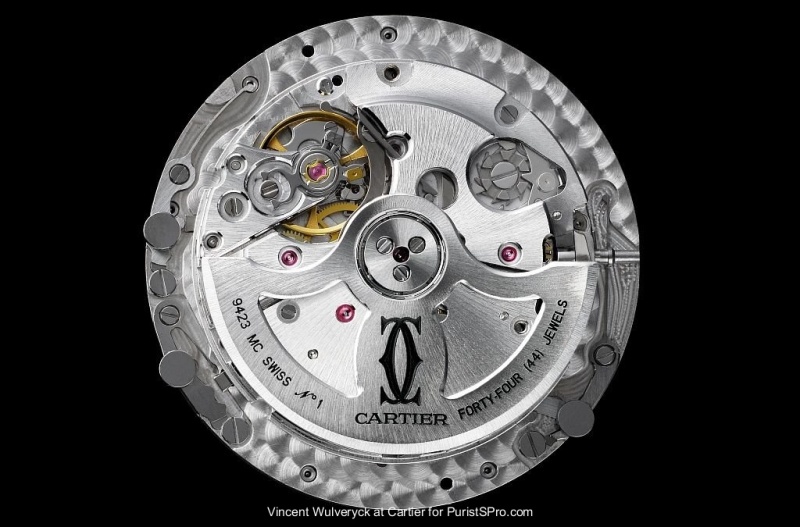
Calibre 9423 MC
Vincent Wulveryck © Cartier
Movement: Manufacture mechanical, with automatic winding, perpetual calendar chronograph
Casing-up diameter: 25.28 mm
Total diameter: 32 mm
Thickness: 7.70 mm (without hands shaft)
Number of jewels: 44
Number of parts: 445
Balance: 28,800 vibrations / hour
Power reserve: 48 hours
This mechanical heart is carefully hand-finished to the highest standards of fine watchmaking, including an open-work oscillating weight, and it is powered by two barrels in order to raise torque and give it a power reserve of 48 hours.
Another important innovation in this model is an in-line, flexible lever that reduces stress on the bearings of the hand shafts when the displays are reset to zero.
To ensure accuracy in short-period timing, Cartier watchmakers chose to use the latest generation of vertical clutch that allows timings to start with no hand-jump and to operate without affecting the torque of the calibre.
Perpetual Calendar Algorithm.
A major factor relevant to the perpetual calendar algorithm is the peculiar and variable length of February. February used to be the last month of the year with the first 11 months (March through January) having a five-month repeating pattern of days: 31, 30, 31, 30, 31, ...,
For a more detailed treatise on 'Calendar Watches', please read the excellent article by Prof Marcus Hanke by clicking the following URL Link:
home.watchprosite.com
=
How does a perpetual calendar mechanism work? (Simple explanation version)
The principal part of the mechanism is the perpetual lever which pivots. It returns to resting position by the action of a spring and usually pushes against the perpetual cam. A small 'finger' or feeler completes one turn per day when it drags the lever at the midnight hour. In practice, this is usually adjusted between 23:00h and midnight.
Day change.
The perpetual lever has two pawls (allowing one-directional movement of the gear wheel, like ratchets), that are moved by two independent springs. Each day, around midnight, the lever moves a seven-pointed day-star forward by one day. Five times a year, when the date changes from the 30th to the 1st (except Leap years: from February 28 to 29), one pawl causes the hand to move from 30 to 1 (or from February 28 to March 1).
Month change.
For the month change, a lever moves the month-star from February to March.
The perpetual lever at rest, pushes against the perpetual cam. This cam is the 'memory' for the perpetual calendar. It has seven ridges corresponding to the months with 31 days, four dents that correspond to the months with 30 days and a movable rectangle for February.
The cam thus determines the three levels of rest for the perpetual lever: 31-day months vs 30-day months vs. 28/29 day February. The pawl of the perpetual lever can occupy one of three different levels. For the months of February, the lever pushes on one side of the rectangle allowing the pawl to move the date from February 28 or 29 directly to March 1.
Year change.
The Leap year mechanism is a small movable rectangle with three sides equidistant from a centre of rotation; a fourth side is positioned higher than the others. This mechanism only rotates one-quarter of a turn each year so that once every four years, the highest side pushes on the lever. For that Leap year, the pawl will only act on the 29th of February.
Hands-on review
These two complications are actually useful in the real world. Even if we have electronic devices to record stop-watch functions and calendar day-date, the innate joy just observing a date change from 28th February to 1st March or even the rare 29th February is sufficient to get this watch.
It is easy to understand why the white gold version with the silver coloured, guilloche, multi-level dial, roman numerals and secret signature on the VIII marker is the more popular 'classic Cartier' style. The dial information is clear and instantly recognisable as Cartier. This is a key point for perpetual calendars: LEGIBILITY.
The pink gold variant with chocolate coloured dial (some say Cuban cigar brown) is more flamboyant. I was initially not a fan but each time I see one, I have to confess to an incremental slight change in my attitude.
The retrograde display of day with its dinky little hammer-shaped hand is fun. in fact, all the calendar displays utilise hammer-shaped hands while the time displays are variants of sword hands.
The pushers were pleasant to push with a distinct 'break' at activation. There was no discernible hand jump and although this was only a sample of one example, there is nothing to suggest that any other sample would be different with Cartier quality control.
I still like the silver dial on white gold version but the chocolate dial on pink gold variant is not far behind.

Rotonde de Cartier perpetual calendar chronograph watch in white gold
Laziz Hamani © Cartier
Case: 18-carat white gold
Thickness: 14.9 mm
Diameter: 42 mm
Crown: beaded, in 18-carat white gold set with a sapphire cabochon
Case back: sapphire
Water-resistance: 30 metres
Dial: white galvanised guilloché, silvered openwork grid with sunray effect, black transfer Roman and Arabic numerals, months and days of the week
Hands: sword-shaped, in blued steel / hammer-shaped, in blued steel
Strap: black alligator skin
Clasp: double adjustable folding clasp in 18-carat white gold


Rotonde de Cartier perpetual calendar chronograph watch in pink gold
Laziz Hamani © Cartier
Case: 18-carat pink gold
Thickness: 14.9 mm
Diameter: 42 mm
Crown: beaded, in 18-carat pink gold set with a sapphire cabochon
Case back: sapphire
Water-resistance: 30 metres
Dial: brown galvanised guilloché, silvered openwork grid with sunray effect, black transfer Roman and Arabic numerals, months and days of the week
Hands: sword-shaped, in blued steel / hammer-shaped, in blued steel
Strap: black alligator skin
Clasp: double adjustable folding clasp in 18-carat pink gold

I like this combination of a chronograph and a perpetual, which is a very traditional "large" complication, to differ it from a true "grande complication". While the tobacco dial itself is beautiful, the gold-coated hands suggest a very bad legibility, which appears confirmed by the first, real-world picture. In this respect, blued hands over a silver dial are much better. What I consider a most clumsy solution, is the retrograde indication of the weekdays at 6. Making use of only a small segmen
It's a watch I have it in my mind. Who knows? 5 Cartiers' are better than 4. I would have expected more than 48 hours power reserve (to avoid to put in the winder over the weekend) and a gold rotor. Constantin
But of course, I could handle the other one: Thanks Melvyn for your article! Fx
Marcus, The comment about retrograde day display may be true for some users. On the other hand (pun intended) , it is unusual and fun display for those who don't expect to use this watch to time their next mission on Her Majesty's Secret Service..... ;) I like moon displays but in this case (another pun), it may be too busy if you just want a chronograph with perpetual calendar function. Thinking about it, there is no moonphase Cartier watch currently....is there? hmmm....... Regards, MTF
tudorctin, Good point. The rotor must be of dense material to work despite the open-work construction. Of course, gold is dense but expensive ($2000 at peak prices) but it does not look like tungsten either. I'm not sure that tungsten can be rhodium plated?!? Regards, MTF
1) Cartier pushed the pink gold with chocolate dial version to Asia because people like their gold to look like gold rather than steel. 2) Chocolate version is so popular that it sold out in France. 3) Chocolate version is Not popular in Asia and we keep seeing it! ;) None of the above; our observations are just randomised samples across the wold..... Regards, MTF
This thread is active on the Cartier forum with 8 replies. Share your knowledge with fellow collectors.
Join the Discussion →