Complications
SJX provides an in-depth look at the Rotonde de Cartier Reversed Tourbillon, a piece he identifies as one of his favorites from SIHH 2012. He meticulously details the architectural movement design and the dramatic aesthetic created by its elevated components. This review offers a critical appreciation of Cartier's Fine Watchmaking line.


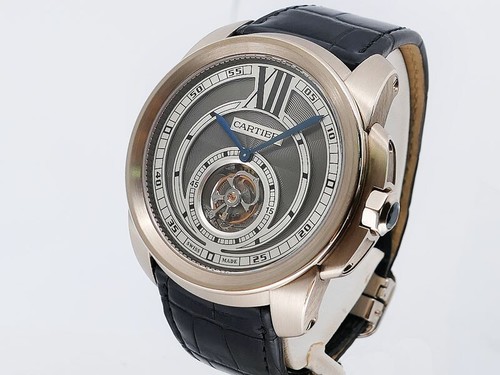
Launched at SIHH 2012, this is growing into one of my favourites of the year. When I first saw it I found the 46.2 mm wide case too large, but it slowly sinks in that the case is the perfect size for the design. Any smaller and the proportions would have been off.

Let's start with the movement first. Originally launched as the Cadran Lové Tourbillon watch, but now known as the Reversed Tourbillon watch, this uses a flying tourbillon calibre with Geneva Seal, variants of which are used throughout the Fine Watchmaking line.

Despite the name, the 9458 MC movement is not actually inverted. Rather, the base plate has been largely eliminated, leaving the barrel, keyless works and tourbillon regulator elevated from the surface of the dial (the gear train is also visible). This gives the watch a great deal of depth and an architectural feel.
Over on the back it appears to be a single bridge covering the entire movement, but the mechanical parts are actually concentrated in the area around the crown, as seen from the front.

All the exposed parts are expertly and appropriately finished, though as I have noted in other posts, the lack of sharp inward angles on the bevelled bridges is a shortcoming.


But what really gives this watch a dramatic look is the sweeping curve of raised, 18k white gold Roman numerals on the left of the dial. The curve and sweep of the Roman numerals is reminiscent of a Roman amphitheatre.


This skeletonised grid is machined from a piece of gold, and then hand finished just like a watch movement. The flanks of the numerals are drawn and the edges are bevelled, though the bevelling is not as prominent as on the steel parts of the calibre. Combined with the raised movement, this makes for a very compelling presentation of the mechanics of a tourbillon.
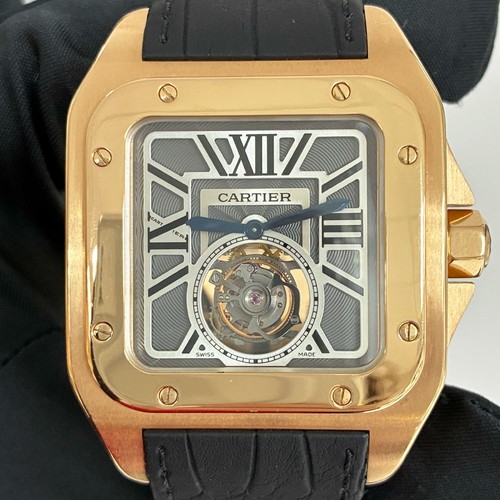
Notably, this same calibre was used in the crocodile tourbillon of last year, which looks strikingly different - and much less attractive in my opinion. Despite its size the Reversed Tourbillon has an air of elegance about it, which the crocodile tourbillon lacks.


The Reversed Tourbillon demonstrates Carole Forestier's philosophy of movement design that gives a great deal of consideration to aesthetics. In fact, this watch is more about movement design, rather than construction per se, since the calibre it is based on is an existent movement.
- SJX


but more mechanically complex.
the visual effect is different, given the depth of the dial. - SJX
Thanks for the HD pics, great job BTW
2,764 Cartier listings are live on the eBay market and 183 collector listings on the WatchProSite marketplace.
This thread is active on the Cartier forum with 3 replies. Share your knowledge with fellow collectors.
Join the Discussion →