Collection
SJX's insightful 'Cartier Santos Shootout' from 2010 remains highly relevant for understanding the evolution of a Cartier icon. This article delves into the distinct characteristics of the Santos 100, Santos Galbee XL, and the then-new Santos 100 Carbon, offering a comparative look at their design nuances and historical connections. Collectors seeking to appreciate the subtle differences and enduring appeal of the Santos line will find SJX's detailed observations invaluable.



An enduring and iconic design, the Cartier Santos was famously created for Brazilian aviator Alberto Santos-Dumont in 1904. Since then it has gone on to become one of Cartier’s blockbuster models, especially in its Santos 100 guise. That success has continued with the Santos 100 Carbon with an ADLC coated case unveiled in 2009. But despite the Santos 100 being the best known Santos, Cartier also makes the slimmer Santos Galbee XL, which is arguably closer to the original 1904 Santos than its bigger brother. And of course the Santos is also available in the Fine Watchmaking collection, most notably as a skeleton in either the Santos 100 or Santos Dumont case.

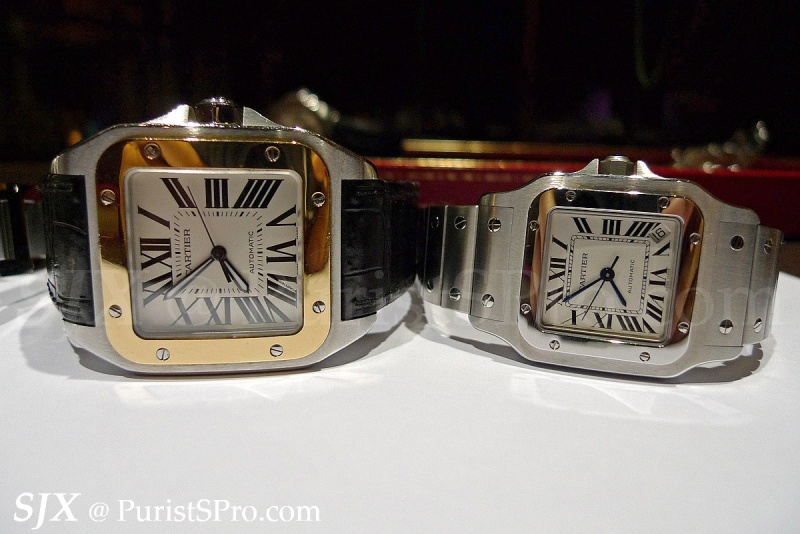
A early Santos with the Santos 100 XL behind
First, the bestseller: the Santos 100 got its name because it was unveiled in 2004 for the centenary of the Santos. Santos 100 watches made in that first year have “1904-2004” engraved on the caseback to distinguish them from later pieces which are otherwise identical.
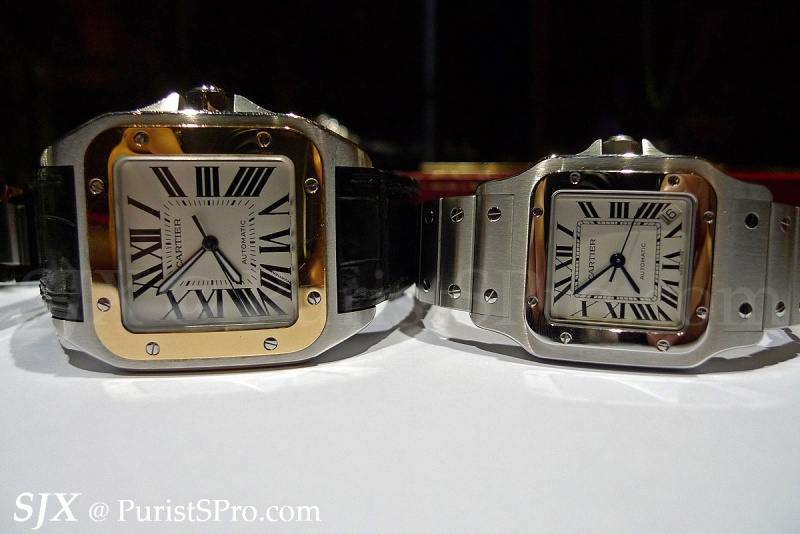
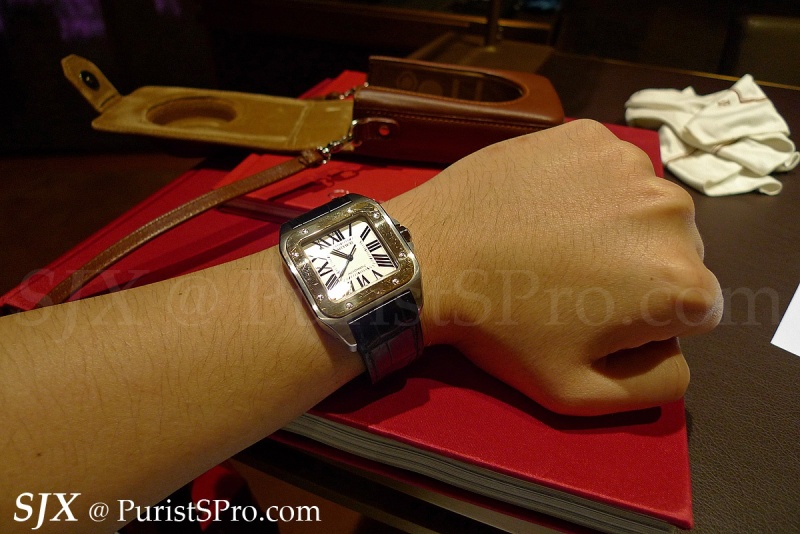
At 38 mm wide and 51 mm long, the Santos 100 XL is a massive watch. It does, however, retain the classic Santos design elements of a square case and screw bezel. But look closely and you’ll notice the dial has been modernised – the railway minute track is gone and the hands have Luminova filling. Though these changes are subtle they change the look of the watch significantly.


Santos 100 XL (left) and Santos Galbee XL


The missing railway track is even more obvious on the black and white of the Santos 100 Carbon
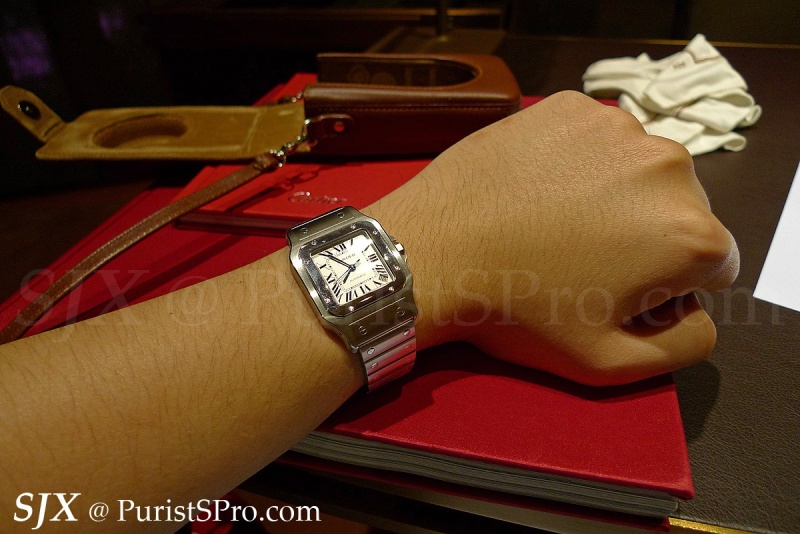
In contrast the Santos Galbee XL measures a mere 32 mm by 45 mm. It retains the classic Cartier railway minute track and blued steel sword hands. This is one of my all time favourite Cartier watches.
Though it is tangibly the same as the Santos 100 in so many ways, it is utterly different in look and feel.
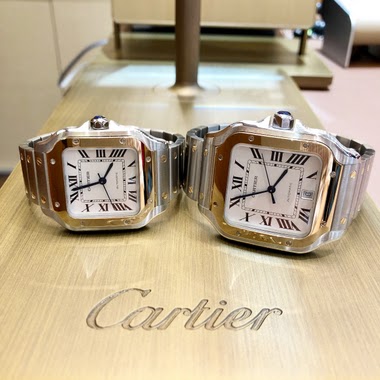
Below: Santos 100 in steel and gold, Santos 100 Carbon and Santos Galbee


This divergence is most pronounced with the Santos 100 Carbon because of the effect of the ADLC coating which gives it an aggressive yet sleek look, the total antithesis of the original Santos design. Yet there is some irony in this – the original Santos was designed as an aviator’s watch but modern tastes dictate that is now a dress watch while the Santos 100 Carbon is sports watch.

Santos Galbee XL and Santos 100 Carbon
The Santos 100 is more massive all round compared to the Santos Galbee, yet the bloodline is evident. Even the bevelled edges of the case are the same.


Interestingly the Santos Galbee developed during the 1980s and the first automatic Santos Galbee had domed case backs to accommodate the additional height of the automatic movement instead of a flat quartz calibre. A sure sign of its success in that era can be found in Wall Street, where Gordon Gekko wears a quartz Santos Moon Phase on bracelet, in solid yellow gold naturally. But unlike other eighties classics like the Ebel Wave watch, the Santos never went out of fashion. And after Cartier revamped the Santos with the 100, the Santos became a smash hit.

The gold Santos is just visible above
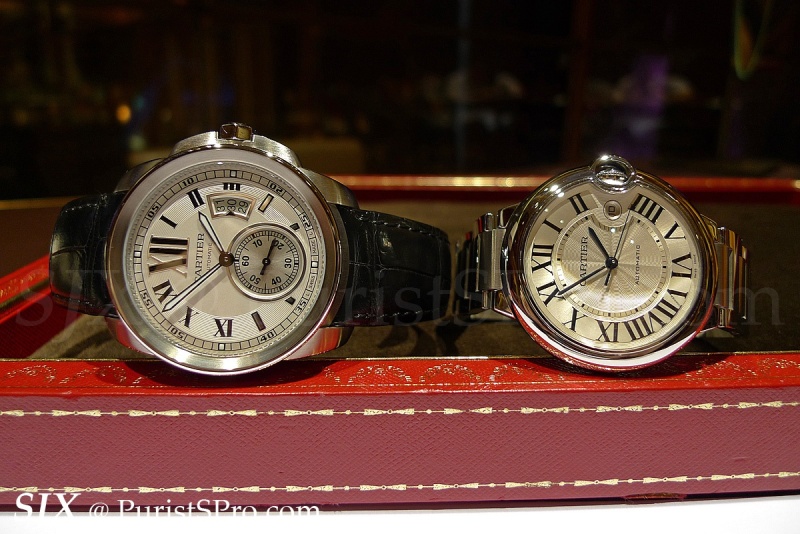
But despite the success of the Santos 100, it is bested in the sales rankings by the Ballon Bleu which is one of the bestselling watches in the world. Its shape, slimness and classical designs are well received in certain countries, like China for instance. Yet the design was not all that well received, even within Cartier, when it was first presented. The Ballon Bleu, along with the Santos 100 and the latest Calibre de Cartier, can be said to be the brand’s Holy Trinity. They sell very well and are the rock stars of the entry to mid range men’s watch segment.

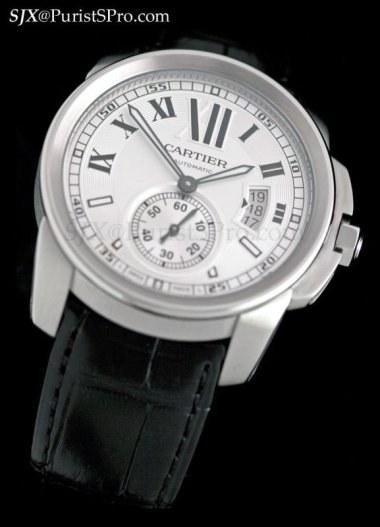
Calibre de Cartier and Ballon Bleu de Cartier


Although the Calibre de Cartier is still in its early days, it has already proven to be a good seller, making further inroads into the segment for Cartier of the masculine, sporty watch. I reviewed the Calibre de Cartier here and I must immodestly add that the review is the most read post on this forum. Of all the watches in the Cartier collection now, the Calibre de Cartier is the one that has the least traditional Cartier design in my opinion, which is possibly why it appeals to new buyers who would previously have considered a Rolex or IWC as a sports watch and a Cartier only as a formal watch.


So what does all of this prove? In my reckoning it shows demonstrates two ideas. One is that classic designs like the Santos, and others like the Tank, will endure – the Santos survived the eighties and ADLC coating – and still be around for the second centenary. But the world changes and a brand cannot only depend on classics. And so the second principle is that new classics must be made. They may cause controversy, like the Ballon Bleu originally did and the Calibre de Cartier is still, but they are essential. They may not be as iconic as the old classics, because there no aviation pioneers or Maharajahs to add a dash of glamour to the story, but new designs keep the brand alive.
- SJX

The Cartier Santos 100 was introduced in 2004 to commemorate the 100th anniversary of the original Santos-Dumont watch. It represents a contemporary interpretation of the historic pilot's watch, featuring a larger and more robust case design compared to its predecessors. This model positioned itself as a sportier, more modern offering within the Santos collection, appealing to collectors seeking a bolder presence on the wrist while retaining the iconic square aesthetic.
The Santos 100 typically features a stainless steel or precious metal case, often with a brushed finish and polished bezel screws. Case dimensions vary, but common sizes include a large model around 51mm x 41mm. It is powered by an automatic mechanical movement, often a modified ETA caliber, providing reliable timekeeping. The crystal is usually sapphire, and water resistance is generally rated for daily wear.
For collectors, the Santos 100 is notable for its blend of heritage design with modern proportions and construction. It marked a significant update to the Santos line, moving towards a more substantial and contemporary aesthetic. Its robust build and versatile design made it a popular choice, bridging the gap between Cartier's dressier offerings and more overtly sporty watches.
cos of the Calibre de Cartier. Thanks for the report.
Against the other Cartier watches? - SJX
its in-house calibre. The watch is sporty, yet somewhat classic looking to me (may be due to the roman numbers?).
One day it will be mine, it's so good looking and versatile. GEO
in a magazine and I loved it immediately. Researching the watch led me to this forum and a renued interest in watches in general. The carbon/rose gold model was my first watch purchase in seven years, and it gets a lot of wrist time. I usually stick with round cases, but I love the screwed down bezel and bevelled edges of the case. The lack of sharp edges/angles on the case and the 4 short sides of the octagonal case give a sense of roundness to it. One thing that interests me in my research of
who during dinner parties likes to scratch his Santos 100 Carbon with his house keys to demonstrate its scratch resistance. Last I heard his key got so worn down he couldn't unlock his house door. - SJX PS: Yours is the automatic with rose gold or titanium bezel correct?
This thread is active on the Cartier forum with 20 replies. Share your knowledge with fellow collectors.
Join the Discussion →